MAM Trading Explained: How Allocation Works
MAM trading is a managed-account model in which one manager's orders are copied to several separate investor accounts. A multi-account manager (MAM) is the software that applies an allocation rule to each order, so every account receives its share. Each investor keeps its own balance and trade history. MAM trading does not guarantee profit.
Last updated: 7 November 2026. Reviewed by the FxTrusts editorial team.
Ownership disclosure: FxTrusts publishes this guide and sells broker technology, including a MAM module. The product references below are commercial, so this is not an independent review. The guide is general information, not investment advice, and it has not been reviewed by a licensed financial professional. The sources are listed at the end.
What MAM trading means in practice
In a MAM set-up, the manager's strategy runs on a master account. When the manager places an order, the system creates matching orders on linked investor accounts, which some vendors call slave accounts. Each investor account has its own equity and history. Investors do not share one pooled balance. The software only allocates the same instruction across the accounts, and the accounts themselves stay separate.
Many brokers offer MAM as a form of forex trading account management. One desk can run the same strategy across many MAM accounts, and each investor still sees a separate record. That combination is the reason the model is popular with brokers, but it also means every account must be allocated correctly.

Key benefits of a multi-account manager
A MAM is usually chosen for three practical reasons. Each one depends on the allocation rule and on clean execution.
- Less manual order entry. The manager places one order instead of one order per account.
- Proportional risk allocation. A rule such as equity-based sizing gives larger accounts larger positions and smaller accounts smaller ones.
- Account-level reporting. Each investor sees a history for the account, which is easier to reconcile than a shared pool balance.
These benefits are not guarantees. A proportional rule can still produce different results in each account, for the reasons covered in the next section.
Allocation rules: lots, equity or balance
Allocation is the part that needs the most care. Common rules include a fixed lot size per account, an equity-proportional lot size, a balance-based size, or a percentage of the master order. Some systems also offer an equal-volume option. Write the rule down before the first trade, because it decides how much each account is exposed to the same market move.
Illustrative example (assumed numbers, no result implied). Suppose the master reference equity is $100,000 and the manager places a 1.00 lot buy order. An equity-proportional rule would give an account holding $10,000 about 0.10 lot. Real results vary. Lot rounding, minimum volume, contract size and margin can change the executed size, and fills at different prices can change the result for each account.
MAM vs PAMM: the account structure decides the risk
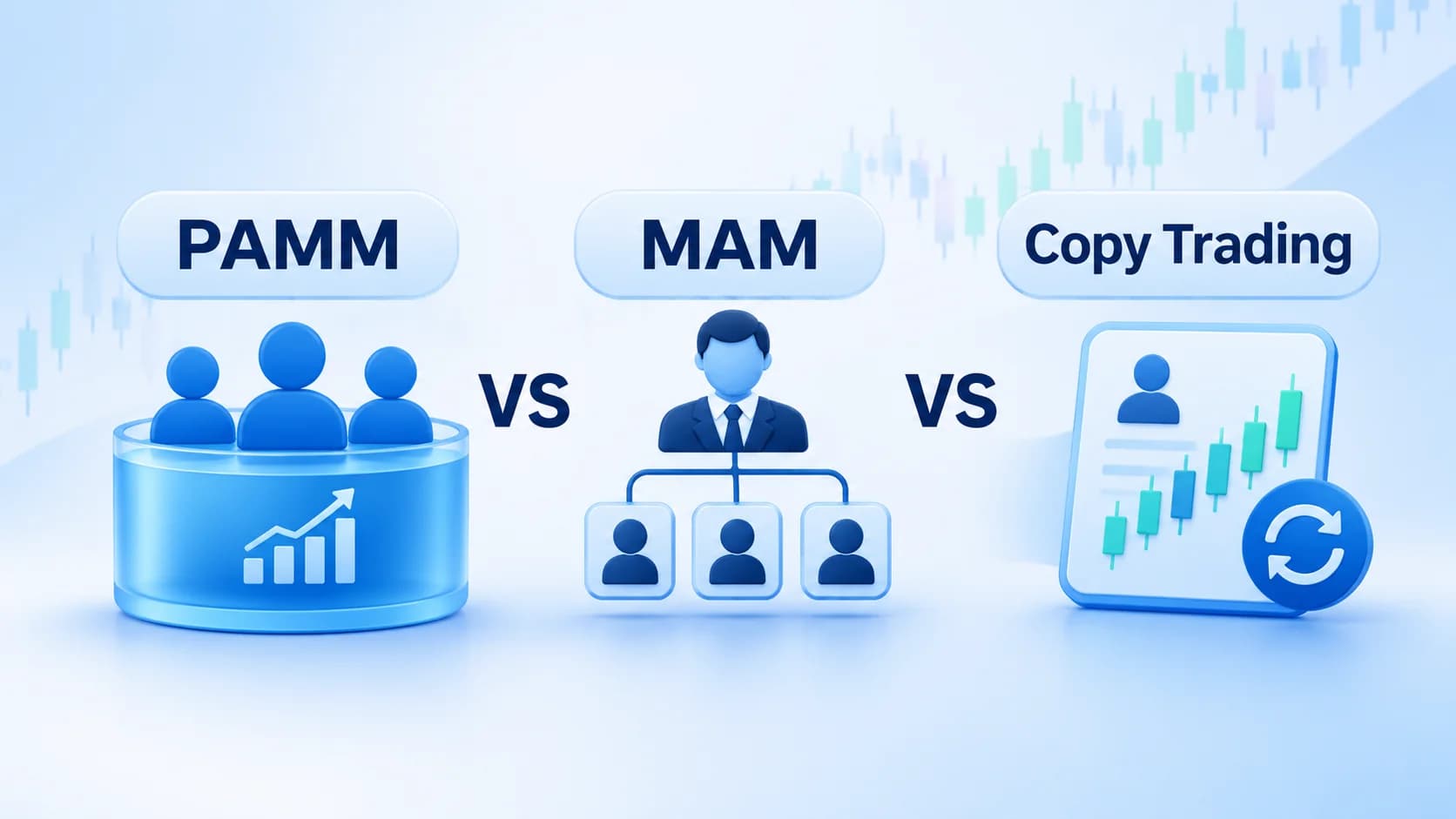
MAM and PAMM are often compared because both let an investor take part in a manager's strategy. They differ in how money is held and how profit and loss are shared. That difference changes the paperwork, the disclosures and the operational controls you need. For a plain definition of PAMM, read the PAMM answer in the copy trading library.
| Feature | MAM | PAMM |
|---|---|---|
| Investor funds | Each investor has a separate account | Investor funds are pooled into one master account |
| Profit and loss | Each account records its own result from its own fills | The pool result is shared by units or percentage shares |
| Investor control | Usually limited to the account's settings and permissions | The investor holds a share of the pool, with no per-trade control |
| Main operational task | Allocation accuracy and fill differences | Unit pricing, deposits, withdrawals and fee accrual |
| Typical regulatory question | Who holds trading authority and what the manager may do | Whether the arrangement is a collective pool of client money |
The CFTC's investor guidance describes a commodity pool as one in which participants share in the profits based on how much money they contribute. A PAMM resembles that structure. A MAM, in its usual form, keeps accounts separate. Do not assume that separate accounts remove regulatory duties. The analysis depends on your market, your contract and how the manager is paid.
Choose between the two on the record you need to keep and on who must be able to see it. A MAM gives each investor an account-level history. A pool gives one shared ledger and unit prices. Neither choice is safe by default.
Roles in a MAM: manager, investor and broker
A MAM involves three roles, and each needs a clear responsibility. Confusion between them is a common reason for disputes.
| Role | What it does | What to document |
|---|---|---|
| Manager | Sets or runs the strategy and places master orders | Authority, strategy description, risk limits and fee basis |
| Investor | Funds an account and accepts the stated risks | The agreement, risk disclosure, withdrawal rights and reporting access |
| Broker or operator | Hosts accounts, executes orders, keeps ledgers and produces reports | Server configuration, allocation logs, fee calculations and record retention |
The broker or operator is often the party that can prove what happened. Keep allocation logs that show the master order, the rule applied, the account reached, the executed price and the time. Without those records, a dispute over one account becomes a dispute over the whole system.
Selecting MAM software: what to test
The FxTrusts MAM page describes allocation by lots, equity or percentage, with performance reporting and fees. It lists MT4 and MT5 connectors, a cTrader API and FIX or web API scope, each marked to confirm. Treat those as supplier statements to verify. When you compare any MAM software, test these points rather than relying on a feature list.
- Platform fit. Confirm the supported MT4, MT5 or cTrader version and any API access it needs.
- Allocation modes. Check whether the rule can be changed per account, and whether each change is recorded with a date.
- Hosting and recovery. Ask where the software runs, including VPS hosting, and how it recovers from a disconnection.
- Demo testing. Run partial fills, rejected orders and a fast price move on demo accounts, and record each account's outcome.
- Audit trail. The software should link each master order to every investor fill.
- Fee calculation. If performance fees apply, check how the high-water mark is tracked for each account and each period.
Set-up steps for a broker or manager
- Confirm permissions first. Check the rules for managed trading in each market you serve. The FCA's authorisation guidance is one example: carrying on regulated activities without authorisation is an offence in that jurisdiction. A software licence or platform contract does not authorise the activity by itself.
- Write the allocation rule. Define the basis, rounding, minimum sizes, handling of deposits and withdrawals, and what happens when an account cannot take its share.
- Configure master and investor accounts. Test permissions so that investors can see their own accounts and cannot change the master.
- Test on demo accounts. Run partial fills, disconnections, rejected orders and a sudden price move. Record how each account responds.
- Set reporting and fee calculations. Agree the reporting period and the fee basis, and state whether fees are charged on profit, equity or volume.
- Publish disclosures before funding. State the strategy risks, the allocation method, the fee basis and how an investor can exit.
- Review the controls monthly. Compare allocated and intended volumes, and investigate persistent differences between accounts.
A checklist of this kind also helps when you compare vendors. Ask each supplier to show the allocation log, the fee report and the detach process in a live demonstration, not only in a brochure.
Risk checks and disclosures for MAM trading
MAM trading carries the market risk of the strategy. Losses can occur in any account, and a losing period can last longer than an investor expects. Past results of a strategy do not show future results. Investors should not commit money they cannot afford to lose.
Allocation adds operational risk. Two accounts can receive the same master order and end with different results because of fill prices, slippage, spreads, rounding, minimum volumes or margin limits. Disclose that these differences can occur. Also disclose any conflict of interest, such as a fee that rises when the manager trades more often. Read the general risk wording before you publish any investor material.
Keep the disclosure in plain language. Name the broker or operator, the manager, the allocation method, the fee and the way an investor can stop participating. If you cannot explain the calculation in one paragraph, an investor probably cannot evaluate it either.
Key takeaways
- MAM trading copies one manager's orders to separate investor accounts through an allocation rule.
- Each account keeps its own balance and history. PAMM pools funds, which changes the risk and the paperwork.
- The allocation rule, lot rounding and fill differences decide how similar two accounts' results will be.
- Permissions depend on the market and the activity, so check them before you accept client funds.
- Keep allocation logs and fee calculations so that every account can be reconstructed.
How FxTrusts can help with the MAM module
FxTrusts provides broker technology and implementation services. Its MAM solution page describes allocation by lots, equity or percentage, with performance reporting and fees. Use that page as a product description, not as proof of how it will work with your server or legal structure. For managed-account options that include PAMM and copy trading, see PAMM, MAM and copy trading. For the operating model, read the copy allocation knowledge base.
Current FxTrusts commercial scope is listed on the pricing page. Confirm which module, setup work and third-party costs apply to your business in a written quote. Ask for a scoped demonstration with your allocation rules attached. Nothing in this article is a price or a guarantee.
Sources
- CFTC: Seeing Commodity Pools More Clearly (investor guidance, not a legal definition for your market)
- FCA: applying for authorisation (one jurisdiction's example of the permissions question)
The FxTrusts pages linked above are supplier descriptions, not independent evaluations. Product details can change, so check the current pages before relying on them.