Broker CRM Checklist | FxTrusts
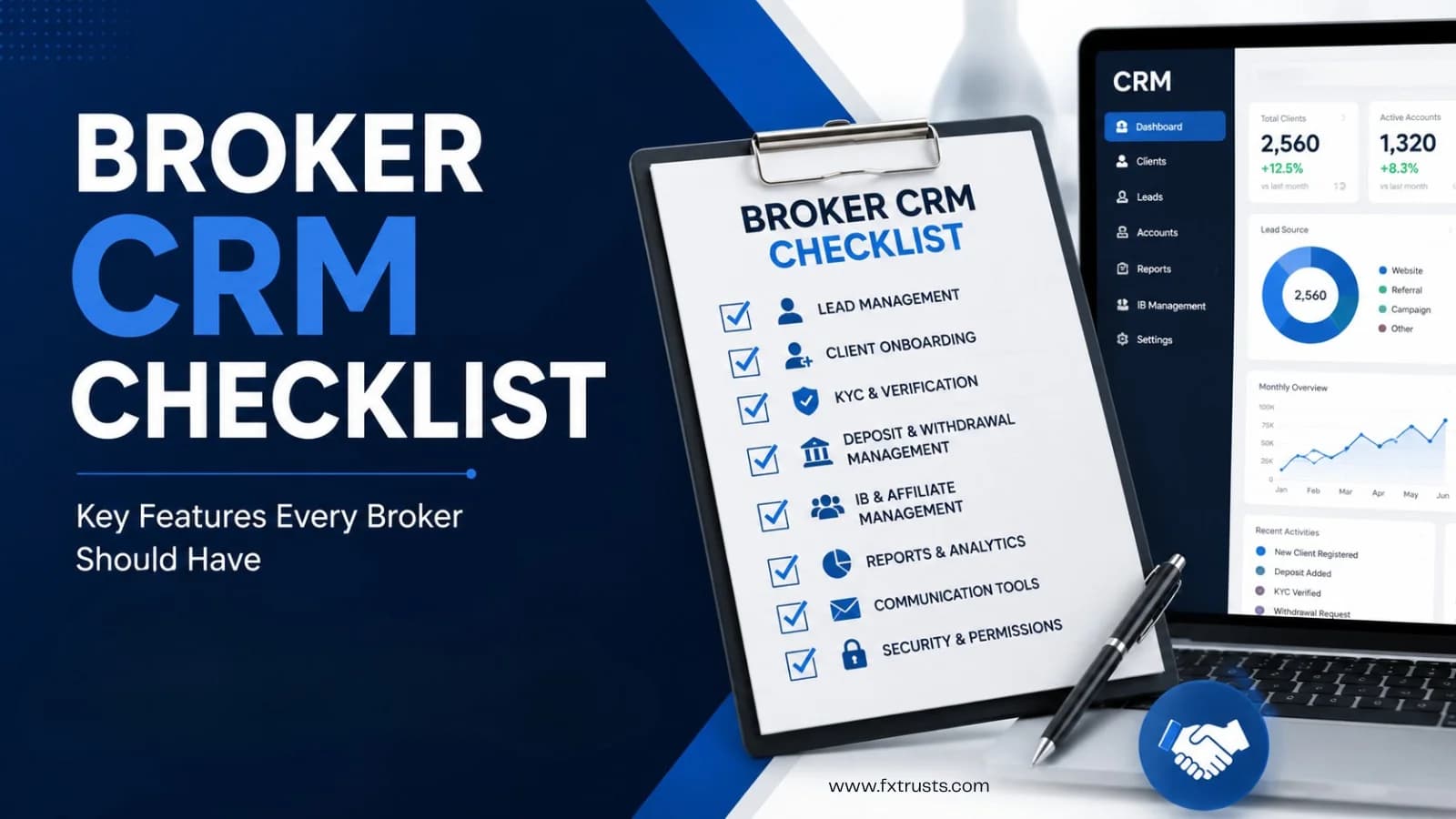
A broker CRM checklist helps operators verify that the system handles client lifecycle, regulatory onboarding, payment flows, and partner tracking before launch. Forex-specific requirements include MT4/MT5 integration depth and IB hierarchy support. The checklist below draws from established buyer guides to surface the questions operators should ask vendors.
FxTrusts sells the white-label brokerage and prop-firm technology discussed on this blog; mentions of our own platform are first-party content, and any partner or affiliate relationships are disclosed.
What should a broker check before CRM launch?
Operators should map their full stack including trading platform version, target regulators, and PSPs before evaluating any CRM. A 2026 forex CRM buyer guide lists trader's room, KYC, deposit management, IB module, and reporting as core modules that must integrate with MT4/MT5 and PSPs. Source 3
Custom pipeline stages should match the actual onboarding flow rather than generic sales stages. The system must support separate record types for clients and referral partners with attribution tracking.
How should CRM workflows be reviewed?
Review begins with event-driven automation between the point-of-sale system, loan or trading origination, and the CRM. When an application completes or status changes, the CRM should update records and trigger tasks without manual re-entry. Source 1
Operators should test a messy file scenario during demos to confirm handling of missing documents, stalled communication, and repeated follow-up. Audit trails for every message and permission control by role are required for compliance.
Which integrations must a broker CRM support?
The CRM must connect to MT4 Manager API or MT5 Gateway/Manager API for real-time account creation, balance operations, and volume data. PSP webhooks, KYC vendor integrations, and documented REST APIs for data export are also required. Source 4
Confirm the exact API version during a live demo against the trading platform in use. One-way account creation without real-time volume feedback can break IB commission calculations.
What compliance and reporting features are essential?
Essential features include exportable audit trails for KYC, data access, and commission events plus role-based permission controls and consent management. Reporting must cover lead sources, stage movement, and funded outcomes without requiring spreadsheet exports. Source 3
GDPR and equivalent data-protection requirements demand encryption, lawful-basis tracking, and support for data-subject requests. Regulators expect the CRM to serve as the compliance system of record.
- Map trading platform version, regulators, and PSPs before vendor evaluation.
- Test automation on a messy file scenario during demos.
- Require real-time MT4/MT5 volume feed for accurate IB calculations.
- Confirm exportable audit trails and role-based permissions for compliance.
- Evaluate IB hierarchy and multi-tier override support separately from core CRM.
How should readers verify this before acting?
Treat this broker CRM checklist article as a verification checklist rather than a promise of outcomes. Read Source 1, Source 2, and Source 3 alongside the site's current setup notes, then separate documented facts, vendor terms, and community observations before making an operational change. The practical review should name what is known from the cited material, what still depends on the reader's configuration, and what must be checked again after publication.
Before acting, write down the assumption being tested, the source that supports it, the risk if it is wrong, and the rollback step. Compare Source 4 and Source 5 with the FAQ and sources list so unsupported shortcuts do not become publishing instructions. Keep the note specific: which setting, workflow, compliance point, or editorial claim needs review; who owns the follow-up; and which source should be reopened if the page is updated later.
The final pass should also check internal links, visible author context, image alt text, schema fields, and whether every recommendation is framed as a documented consideration rather than a universal rule. This keeps the page useful for readers and easier for the Super Admin verifier to audit.
What should be checked before changes go live?
Treat this broker CRM checklist article as a verification checklist rather than a promise of outcomes. Read Source 1, Source 2, and Source 3 alongside the site's current setup notes, then separate documented facts, vendor terms, and community observations before making an operational change. The practical review should name what is known from the cited material, what still depends on the reader's configuration, and what must be checked again after publication.
Before acting, write down the assumption being tested, the source that supports it, the risk if it is wrong, and the rollback step. Compare Source 4 and Source 5 with the FAQ and sources list so unsupported shortcuts do not become publishing instructions. Keep the note specific: which setting, workflow, compliance point, or editorial claim needs review; who owns the follow-up; and which source should be reopened if the page is updated later.
The final pass should also check internal links, visible author context, image alt text, schema fields, and whether every recommendation is framed as a documented consideration rather than a universal rule. This keeps the page useful for readers and easier for the Super Admin verifier to audit.
How can the cited evidence be compared?
Treat this broker CRM checklist article as a verification checklist rather than a promise of outcomes. Read Source 1, Source 2, and Source 3 alongside the site's current setup notes, then separate documented facts, vendor terms, and community observations before making an operational change. The practical review should name what is known from the cited material, what still depends on the reader's configuration, and what must be checked again after publication.
Before acting, write down the assumption being tested, the source that supports it, the risk if it is wrong, and the rollback step. Compare Source 4 and Source 5 with the FAQ and sources list so unsupported shortcuts do not become publishing instructions. Keep the note specific: which setting, workflow, compliance point, or editorial claim needs review; who owns the follow-up; and which source should be reopened if the page is updated later.
The final pass should also check internal links, visible author context, image alt text, schema fields, and whether every recommendation is framed as a documented consideration rather than a universal rule. This keeps the page useful for readers and easier for the Super Admin verifier to audit.
What should be documented after the review?
Treat this broker CRM checklist article as a verification checklist rather than a promise of outcomes. Read Source 1, Source 2, and Source 3 alongside the site's current setup notes, then separate documented facts, vendor terms, and community observations before making an operational change. The practical review should name what is known from the cited material, what still depends on the reader's configuration, and what must be checked again after publication.
Before acting, write down the assumption being tested, the source that supports it, the risk if it is wrong, and the rollback step. Compare Source 4 and Source 5 with the FAQ and sources list so unsupported shortcuts do not become publishing instructions. Keep the note specific: which setting, workflow, compliance point, or editorial claim needs review; who owns the follow-up; and which source should be reopened if the page is updated later.
The final pass should also check internal links, visible author context, image alt text, schema fields, and whether every recommendation is framed as a documented consideration rather than a universal rule. This keeps the page useful for readers and easier for the Super Admin verifier to audit.
This article is for general information only and is not financial advice. Trading, automation, and broker decisions involve capital at risk, risk of loss, and possible loss of capital. Past performance, simulated examples, and backtest references are not indicative of future results.
Sources
- CRM System for Mortgage Brokers: Boost Your Business 2026 — businesslendingblueprint.com, published 2026-06-16, retrieved 2026-07-03. educational.
- Real estate CRM buyer's checklist - Top Producer Blog — topproducer.com, published 2019-07-05, retrieved 2026-07-03. educational.
- Forex CRM: Broker Buyer Guide 2026 — track360.io, published 2026-05-31, retrieved 2026-07-03. educational.
- CRM for Forex Brokers: Features & Compliance 2026 — track360.io, published 2026-05-31, retrieved 2026-07-03. educational.
- Real Estate CRM Setup Checklist | Manifestly Checklists — manifest.ly, retrieved 2026-07-03. educational.
Frequently Asked Questions
What is a broker CRM checklist used for?
A broker CRM checklist is used to evaluate whether a system can handle regulated client onboarding, payment routing, KYC audit trails, and IB partner tracking before deployment. It prevents selection of generic sales tools that lack native trading-platform integration.
Why is the IB module important in a forex CRM?
The IB module tracks hierarchies, calculates multi-tier commissions, and provides partner self-service portals. Many generic CRMs treat this layer as an afterthought, requiring a separate dedicated platform for accurate payouts.