
Prop Challenge Manager
Configure 1-step, 2-step, or 3-step evaluations with documented profit targets, drawdown types, daily loss rules and instrument restrictions.
FxTrusts white label prop firm software is for operators launching funded trader challenges without building every workflow from scratch. A proposal can combine challenge management, evaluation logic, risk monitoring, trader dashboards, payment and CRM handoffs, and approved platform connectors, with pricing shaped by rules, scale, branding, integrations and support scope.
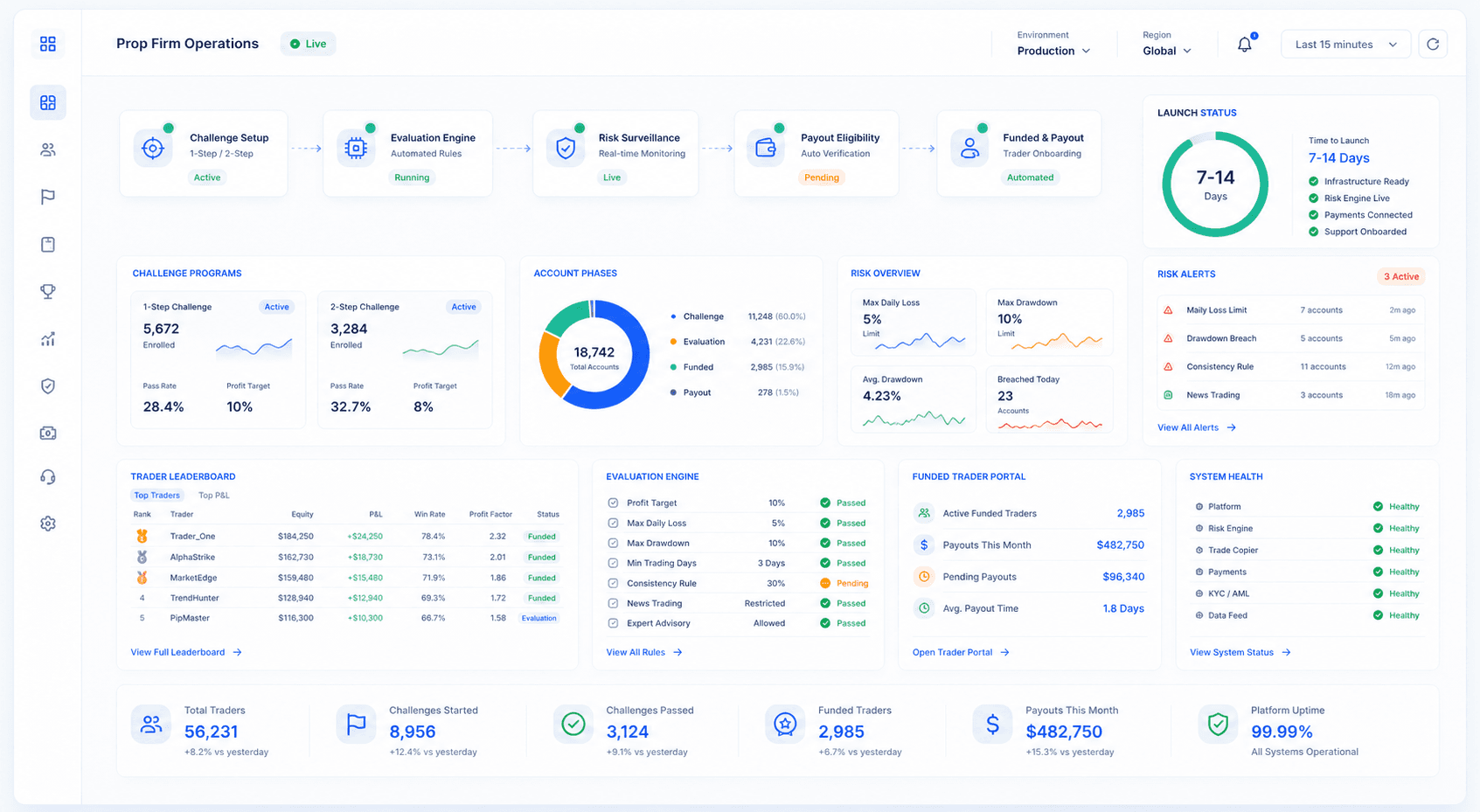
Interface illustration with sample values. Metrics shown are not measured customer results or service-level commitments.
The FxTrusts prop firm platform can connect selected challenge, evaluation, risk, dashboard, competition and integration modules. The proposal identifies each system of record, connector, third-party dependency and handoff from challenge purchase through payout review.
Configure 1-step, 2-step, or 3-step evaluations with documented profit targets, drawdown types, daily loss rules and instrument restrictions.
Monitor evaluation rules and automate eligible phase transitions, with configurable review gates and an audit record for exceptions.
Configurable behavioral signals flag short-duration trading, news-window activity, latency patterns and correlated accounts for review against the firm’s published rules.
Contest workflows can combine rankings, prize calculations, sharing and review signals; acceptance tests should cover ties, corrections, disqualifications and payout approval.
The branded client portal where traders track evaluation objectives, equity curves, drawdown limits, and performance analytics in real time.
Use the available sandbox to review the admin back office and trader-facing portal; demo permissions and data are separate from the production scope.
The commercial proposal identifies the included trading-server connector, environments, support channel and response coverage. Additional servers, platforms, priority coverage and custom adapters are priced only after compatibility and capacity requirements are confirmed.

Trading terminal integration

Manager API scope to confirm

API scope to confirm


Connector feasibility confirmed per provider
The Prop Challenge Manager compares available trade data with the configured rule version. It can reduce repetitive administration while retaining data checks, review gates, exception handling and an audit trail.
For direct-funding and multi-phase evaluations, define which checks may run automatically, which outcomes require review and how corrections or delayed events are handled before the account status changes.
For founders asking how to start a prop firm, this is the control layer that connects the trader evaluation software, prop firm CRM, risk dashboard, payout workflow, and the platform connectors agreed for your deployment. Confirm MT4, MT5, cTrader, Match-Trader and DXTrade workflows; additional platform requirements need separate feasibility review. New to the model? Start with our guide on how to evaluate prop firm technology before configuring your first challenge.
The Automated Evaluation Engine is the high-performance backend module that sits between your trading server and your client database. It solves the Friday night bottleneck, when hundreds of traders hit targets simultaneously and manual auditing becomes impossible.
The engine validates trading history and configured rules before provisioning the next phase account. Review gates and delivery targets are agreed for your deployment.
Automate the next account step after targets, rule checks and configured review gates are complete.
Apply configured criteria consistently and retain the evidence operators need to investigate exceptions and disputes.
Fire webhook events to Discord, Telegram, CRM, or social media when a trader passes a phase.
Branded funded trader certificates generated and delivered automatically on phase completion.
The Prop Risk Dashboard combines deterministic rule checks with configurable review signals. Operators should define each input, threshold, evidence source and response before using an alert in an account decision.
Where a risk score is configured, it prioritizes records for review and does not by itself prove abuse. Deterministic account actions should follow the documented rule version, data checks, exception path and appeal policy.
The dashboard operates on two distinct layers.
Deterministic rules, such as maximum drawdown, daily loss limits and minimum trading days, compare configured thresholds with account data. Validate the inputs, timezone and rule version, then apply the documented action and dispute-review policy.
Risk signals — toxicity score, behavioral fingerprinting, IP correlation are probabilistic indicators that flag an account for human review, not an automatic fail. Knowing which category an alert falls into helps the operator choose the investigation, evidence and action required by the documented review policy.
Define how operators review risk signals and disputed rule breaches. Even a deterministic calculation can need investigation if its input data, timezone or configuration is wrong.
Flags configured short-duration and price-feed timing patterns for investigation against documented rules.
Configurable no-trade windows around high-impact economic releases, adjustable per account group.
Reveals hidden networks using identical devices or VPN masking to operate multiple accounts.
Statistical correlation of entry, exit, and symbol across accounts to surface organized copy groups.
This worked example uses an initial balance of $100,000, a fixed maximum loss of 10% of initial balance, and a daily loss limit of 5% of a $100,000 day-start balance. It assumes a breach occurs when equity falls below the limit. It illustrates a test specification, not a production result or the rules of every prop firm.
| Check | Calculation | At $94,400 equity |
|---|---|---|
| Fixed maximum-loss floor | $100,000 − (10% × $100,000) = $90,000 | No maximum-loss breach |
| Daily-loss floor | $100,000 − (5% × $100,000) = $95,000 | Daily-loss breach |
| Phase transition | Check every active rule and review gate | Do not pass an account with this breach |
Also test equality at the threshold, open profit/loss, commissions, swaps, the daily reset timezone, deposits or payouts, and delayed events. Trailing rules need a separate high-water mark calculation. Save the rule version, input events and expected result for each test. Compare the challenge rule definitions with your published trader terms before deployment.
The Trader Leaderboards & Competitions module supports configurable contest and ranking workflows for a branded community experience.
Registration, ranking and prize workflows can be connected under defined approval rules. Measure acquisition and engagement rather than assuming a contest will produce a particular marketing result.
The Prop Dashboard for Traders is the primary interface where clients interact with your firm's brand every day. It is a comprehensive hub that guides traders through evaluation with clear objectives, drawdowns, and performance analytics.
Clear, timely drawdown status can reduce repetitive questions when the displayed calculation matches the published rules. Measure ticket volume and investigate any difference between the dashboard and source records.
Login to the trader portal with sandbox credentials. See challenge tracking, drawdown monitoring, and analytics in action.
Select hosting locations, capacity, access controls and monitoring for your requirements. The locations below are deployment options to discuss, not confirmation that every customer uses all locations. Availability and recovery arrangements belong in the proposal.
| Data Center | Location | Primary Role | Provider |
|---|---|---|---|
| Equinix LD4 | London, UK | Primary Trading Hub & Risk Monitoring | Equinix |
| Equinix NY4 | New York, USA | Global Connectivity & Redundancy | Equinix |
| Equinix FR2 | Frankfurt, Germany | European Data Processing Node | Equinix |
| Equinix TY3 | Tokyo, Japan | Asia-Pacific Market Optimization | Equinix |
| Equinix SG1 | Singapore | APAC Risk Monitoring Node | Equinix |
Review encryption, access permissions, API limits, tenant isolation and recovery procedures for the contracted deployment.
Configure alerts and permitted automated actions for suspicious trading patterns. Validate detection, false positives and response timing in your environment.
Define account volume, peak event rates, monitoring, failover and recovery objectives, then test them against agreed acceptance criteria.
Scope REST APIs, webhooks and the selected trading-server connector so developers can connect the agreed client portal, CRM, notifications and payout workflows. Confirm supported operations and access rights for the proposed deployment.
Confirm the connector version, supported workflows and deployment evidence in the integration status matrix. Payment connectivity does not establish merchant eligibility. For example, Stripe's published policy prohibits funded prop trading; do not use a generic Stripe connector for that activity. Obtain approval from each payment provider for your entity, countries and transaction types.
To start a prop firm, you need a challenge model, trading platform access, trader CRM, payment flow, risk rules, evaluation logic, payouts, and a branded trader portal. FxTrusts provides the prop firm software layer that connects those pieces so the firm can launch without building its own challenge infrastructure from scratch.
Launch timing depends on platform access, provider approvals, rule configuration, branding, payment eligibility and acceptance testing. Request a milestone plan with named responsibilities and dependencies. Software delivery does not guarantee payment or regulatory approval.
The challenge manager can be configured for direct-funding, 1-step, 2-step and 3-step models. Confirm the exact phase logic and rule set—including profit targets, drawdown limits, trading-day, consistency, instrument and news-window rules—in the signed acceptance specification.
Transitions depend on the configured rule checks, review gates, platform API and notification delivery. Agree a provisioning target for the selected deployment and verify it with test records. Exceptions may require operator review before credentials are issued.
Yes. The platform supports Fixed, Trailing, and Relative drawdown types. Drawdown can be calculated against balance or equity, with high-water mark tracking updated tick by tick.
The Prop Risk Dashboard uses behavioral fingerprinting, analyzing trade duration, frequency, and entry timing patterns. It flags sub-second position durations, latency arbitrage, and group trading rings by correlating IP addresses, hardware IDs, and statistically improbable patterns.
Yes. News trading filters are configurable per account group, so you can allow news trading on one tier while enforcing strict no-trade windows on another.
Yes. The Leaderboards & Competitions module supports daily, weekly, monthly, and seasonal contests with customizable ranking formulas, entry fees, prize distribution, and anti-cheat monitoring.
Branding can cover the trader dashboard, evaluation portal, leaderboards, notifications, certificates, competition pages and an optional mobile app. The signed scope should identify every surface, store listing and third-party screen that can or cannot be branded.
FxTrusts documentation references MT4, MT5, cTrader, Match-Trader and DXTrade connectivity. Confirm the exact connector, current platform build, API permissions, tested workflows and commercial entitlement in the integration matrix and your proposal. TradeLocker, Rithmic and Volumetrica requirements need separate feasibility and scope confirmation.
CRM scope can connect selected dashboard, challenge, payment, KYC, evaluation, payout and support statuses. Confirm source systems, field ownership, update direction, error handling and reconciliation before relying on a consolidated view.
Licensing depends on the jurisdiction, business model, instruments, marketing claims, and whether the firm handles client money or offers brokerage services. FxTrusts can connect the prop firm software layer with compliance, KYC, and licensing guidance, but legal status must be confirmed with qualified counsel.
The deployment security schedule should document data isolation, transport and storage encryption, privileged access, backup and restore requirements, DDoS controls, retention and evidence available to the client.
Prop firm software coordinates selected onboarding, evaluation, rule, dashboard, leaderboard and payout workflows. Legal, payment-provider, platform and operator responsibilities remain separate unless the signed scope assigns them.
A challenge manager records evaluation rules such as profit targets, drawdown and minimum trading days, calculates configured outcomes and routes exceptions through the documented review process.
A white label prop firm is a ready-made, rebrandable prop-firm platform you operate under your own name without building the evaluation, risk and payout technology in-house.
A proprietary trading firm trades for its own account. In an evaluation-based prop business, the operator may offer simulated evaluations and performance accounts under a reward contract. The firm's terms must identify whether each account stage is simulated or live, how rewards are calculated and any separately approved live-capital arrangement.
An evaluation business defines account stages, profit targets, drawdown limits, review gates and reward conditions. Passing a challenge does not by itself establish that the next account trades live firm capital. Confirm the simulated or live account model, contract and payout conditions for each stage.
Scope your challenge rules, platform access, payment approvals and branded trader portal. Get a deployment plan with named responsibilities, acceptance tests and a launch date based on confirmed dependencies.
Planning your implementation
Start with your published challenge rules and test how the software applies them. Daily loss, overall drawdown, time zones and phase transitions can produce different outcomes depending on the calculation method. Your operations team should be able to explain an account decision using the recorded rule, input data and event history.
Use your actual published challenge rules as the acceptance script. A trader should be able to understand an account decision from the same records your operations team uses.
These are proposed acceptance tests to agree with your supplier, not results from a completed FxTrusts certification.
| Workflow | What to test | Evidence to keep |
|---|---|---|
| Daily loss boundary | Test open profit or loss on both sides of the daily reset, including a value exactly at the loss limit. | The time zone, balance or equity basis, reset value and rule version used for the decision. |
| Phase transition | Replay the same passing event twice and review a case with a pending rule exception. | One authorized transition, clear exception handling and a traceable new-account assignment. |
| Payout review | Request an eligible payout, reject a second request and reconcile a provider failure. | Eligibility inputs, approval history and a final paid or failed state without a duplicate payout. |
Provide challenge phases, rule formulas, simulated or live account model, platform connections, expected accounts and payout methods. Confirm CRM, evaluation engine and terminal charges separately, even when sold in one proposal.
Build a first-year cost worksheet and check integration status before finalizing the scope.
Compare all products and servicesDiscuss your implementation scope