
What Is a Funded Account in Trading?
A funded account in trading is a trading account a prop firm provides under its written rules, usually after the trader passes an evaluation, although some firms offer one without an evaluation. Any profit split follows the firm's terms. Trading CFDs and forex carries a real risk of loss, which a funded account does not remove.
FxTrusts supplies brokerage and prop firm technology, so this definition reflects our commercial perspective. It is general information, not legal, tax or investment advice.
On this page
- Funded account definition for prop firms and traders
- The funded account lifecycle: evaluation, pass and funded
- What the firm configures at each stage
- Fees and profit splits as written firm terms
- Risk, and why a funded account is not a guarantee
- Warning signs to check before you rely on a funded account offer
- Where FxTrusts fits: prop firm software, not a funded account provider
- Key takeaways
- Frequently asked questions
Funded account definition for prop firms and traders
In plain terms, a funded account gives a trader access to a prop firm's trading capital, and the trader works within the firm's rules. The trader does not own that capital, and the firm sets the conditions for keeping access. For the operator, a funded account is a contract state: a set of rules, limits and payout terms that the firm must configure, publish and apply the same way to every trader.
The term is used mainly in proprietary trading, where a firm trades its own money rather than customer deposits. In prop firm models, the firm may run a funded account in a simulated or live environment, depending on the firm and the agreement. The label “funded” describes access to capital under rules. It is not a guarantee of income.
The funded account lifecycle: evaluation, pass and funded
The diagram shows a common three-stage pattern. Stage names and numbers vary by firm, so read each firm's written ruleset rather than relying on a general label.

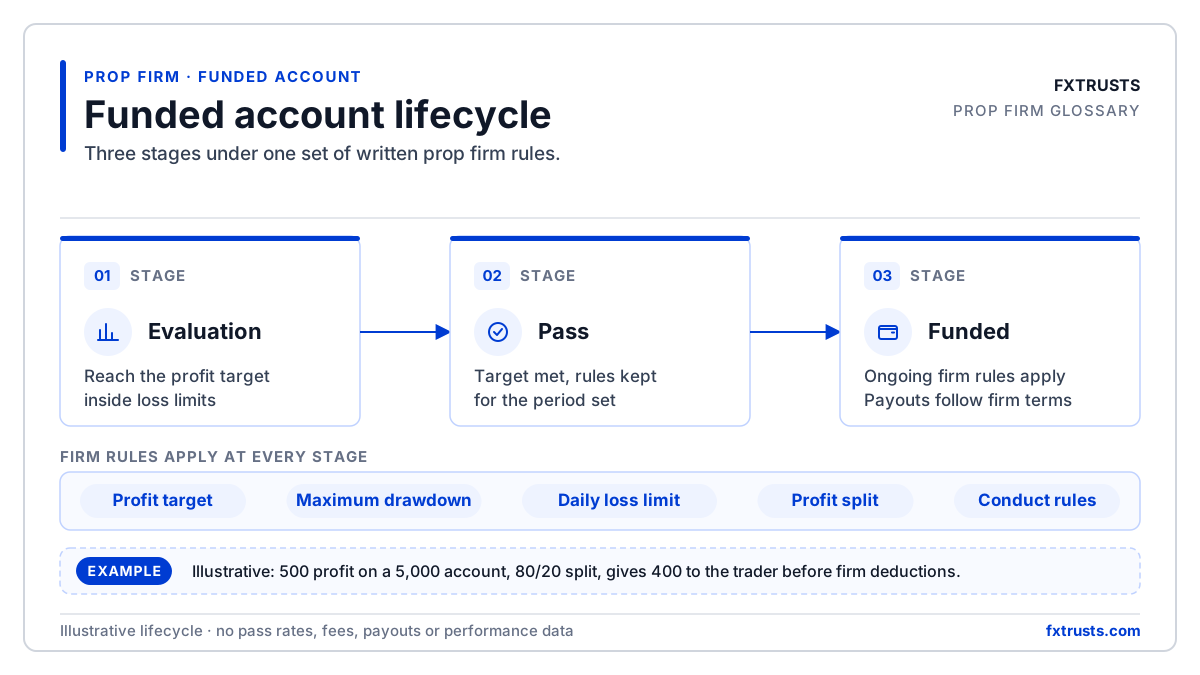
- Evaluation. The trader pays an evaluation fee, where the programme requires one, and trades a simulated or challenge account to meet the stated objectives.
- Pass. The trader meets the profit target and stays within the drawdown and conduct rules for the period the firm sets.
- Funded. The firm gives the trader an account to operate under its ongoing rules. Profit splits and any payout process then follow the firm's terms.
Some firms add a verification step or a second phase before the funded stage, and some sell direct funded accounts with no evaluation at all. Whatever the model, each stage needs a written rule, a recorded decision and an owner on the firm's side.
What the firm configures at each stage
The detailed rule maths (profit targets, static and trailing drawdown, daily loss) is covered in our prop evaluation rules knowledge base. This table shows the stage view instead: what the trader does, and what the firm has to set and record.
| Stage | What the trader does | What the firm sets and records |
|---|---|---|
| Evaluation | Trades a challenge or simulated account against stated objectives | The ruleset version, fee terms, account type and the event data used to judge each rule |
| Pass review | Meets the target without breaching drawdown or conduct rules | Who reviews the result, what evidence is checked and how the decision is logged |
| Funded | Trades under ongoing limits | Account limits, permitted instruments, the profit split and the payout approval steps |
| Breach or close | Loses access after a rule breach or on request | The breach evidence, the notice sent and any appeal route |
- EvaluationWhat the trader does: Trades a challenge or simulated account against stated objectivesWhat the firm sets and records: The ruleset version, fee terms, account type and the event data used to judge each rule
- Pass reviewWhat the trader does: Meets the target without breaching drawdown or conduct rulesWhat the firm sets and records: Who reviews the result, what evidence is checked and how the decision is logged
- FundedWhat the trader does: Trades under ongoing limitsWhat the firm sets and records: Account limits, permitted instruments, the profit split and the payout approval steps
- Breach or closeWhat the trader does: Loses access after a rule breach or on requestWhat the firm sets and records: The breach evidence, the notice sent and any appeal route
A trailing drawdown moves with new equity peaks, which changes the loss limit over time. The trailing drawdown floor explainer walks through how the floor moves and how to test it against your own data.
Fees and profit splits as written firm terms
Many programmes charge an evaluation fee up front. The fee pays for access to the evaluation and is separate from any trading loss. For the firm, the refund conditions, the fee schedule and any reset charges are terms to publish before purchase and apply consistently, because disputes usually start where the written terms are vague.
Profit splits describe how gains are shared once a funded account is running. The firm should state the split, the payout frequency, any deductions and the approval checks in writing, and keep the calculation reproducible from the account records.
Illustrative example
Suppose a hypothetical firm charges a 100 evaluation fee on a 5,000 account and offers an 80/20 profit split. If a trader closes 500 of profit within the rules, the split would give the trader 400 before any firm deduction. These numbers are invented for explanation only and are not market data.
The example is arithmetic, not a forecast. Real programmes differ in fees, targets, split levels and deductions, and any profit depends entirely on trading results.
Risk, and why a funded account is not a guarantee
A funded account gives access to capital under rules. It does not remove market risk, and it does not guarantee that a trader will pass an evaluation or receive any payout. CFD and forex trading carry a real risk of loss, and leverage increases that risk. The CFD glossary entry explains how CFDs are structured.
UK rules show how regulators treat retail CFD risk. The FCA confirmed permanent restrictions on CFDs and CFD-like options sold to retail consumers. Firms must limit leverage to between 30:1 and 2:1 and show a standardised risk warning that states the percentage of retail client accounts that make losses.
Those rules apply to firms selling CFDs to UK retail clients. They show the baseline risk disclosure a regulator expects, but they do not tell you whether a particular prop programme is regulated.
Warning signs to check before you rely on a funded account offer
Funded account language is also used in investment fraud. A CFTC investor alert on fraudulent crypto and digital-asset trading websites warns about promises of high guaranteed returns with little or no risk, and about requests for extra fees before a withdrawal. A legitimate firm makes these signs easy to rule out by publishing its rules, its legal entity and its payout process.
- Guaranteed returns, or claims of little or no risk.
- A request for an advance fee before a withdrawal is processed.
- Pressure to act quickly or to move funds somewhere else.
- No written rules, and no clear legal entity or licence status for the firm.
- No way to verify the firm on a regulator's list.
For UK-facing offers, the FCA Financial Services Register shows whether a firm is authorised, and the FCA also publishes warnings about firms it says may be operating without permission. Check the register, the warnings and the firm's legal entity yourself, and take qualified advice on which permissions apply to your own programme.
Where FxTrusts fits: prop firm software, not a funded account provider
FxTrusts is a technology provider for forex and CFD brokers and prop trading firms. We are not a broker, bank or regulated financial institution, and we do not offer retail trading accounts. Our commercial view is that a funded account is a rules problem as much as a trading problem: the firm must configure rules, record evaluations and approve payouts consistently.
The prop firm software page describes challenge configuration, an evaluation engine that monitors rules and supports phase transitions with review gates, and a payout review gate that checks rule results before an authorised operator approves a payout. Whether a given firm uses those features, and how its rules are set, remains that firm's decision.
For the wider business model, read prop firm versus broker and the MT5 setup guide for prop firms.
Key takeaways
- A funded account in trading is trading access provided under a prop firm's written rules. It is not a guarantee of profit.
- Each stage (evaluation, pass review, funded, breach) needs a written rule, a recorded decision and an owner on the firm's side.
- Static and trailing drawdown limits behave differently, so test the calculation against your own data.
- Evaluation fees, refund terms and payout approval steps are firm-specific and should be confirmed in writing.
- Check regulator warning lists and firm registrations, and treat guaranteed returns or advance-fee demands as red flags.
Frequently asked questions
Is a funded account the same as a brokerage account?
Not necessarily. A brokerage account is typically opened with a regulated broker by a client who deposits their own money. A funded account is usually provided by a prop firm under its evaluation and risk rules. Check the contracting entity and what it is authorised to do in your country before you sign.
Do you have to pay to get a funded account?
Terms vary. Many prop firm programmes charge an evaluation fee, so check whether it is refundable, what it covers and which other charges apply. A demand for an extra fee before a withdrawal can be a warning sign of fraud.
Is the money in a funded account real?
It depends on the firm's model. Some programmes run evaluations in a simulated environment, and others use live accounts with the firm's capital. Ask how the account is run, where the capital comes from and what the trader's actual exposure is under the rules.
Can a funded account be a scam?
Yes. Some offers are misrepresented or fraudulent, and common warning signs include guaranteed returns, pressure to act quickly and no verifiable legal entity. Check the CFTC and FCA warning pages before you pay any fee, and confirm the firm's legal entity, its written rules and how payouts are approved. A firm that will not put those terms in writing is a reason to stop.
What is the difference between a funded account and a prop firm challenge?
A challenge, also called an evaluation, is the test a trader must pass. A funded account is usually the access granted after passing, under the firm's ongoing rules, although some firms sell funded accounts with no evaluation. Some firms use the terms loosely, so check the written stages and the conditions that apply to each.
Related FxTrusts resources
Sources
- FCA: permanent restrictions on CFDs and CFD-like options sold to retail consumers
- FCA Financial Services Register
- CFTC investor alert: watch out for fraudulent digital asset and crypto trading websites
Scope a prop firm programme with FxTrusts
Talk to our team about challenge configuration, evaluation rules and payout review for your own firm.
Contact FxTrusts