Prop Firm vs Broker: Key Differences Explained
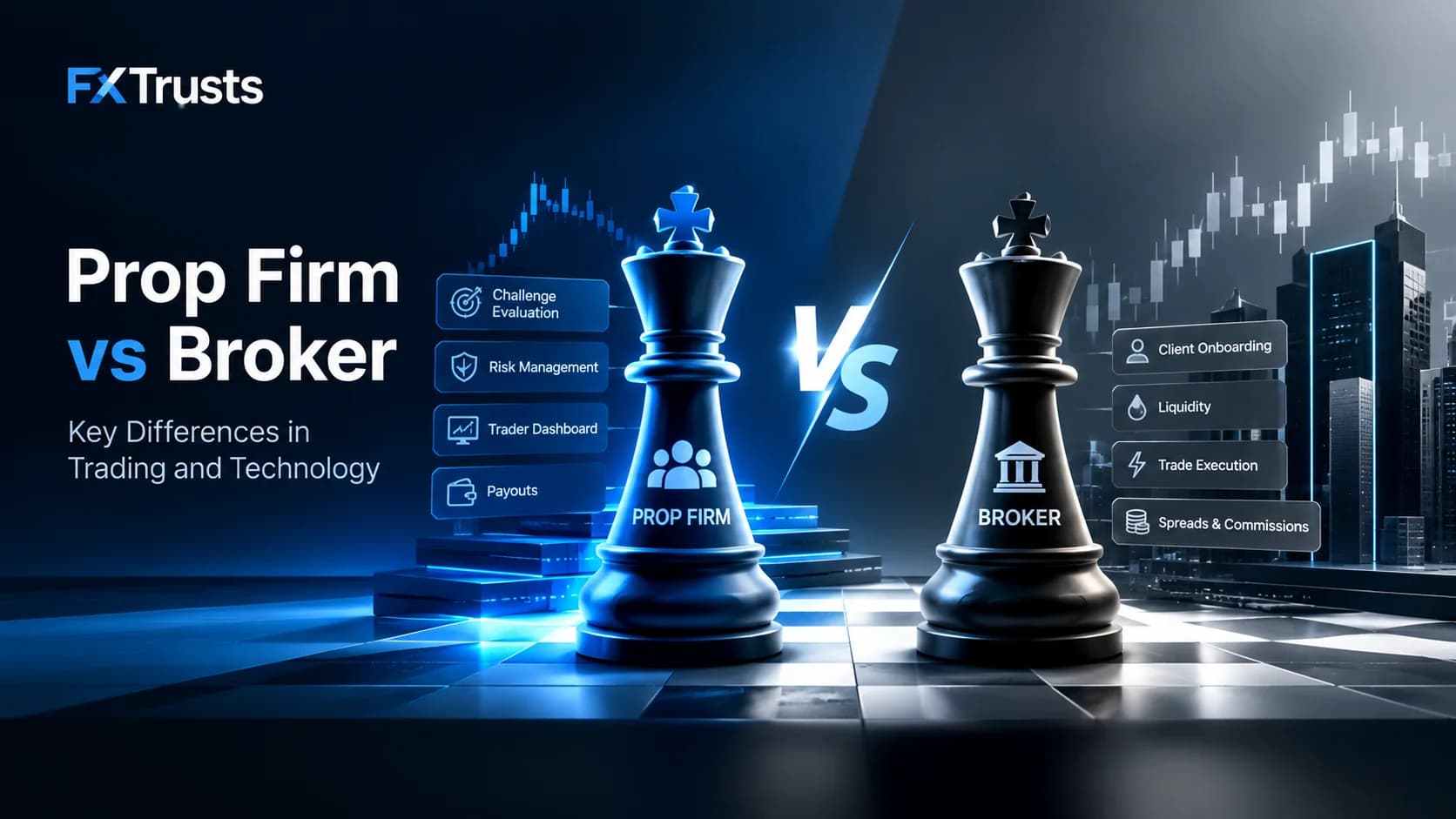
Prop firm vs broker is a choice between an evaluation-based model and direct access to an account funded with your own money. A prop model may impose rules and simulated environments, while a broker offers more control but leaves trading losses with the account holder. The right comparison starts with capital, risk, fees, and operations.
Prop firm vs broker: definition and decision context?
Prop firm vs broker describes two different operating models, not two versions of the same service. A broker gives a client access to markets through an account using the client’s capital, while a modern retail prop firm commonly recruits traders through an evaluation or challenge. The distinction matters because control, account structure, risk allocation, and revenue mechanics change with the model.
One 2026 comparison says understanding the difference helps determine which route suits a trader, but that conclusion should not be stretched into a universal recommendation. the 2026 comparison For a founder, the same distinction affects the technology stack, customer journey, disclosures, support process, and compliance review. A useful first question is therefore not which model sounds more attractive, but which operating obligations the business can actually support.
The phrase “prop firm” can also be ambiguous. Institutional proprietary trading traditionally refers to a firm trading its own balance sheet with salaried traders, whereas much retail discussion concerns evaluation programs and funded-account structures. the institutional-versus-retail distinction A business plan should define the intended model before selecting a platform or preparing commercial materials.
Who should consider prop firm vs broker?
There is no evidence in this research bundle that makes one model suitable for every participant. The practical comparison should begin with capital access, risk management, fees, and any profit split rather than with headline account size. the comparison factors Those categories give founders and operators a clearer way to separate customer expectations from the mechanics they must deliver.
A broker model is oriented around a client depositing capital, placing trades, and retaining the resulting profits or losses after fees. the broker account description This normally places greater responsibility for account funding, trading decisions, and loss exposure with the client. A prop model changes the customer journey: the participant may first enter an evaluation, follow a rule set, and then move to a later stage defined by the firm.
For an operator, this means the selection question is also an implementation question. A broker launch may need workflows for account opening, deposits, trading access, client support, and compliance controls. A prop launch may need evaluation logic, rule monitoring, account-state handling, payout operations, and clear communication about whether the trading environment is simulated. Internal planning should make those distinctions explicit before a vendor or white-label arrangement is chosen.
Benefits and practical limitations
The main benefit of a prop structure is that it can give a participant access to a larger stated balance without requiring the same form of personal trading deposit. That benefit is paired with limits: evaluation rules, daily loss controls, maximum drawdown conditions, fees, and profit-sharing terms may affect how the account is used. The research specifically recommends comparing capital access, risk management, fees, and profit splits together rather than in isolation. the risk-and-fee framework
A broker provides a different kind of flexibility. The client decides position sizes, strategy, and risk, while the account remains tied to the client’s deposited capital. the control comparison That flexibility does not remove market risk, financing costs, execution considerations, or the need for suitable controls. It simply means the account rules and financial exposure are structured differently.
Potential operating benefits
- A prop model can organize trader onboarding around an evaluation process.
- A broker model can provide direct account control for clients.
- Each model can be designed around a distinct customer and revenue journey.
Material limitations
- Prop rules may terminate an account after a breach of stated limits.
- A simulated account is not automatically the same as a segregated brokerage account.
- Broker clients remain exposed to losses in their own trading capital.
These are model-level observations, not a prediction of outcome. They should be tested against the proposed jurisdiction, customer profile, platform design, payment process, and compliance review.
Yo pips prop firm review and the reader decision
This article does not review YoPips, because the approved research bundle contains no evidence about that named firm. The supported reader decision is narrower: compare the account relationship and protections described for the chosen model rather than relying on an unrelated brand example.
A traditional broker gives the client their own capital and control, and a licensed firm may provide a regulated relationship with defined protections. the broker relationship description That statement is conditional on licensing and does not establish that any particular broker is licensed, suitable, or available in a reader’s jurisdiction.
For a prop operator, the corresponding review questions are structural. Is the evaluation clearly described? Are the rules understandable? Does the customer know whether the account is simulated? Are fees, payout terms, and restrictions presented before purchase? The bundle supports the importance of these distinctions, but it does not support a rating, payout record, client count, or product-level conclusion about YoPips.
About me:prop firm tradera retail trader in europe, the united states, the united arab emirate
The supplied research does not establish a customer profile, regional eligibility, or operating rule for the long phrase in this heading. A neutral decision framework is therefore more reliable than a demographic assumption. Start by identifying who supplies the capital, what account the participant receives, what rules apply, and which entity is responsible for the service.
A 2026 comparison frames the choice as a question of fit rather than a universal contest. the fit-based comparison For a broker or prop-firm founder, fit includes more than trader preference. The business may require different corporate structures, technology infrastructure, and operational approaches because the models generate revenue differently and can carry different regulatory requirements. the operating-model comparison
Regional launch work should remain jurisdiction-specific. The approved material does not identify a regulator for this audience, so this article does not name one or infer licensing requirements. A launch plan should obtain qualified legal and compliance advice before making claims about authorization, client protections, or suitability.
Conclusion
Prop firm vs broker is best understood as a comparison of account structure, capital exposure, control, rules, and operating responsibility. A prop model may center on evaluation and simulated access, while a broker model centers on client-funded market access. Neither description alone establishes suitability, profitability, legality, or future performance.
For a technology decision, document the intended model first. Then map onboarding, account management, risk rules, payments, support, reporting, and compliance responsibilities to the selected architecture. A platform overview can help organize that discussion, while a Forex white label or Prop firm software page may be relevant only after the business model is defined.
Keep the decision evidence-led and jurisdiction-aware. The supplied comparison sources explain the models, but they do not replace professional legal, compliance, or financial advice.
Sources
- Prop Firm vs Broker: Which Is Better in 2026? — audacity.capital, 2026-07-03T11:30:00.000Z
- Prop Firm vs Broker: Pros, Cons and Which to Choose — wikilix.com, 2026-01-14T12:02:53.000Z
- Prop Firm vs Broker: Which Is Best for Your Trading? — thetrustedprop.com, 2026-08-26T17:32:00.000Z
- Prop Firm vs Broker — Which Should You Choose 2026 — worldfxclub.com, 2026-08-18T08:33:22.000Z
Frequently Asked Questions
What should a new prop firm compare with a broker?
A new prop firm should compare capital access, risk management, fees, profit-sharing terms, account structure, and operational obligations. The research describes brokers as providing access through client money, while retail prop models commonly use an evaluation or challenge. Confirm the intended structure and obtain jurisdiction-specific professional advice before launch.
What Is the Difference Between a Prop Firm and a Forex Broker?
A prop firm allows traders to trade under its evaluation and risk-management rules, while a forex broker provides access to financial markets by facilitating trading transactions.
How Do Prop Firms Make Money Compared to Forex Brokers?
Prop firms may earn revenue from evaluation fees and their share of eligible trading profits. Forex brokers may generate revenue through spreads, commissions, and other trading-related fees, depending on their business model.
Do Prop Firms Need the Same Technology as Forex Brokers?
No. Both may use trading platforms and risk-management tools, but prop firms often require challenge evaluation, drawdown monitoring, trader dashboards, and payout management. Brokers typically need additional infrastructure for client onboarding, liquidity, and trade execution.
What Software Does a Prop Firm Need to Operate?
A prop firm may need challenge management software, trading platform integration, risk monitoring, trader dashboards, CRM, payment processing, and automated evaluation workflows.
Can a Forex Broker Also Start a Prop Trading Business?
Yes. A forex broker may expand into prop trading by establishing a suitable business model, implementing challenge and risk-management systems, and assessing the relevant legal and regulatory requirements.