
CFD Meaning: What a Contract for Difference Is
CFD meaning: a CFD, or contract for difference, is a derivative in which two parties exchange the change in price of an underlying asset, such as a share, index, commodity or currency pair. The buyer does not own that asset. Profit and loss settle in cash, and positions are usually leveraged, so losses can be large relative to the deposit.
FxTrusts supplies brokerage technology and services to forex and CFD brokers and prop firms, so this page reflects a technology provider's commercial view of how brokers handle CFDs. It is general information, not legal, tax or investment advice.
On this page
- CFD meaning in plain terms
- How a CFD position works
- CFD compared with owning the underlying asset
- Where retail CFD sales are restricted
- What a broker must set up before listing CFDs
- CFD and related terms for broker teams
- Commercial view: where CFD revenue and risk sit
- Key takeaways
- Frequently asked questions
CFD meaning in plain terms
For a broker, the more useful question is what your platform, liquidity and compliance setup must do to offer one.
A CFD pays or charges the difference between the price when a position opens and the price when it closes, multiplied by the position size. A client who buys a CFD on a share index gains when the index rises and loses when it falls. The client never holds the index, its constituent shares, or any voting or delivery right attached to them. The FCA describes CFDs in the same way, as a way to bet on the price of a share or asset moving up or down without owning it (FCA, 13 November 2025).
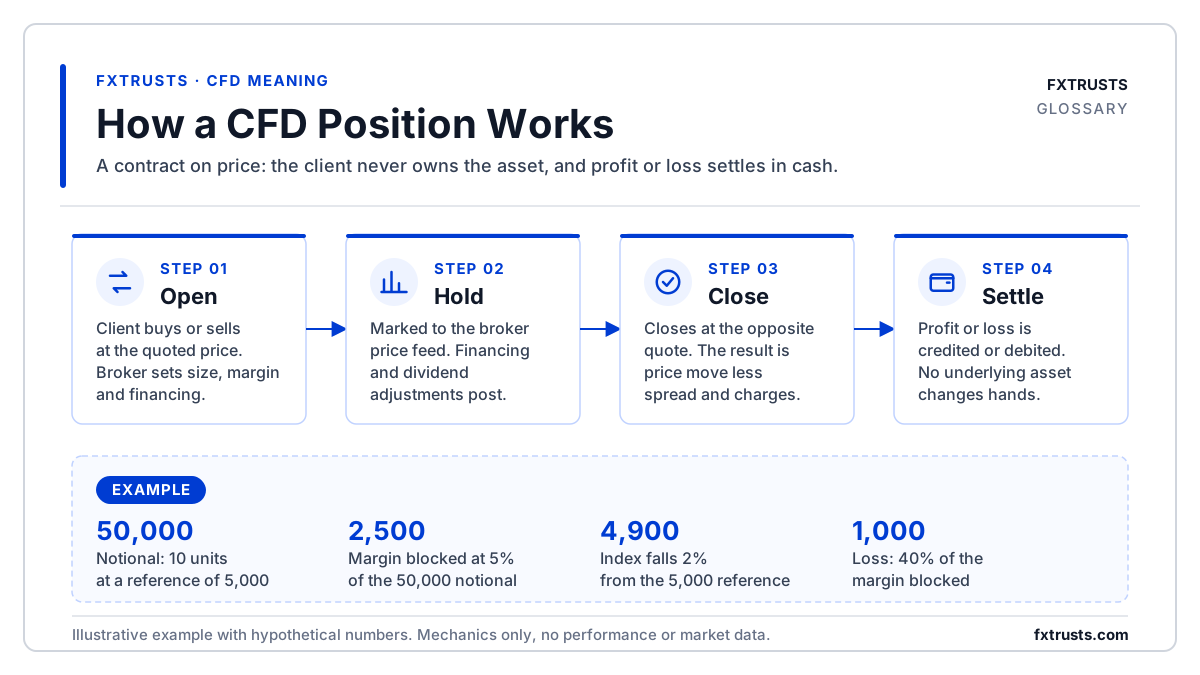
The diagram below shows the four stages of a CFD position: open, hold at the broker price feed, close, and settle in cash, with a hypothetical margin example. It is a generic picture, not a description of any one product.

How a CFD position works
A CFD position moves through four stages. Each stage needs a rule in the trading platform and a matching entry in the back office, so the definition has to become configuration before a single client trades.
- Open: the client buys or sells at the quoted price. The broker sets the position size, the margin requirement and the financing rule that applies.
- Hold: the position is marked to the broker price feed. Overnight financing and any dividend or corporate action adjustments post according to the product terms.
- Close: the position closes at the opposite quote, so the result is the price move less spread, commission and charges.
- Settle: profit or loss is credited or debited in the account currency. No underlying asset changes hands.
Illustrative example
Assume a hypothetical index CFD with 10 units open at a reference price of 5,000, so the notional value is 50,000. A 5% margin requirement blocks 2,500 in the account. If the index falls 2% to 4,900, the loss is 1,000, which is 40% of the margin blocked. These figures are invented for teaching and are not market data.
Two points follow from the example. First, the margin is a deposit, not a ceiling on the loss, because the result is measured against the whole position. Second, the close-out rules decide when a losing position is cut. Those rules are what regulators have examined most closely in retail markets, as set out below.
CFD compared with owning the underlying asset
The table sets a CFD beside direct ownership of the same asset. It is the comparison most often needed in product disclosure, client onboarding material and internal sign-off.
| Feature | CFD | Owning the underlying asset |
|---|---|---|
| Ownership of the asset | None. The client holds a contract on the price. | Yes. The holder owns the share, unit or currency. |
| What the broker or intermediary provides | A price quote, a margin account, financing and close-out handling, under the broker's own terms. | Market access and custody through a broker or custodian, under market rules. |
| How the result settles | Cash credit or debit based on the price difference. | Sale proceeds, or delivery under the market rules. |
| Capital needed up front | Margin, a fraction of the position value set by the broker. | Full purchase price, unless financed through a separate arrangement. |
| Voting or delivery rights | Not held. | Held, subject to the rules of the asset. |
| Where the price comes from | The broker quote, built from its price source and rules. | The exchange or market where the asset trades. |
| Costs to disclose | Spread or commission, financing and fees set by the broker. | Exchange, custody and transfer fees set by the market and custodian. |
- Ownership of the assetCFD: None. The client holds a contract on the price.Owning the underlying asset: Yes. The holder owns the share, unit or currency.
- What the broker or intermediary providesCFD: A price quote, a margin account, financing and close-out handling, under the broker's own terms.Owning the underlying asset: Market access and custody through a broker or custodian, under market rules.
- How the result settlesCFD: Cash credit or debit based on the price difference.Owning the underlying asset: Sale proceeds, or delivery under the market rules.
- Capital needed up frontCFD: Margin, a fraction of the position value set by the broker.Owning the underlying asset: Full purchase price, unless financed through a separate arrangement.
- Voting or delivery rightsCFD: Not held.Owning the underlying asset: Held, subject to the rules of the asset.
- Where the price comes fromCFD: The broker quote, built from its price source and rules.Owning the underlying asset: The exchange or market where the asset trades.
- Costs to discloseCFD: Spread or commission, financing and fees set by the broker.Owning the underlying asset: Exchange, custody and transfer fees set by the market and custodian.
Two rows need the most care in product documents: the price source and the financing rule. Both can change the result of a trade that looks correct on a chart, and both are common sources of client complaints when they are not described clearly.
Where retail CFD sales are restricted
Several regulators restrict how CFDs are sold to retail clients. The UK rules are the clearest published example, and the EU took a similar path in 2018 with temporary measures. This section is general information. It does not give legal advice, and the rules for your entity must be confirmed with counsel and the regulator for each market you plan to serve.
In September 2018, ESMA renewed restrictions on retail CFDs. The leverage caps depended on the volatility of the underlying asset, and a provider had to close out positions when the account fell to 50% of the minimum required margin (ESMA, 28 September 2018). The caps in that statement were set by underlying type, as shown below. ESMA's measures were temporary EU-wide interventions, so check the current rules of the national regulator in each market rather than relying on this 2018 table.
| Underlying (ESMA 2018 tiers) | Maximum retail leverage |
|---|---|
| Major currency pairs | 30:1 |
| Non-major currency pairs, gold and major indices | 20:1 |
| Commodities other than gold, and non-major equity indices | 10:1 |
| Individual equities | 5:1 |
| Cryptocurrencies | 2:1 |
- Major currency pairsMaximum retail leverage: 30:1
- Non-major currency pairs, gold and major indicesMaximum retail leverage: 20:1
- Commodities other than gold, and non-major equity indicesMaximum retail leverage: 10:1
- Individual equitiesMaximum retail leverage: 5:1
- CryptocurrenciesMaximum retail leverage: 2:1
The UK Financial Conduct Authority made its version of the restrictions permanent in 2019. Its press release sets leverage between 30:1 and 2:1 and requires firms to close out positions when the funds in a client account fall to 50% of the margin required (FCA press release, 1 July 2019). The policy statement ties those leverage tiers to the volatility of the underlying asset. It also requires firms to ensure a client cannot lose more than the total funds in the trading account, and it stops monetary and non-monetary inducements to trade (FCA PS19/18).
Check before you launch
Some markets do not permit retail CFD sales at all, and others allow them only for certain client types. Permitted products, client types and countries differ by regulator and by legal entity. Write those limits into the product rules, and record the source of each answer in the permissions file. See the forex broker licensing and regulation cluster for the questions to ask.
What a broker must set up before listing CFDs
Listing CFDs is a product, pricing and compliance project, not a single switch in a platform. A broker needs a defined instrument list, a price source, margin and leverage rules that match its permissions, a close-out process and reports that show what each client owes. The checklist below is the minimum set of decisions to record before go-live.
- Permissions: confirm, in writing, which products, client types and countries the licensed entity may serve.
- Instrument specification: contract size, tick value, trading hours, financing, and dividend or corporate action rules for each symbol.
- Price source: the liquidity provider or quote feed behind each bid and ask, plus the stale-price filter. The liquidity provider selection guide lists the checks to run.
- Margin and leverage: tiers by instrument and client type, set within the permitted caps.
- Close-out and negative balance: the trigger level, the order in which positions close, and how any shortfall is handled.
- Reporting: daily positions, financing, profit and loss, and client exposure, reconciled to the price source.
Platform scope needs the same discipline. FxTrusts supplies white-label brokerage technology and liquidity connectivity for brokers. Which CFD symbols run on MT5, cTrader or RTX5 depends on the platform scope confirmed in writing for your deployment. Confirm the instrument list before you promise it to clients, and do not assume that a symbol offered by one platform is available on another.
CFD and related terms for broker teams
The list below separates them by what the broker is actually doing.
- Spot forex: an exchange of one currency for another at the current rate, with a settlement convention. A CFD on a currency pair tracks the same price but involves no exchange of currency.
- Futures: a standardised, exchange-traded contract with a set expiry and a defined delivery or cash settlement process. It is not a bilateral contract with the broker.
- Market maker: a counterparty that quotes both sides and can take the other side of client orders. A CFD broker may act in this role, which raises the conflict-of-interest questions covered in the market maker glossary entry.
- Direct market access: routing client orders to external liquidity without the broker taking the other side. Read the DMA glossary entry before describing any CFD product as direct market access.
Commercial view: where CFD revenue and risk sit
A CFD broker typically earns from spreads, commissions and financing charges, and, where its model allows, from the net result of client trades. The business model decides where conflicts of interest and credit risk sit, so it must be documented before product launch. For a fuller view of revenue lines, see how forex brokers make money.
FxTrusts is a technology provider, not a broker, bank or regulated financial institution, and it offers no retail trading accounts. The licensed entity, its liquidity counterparty and its risk policy decide the model. Trading CFDs carries a risk of losing money, and no platform design removes that risk.
Key takeaways
- A CFD is a contract on the price of an underlying asset, and the client does not own that asset.
- Profit and loss settle in cash, and margin is a deposit, not a cap on losses.
- Regulators in several markets restrict retail CFD leverage, close-out and marketing, so check each target market.
- Before listing CFDs, record permissions, instrument specifications, the price source, margin tiers and close-out rules.
- Confirm platform symbol scope and liquidity in writing rather than assuming it from a product list.
Frequently asked questions
What does CFD stand for?
CFD stands for contract for difference. It is a derivative contract that pays the change in price of an underlying asset between the time a position opens and the time it closes. The name describes the settlement: the two parties exchange only the difference in price, not the asset itself.
Is a CFD the same as owning the underlying share?
No. A CFD gives exposure to the price movement without ownership, so the holder has no shareholder rights such as voting. Costs, financing and tax treatment can also differ from direct ownership. Check the terms of the specific product, and seek tax advice where it applies to the client.
How does leverage work in a CFD?
The broker requires a margin deposit that is a fraction of the position value, so the same price move produces a larger gain or loss relative to the deposit. Regulators in several markets cap that leverage. Where negative balance protection does not apply, losses can exceed the funds in the account, so confirm the protection that applies to each client.
Are CFDs restricted for retail clients?
In some markets, yes. The UK FCA made its retail CFD restrictions permanent in 2019, and ESMA imposed temporary EU-wide caps from 2018, so check the current national rules in each EU market. These rules cover leverage caps, close-out rules and limits on inducements, and some markets do not permit retail CFD sales at all. Permitted client types and countries differ by regulator and by legal entity, so confirm the position for each licensed entity with counsel and the regulator.
What should a broker check before listing CFDs?
Confirm permissions for the entity, client types and countries first. Then record the instrument specifications, the price source, margin tiers, close-out and negative balance rules, and the reporting that reconciles client positions. Confirm in writing which platform carries each symbol. The regulator and counsel decide what is permitted, and this list shows what to document.
Related FxTrusts resources
- Market maker
- Direct market access (DMA)
- How forex brokers make money
- Forex broker licensing and regulation
Sources
- FCA PS19/18: Restricting contract for difference products sold to retail clients
- FCA press release: permanent restrictions on the sale of CFDs and CFD-like options (1 July 2019)
- FCA press release on CFD providers and fair value (13 November 2025)
- ESMA: renewal of restrictions on CFDs (28 September 2018)
Scope a CFD-ready broker stack
Send FxTrusts your licensed entity, target markets and instrument list. We will map the platform, liquidity and reporting scope to confirm in writing.
Contact FxTrusts