
What Does DMA Stand For? Direct Market Access Explained
DMA stands for direct market access. In forex broker usage it often describes a setup in which a client order is passed through the broker’s infrastructure to a liquidity provider or venue, rather than being filled against the broker’s own book. The label is used loosely, so the contract, routing rules and execution records decide what actually happens.
FxTrusts supplies brokerage technology and implementation services, so this entry includes our commercial perspective. It is general information, not legal, tax or investment advice, and trading FX or CFDs carries a risk of loss.
On this page
- What direct market access means
- Direct market access in a forex brokerage
- DMA, A-book, B-book and hybrid routing compared
- How a DMA order moves through the stack
- What a partial fill looks like in the records
- What to verify before calling a flow DMA
- How DMA relates to prime-of-prime access
- Where FxTrusts fits in a direct routing setup
- Who decides whether a routing model is allowed
- Key takeaways
- Frequently asked questions
What direct market access means
DMA is the acronym for direct market access, and the letters have other meanings too. Designated Market Area is a US television-ratings term, and the initials appear in unrelated technical and business contexts. In trading, the phrase describes the path an order takes to a market. When a sales deck says “DMA”, ask the vendor to show that path step by step.
Regulators apply the same idea in equities. The US market access rule, Rule 15c3-5 in the Code of Federal Regulations (Cornell LII mirror), defines market access as access to trading in securities on an exchange or alternative trading system as a result of being a member or subscriber, and it requires risk controls for that access.
FINRA’s market access summary states that broker-dealers with market access must maintain written risk controls and supervisory procedures, that these controls apply on a pre-trade basis, and that, with limited exceptions, the controls stay under the broker-dealer’s direct and exclusive control. That is an equities framework, not a forex rulebook. Its lesson still carries over: the firm whose systems send an order into a market is expected to control that path.
Direct market access in a forex brokerage
In an FX or CFD brokerage, DMA describes the routing path rather than a licence or a product. A client places an order on the trading platform. A bridge or gateway converts that order into the provider’s session format. The order reaches a liquidity provider, which may accept, reject, requote or partially fill it under the broker’s contract. Whether the broker or the provider is the counterparty depends on that contract and on the routing rules, not on the label.
The diagram below sets a routed path beside an internalised B-book path, so the difference is visible before the detailed comparison in the next section.

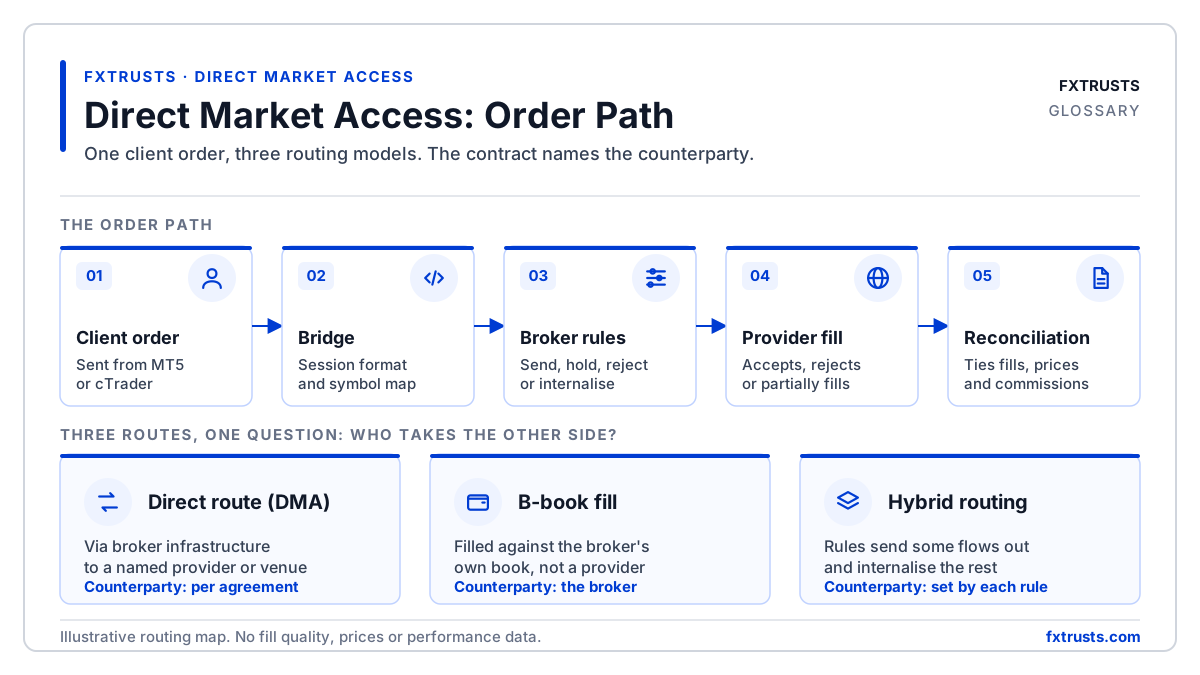
A broker that says it offers DMA is describing a route. The rest of this entry explains how to check that route rather than trusting the marketing word.
DMA, A-book, B-book and hybrid routing compared
The labels are used inconsistently. The liquidity bridge and broker execution answers make the same point: A-book, B-book, STP and ECN appear loosely in marketing, and contracts, message traces and accounting records show the arrangement that actually operates. The table below uses operational meanings.
| Model | Where the order goes | Who is the counterparty | Evidence to request |
|---|---|---|---|
| Direct route (DMA) | Through the broker’s infrastructure to a named liquidity provider or venue | Depends on the provider agreement and whether the provider takes the trade | Counterparty named in the contract, order and fill messages, and execution reports |
| A-book pass-through | Hedged or passed to liquidity providers under routing rules | The provider on the passed-on leg, with residual exposure set by the hedging rules | Hedge logs, routing rules and provider confirmations |
| B-book fill | Filled against the broker’s own book | The broker, so its result on those trades moves against client results | Dealing policy, exposure reports, conflict controls and client disclosures |
| Hybrid routing | Some flows to a provider and some internalised, set by rules | Varies by rule, so each rule needs its own evidence | Written rule set, approvals, change log and audit records |
- Direct route (DMA)Where the order goes: Through the broker’s infrastructure to a named liquidity provider or venueWho is the counterparty: Depends on the provider agreement and whether the provider takes the tradeEvidence to request: Counterparty named in the contract, order and fill messages, and execution reports
- A-book pass-throughWhere the order goes: Hedged or passed to liquidity providers under routing rulesWho is the counterparty: The provider on the passed-on leg, with residual exposure set by the hedging rulesEvidence to request: Hedge logs, routing rules and provider confirmations
- B-book fillWhere the order goes: Filled against the broker’s own bookWho is the counterparty: The broker, so its result on those trades moves against client resultsEvidence to request: Dealing policy, exposure reports, conflict controls and client disclosures
- Hybrid routingWhere the order goes: Some flows to a provider and some internalised, set by rulesWho is the counterparty: Varies by rule, so each rule needs its own evidenceEvidence to request: Written rule set, approvals, change log and audit records
The table has two cautions. A DMA label does not show whether the provider or the broker is the counterparty. A market maker that quotes both sides of a flow can take the other side of client trades, so a provider name alone does not settle the question. A hybrid broker can run both models, which makes the real question which flows follow which rule.
How a DMA order moves through the stack
A routed order creates a chain of records. Each step can be checked, and each step can fail in a different way.
- The client submits an order from a trading platform such as MT5 or cTrader.
- A bridge or gateway converts the order into the provider’s session format and maps the symbol.
- The broker’s routing and risk rules decide whether the order is sent, held, rejected or internalised.
- The provider accepts, rejects or partially fills the order and returns an execution report.
- The broker reconciles fills, prices, commissions and rejects against its trading records.
If a step cannot be explained from a log or a message, start the review there. For more detail on the connectivity layer, read the bridge and gateway routing guide.
What a partial fill looks like in the records
Partial fills show why the record matters. The client sees one position, but the provider may fill the order in several pieces at different prices. The broker needs to show each fill, the time it occurred and how the client price was built from those fills.
Illustrative example
Hypothetical numbers only, not market data. A 5-lot client order is filled as 3 lots at 1.10020 and 2 lots at 1.10021. A simple weighted average is (3 × 1.10020 + 2 × 1.10021) ÷ 5 = 1.100204. The arithmetic shows the bookkeeping, not the price of any instrument, and a real arrangement may use a different method set out in writing.
Agree the fill method with the provider and with your own system before go-live. Include how partial fills, rejects and requotes appear in client statements.
What to verify before calling a flow DMA
Use this list before a sales conversation turns into a contract.
- The legal counterparty for each instrument, named in writing.
- Whether the provider can reject, requote or apply last-look terms, and what those terms are.
- Which markups, commissions and swap charges apply on each route, and who sets them.
- How internalised flow is identified, limited and reported, if the broker also runs a B-book.
- How rejects, cancels, disconnects and sequence gaps are handled, and whether recovery was tested.
- A reconciliation report that ties client positions to provider fills at a set interval.
The liquidity bridge and broker execution answers go deeper on these checks. Compare executable outcomes under representative conditions rather than the displayed price alone, because depth, order size and provider rules can change the result.
How DMA relates to prime-of-prime access
Many brokers compare DMA with prime-of-prime access. A prime-of-prime intermediary gives a broker access to liquidity through its own upstream relationships, so the broker may have no direct contract with the bank or market maker that prices its flow. The prime-of-prime vs direct market access article covers the cost and access trade-offs in full.
For this glossary entry, the useful test is contractual. Ask who supplies the price, who is the counterparty to each trade, and whom the broker can call when a fill is disputed. A route that cannot answer those questions is not a DMA route in any sense that matters for due diligence.
Where FxTrusts fits in a direct routing setup
FxTrusts supplies B2B technology and implementation services to forex and CFD brokers and prop trading firms. It is a technology provider, not a broker, bank or liquidity provider. Our liquidity connectivity page describes a bridge, gateway or FIX link to a named provider, with routing controls, reconciliation and acceptance testing.
The liquidity counterparty is named in the broker’s own agreement with that provider. Any FxTrusts liquidity access is a separate contracted scope and appears only in a signed order form. For the same routing questions from the business side, the execution broker guide is a useful companion.
Who decides whether a routing model is allowed
Whether a routing model is permitted depends on your entity, jurisdiction, activity, client types and the permissions your regulator grants. A technology provider does not settle that question, and neither does a glossary entry. Describe the flow precisely in writing, including the counterparty, the routing rules and the client-money path, then ask your regulator or qualified counsel to confirm it.
Routing choices change who bears certain exposures and how fills are recorded. They do not remove the risk of loss that comes with trading FX or CFDs.
Key takeaways
- DMA describes the order path, so check the counterparty in the contract rather than trusting the label.
- A-book, B-book and hybrid routing differ in who takes the other side, and each needs its own evidence.
- Partial fills, rejects and requotes must trace from the client order to the provider fill.
- The US market access rule shows the control principle: pre-trade controls kept under the firm’s own direct control.
- FxTrusts liquidity connectivity is a contracted scope, separate from the broker’s agreement with its provider.
Frequently asked questions
What does DMA stand for in forex?
DMA stands for direct market access. In forex broker marketing it often describes a setup in which client orders are routed to a liquidity provider or venue through the broker’s infrastructure. The label does not show who is the counterparty, so check the provider agreement, routing rules and fill records before you rely on it.
Is direct market access the same as an ECN?
Not necessarily. An ECN usually describes an electronic matching network, while direct market access describes the order path into a market. Marketing often uses both terms together. Ask which venue or provider receives each order, who matches it, and whether the broker takes the other side of any flow.
Does DMA mean a broker cannot profit from client losses?
No label settles that. A broker that passes orders to a provider earns its return from the agreed commercial terms, while a broker that internalises flow can be the counterparty to client trades. Hybrid models mix both. Ask which flows are internalised, how those flows are limited and how the related conflicts are disclosed and controlled.
Do I need a licence to offer direct market access?
That depends on your entity, jurisdiction, activity and client types, and only your regulator or qualified counsel can reach that conclusion. A technology setup does not grant permissions by itself. Describe the routing model in writing, including counterparty and client-money flows, and get written confirmation before you offer the service.
Related FxTrusts resources
- Market maker
- Prime of prime vs direct market access
- Liquidity bridge and broker execution answers
- Forex liquidity provider connectivity
- Execution broker guide
Sources
- FINRA, Market Access (key topic on Rule 15c3-5)
- 17 CFR 240.15c3-5, Risk management controls for brokers or dealers with market access (Cornell LII mirror of the CFR text)
Scope your liquidity route before you commit
Share the legal entity, platform, instruments, target markets and routing policy. We will map the counterparty, contracts, tests and responsibilities that still need approval.
Contact FxTrusts