
What Is an Execution Broker?
An execution broker is a firm that receives a client’s order and places it with a market, exchange or liquidity provider on the client’s behalf, then reports the result. Its core job is routing, filling and reporting. Some firms also take the opposite side of client trades, so the label alone does not settle the model.
FxTrusts supplies brokerage technology and implementation services, so this guide includes our commercial perspective. It is general information, not legal, tax or investment advice. Trading CFDs and leveraged FX carries a high risk of losing money quickly.
On this page
- What an execution broker does in the order flow
- Order flow from click to fill
- Agency or principal: who takes the other side
- STP, ECN and market maker models in one table
- What does ECN mean in forex trading?
- STP vs ECN broker: what to ask instead
- Partial fills and the execution record
- Best execution duties and what to check
- Where FxTrusts fits in execution
- Key takeaways
- Frequently asked questions
What an execution broker does in the order flow
An execution broker takes a client’s instruction to buy or sell and gets it done with a market, an exchange or a liquidity provider. The client sees one account and one order ticket, but the order usually passes through several systems before it fills. The broker’s duties centre on three things: where the order goes, what price it can fill at, and what record it keeps of the result.
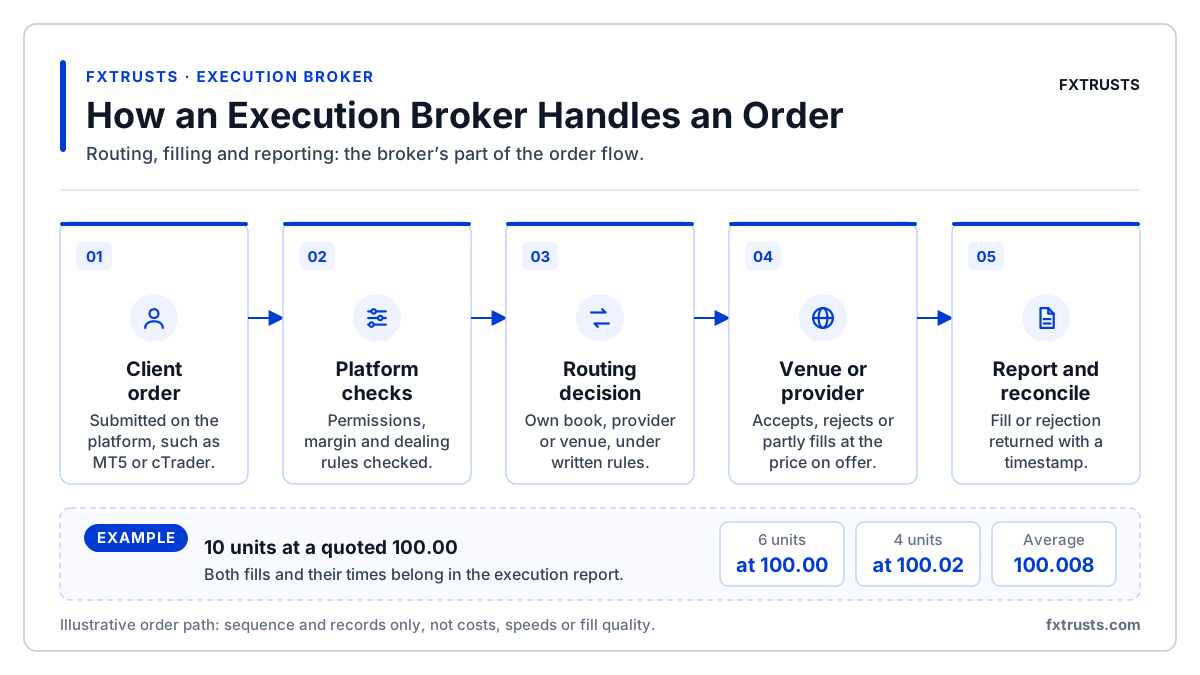
The figure below shows the chain used in this guide: client, broker platform, venue or liquidity provider, fill, and the execution report sent back. Who owns each link is the first question to answer when you assess a provider.

The term describes a function, not a licence category. One firm can act as an execution broker for some orders and take the other side of others. Read the client agreement and the order execution policy rather than relying on the label in marketing.
Order flow from click to fill
A simple market or limit order follows six steps. Each step can fail or delay the trade, so a sound execution setup logs every one of them.
- The client submits an order through the trading platform, such as MT5 or cTrader.
- The platform checks account permissions, symbol settings, margin and any dealing rules, then passes the order onward.
- The broker decides the route: its own book, an outside liquidity provider or an electronic venue, under its written routing rules.
- The venue or provider accepts, rejects or partly fills the order at a price it can offer at that moment.
- The fill, or the reason for rejection, returns to the platform and the client with a timestamp.
- The firm reconciles the trade record against the provider statement and its own ledgers.
Order type changes the outcome. Read about market orders and limit orders in the knowledge base. Partial fills matter too: an order for 10 units can fill as 6 and 4 at different prices, and the client needs both fills in the record.
Agency or principal: who takes the other side
The most useful distinction is whether the firm acts as an agent or as a principal. An agency execution broker routes the client’s order to a market or provider and earns a commission or fee, without taking a position against the client. A principal, or dealing-desk, model can fill the order from the firm’s own book, so the firm’s gain or loss can move opposite the client’s.
The SEC’s investor bulletin on trade execution explains that a broker decides where an order is sent and may fill it from its own inventory, which the SEC calls “internalization”. A market maker is a firm that stands ready to buy or sell at publicly quoted prices. Our market maker definition covers that role on its own terms.
STP, ECN and market maker models in one table
These three labels appear often in broker marketing. They describe how an order is passed on, not a fixed legal category, and they overlap. The table gives a plain description of each so you can read a broker’s own wording. It does not rank them or compare costs, because those depend on the instrument, the provider and the contract.
| Label | What it describes | Who the counterparty usually is | Read more |
|---|---|---|---|
| STP (straight-through processing) | Orders passed on electronically to one or more liquidity providers, without manual dealing | One or more liquidity providers, under the firm’s agreements | Order execution |
| ECN (electronic communications network) | An electronic system that matches buy and sell orders at specified prices | Other participants whose orders are displayed and matched on the system | Liquidity bridge execution |
| Market maker | A firm that stands ready to buy or sell at quoted prices | The firm itself, from its own inventory or hedged book | Market maker definition |
- STP (straight-through processing)What it describes: Orders passed on electronically to one or more liquidity providers, without manual dealingWho the counterparty usually is: One or more liquidity providers, under the firm’s agreementsRead more: Order execution
- ECN (electronic communications network)What it describes: An electronic system that matches buy and sell orders at specified pricesWho the counterparty usually is: Other participants whose orders are displayed and matched on the systemRead more: Liquidity bridge execution
- Market makerWhat it describes: A firm that stands ready to buy or sell at quoted pricesWho the counterparty usually is: The firm itself, from its own inventory or hedged bookRead more: Market maker definition
A single broker can describe itself with more than one label, and the mix can differ by instrument. Treat each label as a prompt for questions, not as proof of a price or a fill quality.
What does ECN mean in forex trading?
ECN stands for electronic communication network, also written electronic communications network. The US SEC describes ECNs as electronic trading systems that automatically match buy and sell orders at specified prices. The name describes the venue type. It does not guarantee a price or fill quality.
In forex, brokers often use “ECN” to describe prices pulled from several liquidity providers onto one feed. That is a commercial usage and does not always match the regulatory meaning. Ask which venues or providers stand behind the prices you see, and whether they can be checked against a record.
STP vs ECN broker: what to ask instead
Many searchers ask whether an STP or an ECN broker is better. The label alone does not answer that. A useful reply covers the questions below, and they apply whatever label the firm uses.
- Who is the counterparty for each order: a provider, a venue, or the firm itself?
- Can the firm decline or internalise an order, and is that routing rule written down?
- What is the total cost per trade, including commission, mark-up, swaps and any fees, and how is each one shown?
- How are rejections, partial fills and requotes reported to the client?
- Which execution statistics does the firm provide, for which instruments and over what period?
Ask for the answers in writing, then compare providers on the same test instruments and the same order sizes.
Partial fills and the execution record
Partial fills are where an execution broker’s record matters most. The worked case below uses hypothetical numbers to show why the average price alone is not enough.
Illustrative example
A client buys 10 units at a quoted price of 100.00. The provider fills 6 units at 100.00 and 4 units at 100.02. The average fill is 100.008, calculated as (6 × 100.00 + 4 × 100.02) ÷ 10. The execution report should show both fills, their times and the quoted price, so the client and the firm can check the average. These numbers are invented for explanation and are not market data.
A report that shows only the average hides the second fill and the time it occurred. Ask for fill-level records and keep them, because reconciliation and any client query depend on them.
Best execution duties and what to check
Where a regulator applies, an execution broker is expected to seek the best result reasonably available for the client, measured on more than the headline price. For MiFID business in the UK, best execution duties sit in COBS 11.2A of the FCA Handbook. In summary, a firm must take sufficient steps to get the best possible result for its clients, weighing factors such as price, costs, speed and likelihood of execution, and to keep an order execution policy.
The SEC’s investor bulletin on trade execution describes a broker’s duty to seek the best execution that is reasonably available. Neither framework guarantees the best price on every order. They set process duties. Apply the rule in your own jurisdiction to your own activity, and take legal advice before relying on any rule described here.
- A written order execution policy that names the venues or providers used and the factors that decide routing.
- Routing rules that someone can audit and that match what the client agreement says.
- Fill and rejection logs kept with timestamps and tied to the client account.
- Periodic review of execution results against the policy, with a documented decision when a venue is changed.
Where FxTrusts fits in execution
FxTrusts is a technology provider, not a broker, bank or regulated financial institution. It does not act as the execution broker for any client, and it does not supply the liquidity itself under this guide’s scope. Its role on the execution path is the technology in the signed contract.
The FxTrusts liquidity page describes connecting a broker to a liquidity provider through a scoped bridge, gateway or FIX link, with routing controls, reconciliation and acceptance tests. The liquidity counterparty is named in the broker’s own agreement with that provider. For how bridges translate orders and reports, read liquidity bridge execution answers.
For the business model behind spreads and dealing income, read how forex brokers make money before you compare execution arrangements.
Key takeaways
- An execution broker is defined by its role in the order: routing, filling and reporting it.
- Ask whether the firm is the counterparty, passes the order to a provider, or sends it to an electronic venue.
- STP, ECN and market maker are descriptions, not rankings. Compare execution records on the same instruments.
- Best execution rules set process duties. They do not guarantee the best price on each order.
- Keep fill-level records so averages and partial fills can be reconciled.
Frequently asked questions
What is an execution broker?
An execution broker is a firm that places a client’s orders with a market, exchange or liquidity provider and reports the result. Its work is routing, filling and reporting. Some firms also take the opposite side of client trades, so the label alone does not settle the model. Read the order execution policy and the client agreement to learn who holds the other side, how orders are routed and what records you receive.
What does ECN mean in forex?
ECN means electronic communication network, also written electronic communications network. The US SEC describes ECNs as electronic trading systems that automatically match buy and sell orders at specified prices. In forex, brokers sometimes use the term for prices from several providers, which is a commercial usage. Ask which venues or providers stand behind the prices you see.
Is an STP broker the same as an ECN broker?
Not necessarily. STP describes passing orders on electronically, while ECN describes an electronic system that matches orders. A firm can use both descriptions in its marketing. Neither label confirms the price, cost or fill quality you will receive, so compare the written routing rules, total costs and execution records instead.
Is an execution broker the same as a market maker?
Not always. A market maker stands ready to buy or sell at quoted prices, often from its own inventory. An execution broker’s role is routing and reporting. One firm can do both, and when it fills from its own book the client’s interests and the firm’s can diverge. Ask which role applies to each instrument and order type.
Does an execution broker have to give the best price?
Rules differ by jurisdiction. Under the UK FCA’s best execution rules for MiFID business, firms must take all sufficient steps to obtain the best possible result, weighing factors such as price, costs, speed and likelihood of execution. These are process duties, not a guarantee of the best price on each order. Get advice specific to your jurisdiction and activity.
Related FxTrusts resources
- Order execution knowledge base
- Liquidity provider connectivity
- Market maker definition
- Execution quality answers
- How forex brokers make money
Sources
- SEC: Electronic Communications Networks
- SEC investor bulletin: Trade Execution
- FCA Handbook COBS 11.2A: Best execution
Map your execution path before you sign
Share your target instruments, liquidity arrangements and routing requirements. We will show which parts FxTrusts covers under contract and which sit with your provider and regulator.
Contact FxTrusts