
How Forex Brokers Make Money: Five Revenue Lines
Forex brokers make money mainly from the bid-ask spread, per-trade commissions, overnight swap charges, account and service fees, and the net result of client trades on its own book (B-book). Much of this depends on trading volume, while B-book results depend on client results, so none of it is guaranteed.
FxTrusts supplies brokerage technology and implementation services, so this guide includes our commercial perspective. It is general information, not legal, tax or investment advice. The figures in the worked example are hypothetical, not market data.
On this page
- How forex brokers make money: five revenue lines
- The spread: the bid-ask gap
- Commissions and per-lot charges
- Swap charges for positions held overnight
- Fees, and the B-book result
- Why client losses make the model sensitive to conduct
- What to check when you model broker income
- Key takeaways
- Frequently asked questions
How forex brokers make money: five revenue lines
A broker’s income comes from what clients pay to trade and from what happens to their trades. The five lines below are priced differently and carry different risks, so it helps to look at each one separately before adding them up.
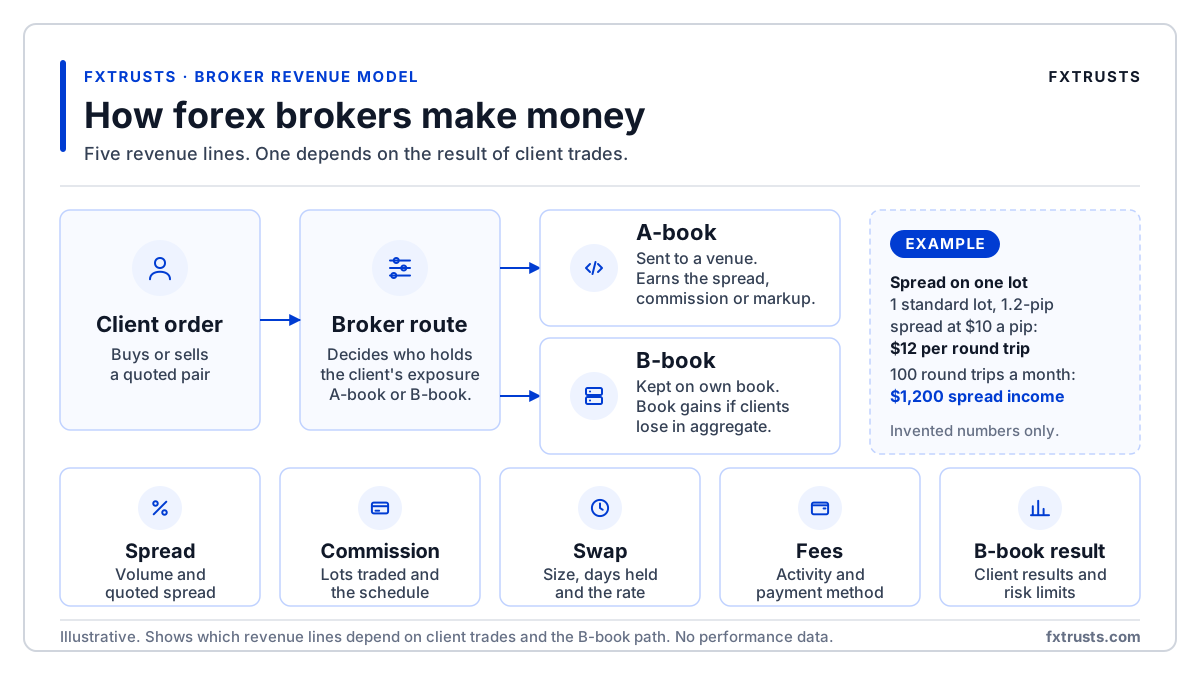
The diagram shows how the lines connect. Client orders pass through the broker’s execution route, and that route decides whether the broker earns from the spread and fees alone or also from the client’s trading result.

| Revenue line | How the broker earns it | What drives the amount | Main exposure |
|---|---|---|---|
| Spread | The gap between the buy and sell price when the broker fills against its own quotes or marks up an external price | Traded volume, quoted spread and market conditions | Pricing practice and client trust |
| Commission | A fixed or per-lot charge on each trade or round trip | Lots traded and the commission schedule | Clients moving to cheaper brokers |
| Swap | Overnight financing on positions held past the rollover time | Position size, holding period and rate | Complaints about unclear or unexpected charges |
| Fees | Account, deposit, withdrawal, inactivity and currency conversion fees | Client activity and payment method | Payment costs, chargebacks and disputes |
| B-book result | Net profit or loss on client trades the broker keeps on its own risk book | Aggregate client results, hedging and risk limits | In a simple unhedged model, a loss when clients' aggregate profit exceeds the spreads and fees collected; hedging costs, slippage and unhedged exposure can add to it |
- SpreadHow the broker earns it: The gap between the buy and sell price when the broker fills against its own quotes or marks up an external priceWhat drives the amount: Traded volume, quoted spread and market conditionsMain exposure: Pricing practice and client trust
- CommissionHow the broker earns it: A fixed or per-lot charge on each trade or round tripWhat drives the amount: Lots traded and the commission scheduleMain exposure: Clients moving to cheaper brokers
- SwapHow the broker earns it: Overnight financing on positions held past the rollover timeWhat drives the amount: Position size, holding period and rateMain exposure: Complaints about unclear or unexpected charges
- FeesHow the broker earns it: Account, deposit, withdrawal, inactivity and currency conversion feesWhat drives the amount: Client activity and payment methodMain exposure: Payment costs, chargebacks and disputes
- B-book resultHow the broker earns it: Net profit or loss on client trades the broker keeps on its own risk bookWhat drives the amount: Aggregate client results, hedging and risk limitsMain exposure: In a simple unhedged model, a loss when clients' aggregate profit exceeds the spreads and fees collected; hedging costs, slippage and unhedged exposure can add to it
The spread: the bid-ask gap
The spread is the difference between the bid, the price at which a client can sell, and the ask, the price at which a client can buy. Where the broker fills a client against its own quotes, the gap between its bid and ask is part of its revenue. Where the broker passes an order to an external venue, it may earn a markup or a commission instead. For the trading mechanics, see our bid-ask spread explainer.
Illustrative example
Assume a hypothetical client trades one standard lot of a USD-quoted pair, where one pip is worth $10 and the broker’s spread is 1.2 pips. The spread cost on one round trip is $12. If 100 such round trips happened in a month, spread income would be $1,200 before any other line. These numbers are invented to show the arithmetic. They are not market data.
The example shows why spread income scales with volume. It also shows why a broker that widens spreads at busy times, or without telling clients, will face complaints even when its headline price looks competitive.
Commissions and per-lot charges
Some brokers charge a commission instead of, or in addition to, a wider spread. A per-lot commission is usually set in the account terms and shown on statements. Commission-based pricing does not remove the spread. Each route still has a cost, and the broker’s total income is the sum of every line it earns.
- Confirm whether the commission applies per side, per round trip or as a percentage of notional value.
- Check whether the schedule changes with account type, volume tier or an introducing-broker agreement.
- Model commission income separately from spread income, because the two react differently to price moves and to changes in volume.
Swap charges for positions held overnight
Swap, also called rollover or overnight financing, is a charge or credit on open positions that cross the broker’s daily rollover time. The rate depends on the symbol’s settings, and buy and sell positions can carry different rates, so check the rates before you rely on a model.
Because swap depends on direction and holding period, it is often the line clients ask about when they hold trades for several days. For the calculation, read our swap and rollover costs page. This guide treats swap only as one revenue line.
Fees, and the B-book result
Account, deposit, withdrawal, inactivity and conversion fees add a steady layer of income. They also generate complaints when they are unclear or appear after a client has funded an account. The most variable line is the B-book result, because it depends on client results and on the broker’s hedging and risk limits.
On A-book flow, the broker passes eligible exposure to an external counterparty under the agreed execution path, so its income from that flow is mainly the spread, commission or markup it keeps. On B-book flow, the broker keeps the exposure within its own risk process. The book gains when clients lose in aggregate. In a simple unhedged model, it loses on that flow when clients’ aggregate profit exceeds the spreads, fees and other charges collected on it. Hedging costs, slippage and any exposure left unhedged can add losses on top. A B-book model is therefore judged on risk limits, hedging and conduct controls as much as on its fee schedule. Our guide to A-book, B-book and hybrid brokers covers the routing choice in more detail.
Why client losses make the model sensitive to conduct
In many retail forex and CFD arrangements, the broker is the counterparty. The CFTC’s customer advisory says that retail forex trading is against the dealer and that the dealer makes money when clients trade more often, lose money, or pay fees, spreads or commissions. It also warns that a customer can lose all of their margin and more.
The UK regulator has been cautious about these products for years. In a December 2016 press release, the FCA said that 82% of clients in its sample of accounts lost money on CFDs. That figure is dated and sample-based, so check the FCA’s current publications before you quote it or use it in a model.
Where client and broker interests pull in different directions, the broker’s records need to show how each order was priced and routed. Our market maker glossary entry explains the role a dealer can play in that flow.
- Document how each client order is priced, filled and routed.
- Review whether spreads widen around news or in thin liquidity, and whether clients were told in advance.
- Set exposure limits for the B-book and monitor them against client results.
- Keep records that show which flow was internalised, externalised or netted, and why.
What to check when you model broker income
A revenue model for a brokerage should start from measured flow, not from a single price list. Build it from lots traded by client segment, the spread and commission schedule, swap by symbol and holding period, the fee schedule and the share of flow routed A-book and B-book. Then test each line on its own.
- Split volume by symbol, client type and routing outcome.
- Price each line from the signed contract terms, not from a headline offer.
- Stress the B-book line with a scenario in which clients win in aggregate.
- Reconcile the monthly income statement against trading and payment records.
FxTrusts supplies parts of the stack this model relies on: A-book, B-book and hybrid routing controls on our liquidity routing page, the CRM and client portal on our traders room page, and payments on our payment infrastructure page. FxTrusts is a technology provider and does not run a trading account business, so the commercial terms of any setup depend on a written scope. For the cost side of a white-label stack, see our MT5 white-label cost breakdown.
Key takeaways
- A forex broker’s income comes from spreads, commissions, swaps, fees and B-book results, and each line has different drivers.
- The spread is broker income when the broker fills clients against its own quotes or marks up an external price.
- Swap is a holding-cost line that depends on direction, holding period and the symbol’s rollover settings.
- B-book income falls when clients’ aggregate profit exceeds the spreads and fees collected on that flow, and hedging costs or unhedged exposure can add to the loss, so risk limits and conduct controls matter as much as pricing.
- Loss-rate figures from regulators are sample-based and dated, so check current publications before you rely on them.
Frequently asked questions
How does a forex broker make money on a trade?
A broker usually earns on each trade through the spread, a commission, or both. If it holds the client’s result on its own book, the broker also gains or loses on that flow. If the order is passed to an external venue, the broker may earn a markup instead. Income therefore depends on trading volume and pricing rules, not on the outcome of any single trade.
Do commission-free forex brokers make money?
Often, yes, but the cost moves elsewhere. A commission-free offer may recover its cost through a wider spread, a swap charge, a fee or a B-book result. Read the full contract schedule and the statement lines rather than the headline offer. The CFTC says retail forex dealers profit through fees, spreads and commissions, so total cost is what matters.
Is the broker my counterparty when I trade forex?
In many retail forex and CFD arrangements, yes. The CFTC notes that off-exchange forex trading is against your dealer rather than an open market. Whether a broker takes the other side of your trade depends on the contract and the execution route. Read the client agreement and the order-routing disclosure before you open an account.
What is swap on a forex trade?
Swap is an overnight financing charge or credit on a position held past the rollover time. Long and short positions can carry different rates, and some weekdays can carry a multiplier. The rates are set in the symbol specification, so check them before you hold trades for several days.
Why would a broker lose money on client trades?
On B-book flow, the broker’s book loses when clients as a group win more than the book earns from spreads, fees and other charges. Hedging, exposure limits and daily monitoring decide how large that loss can become. A broker that externalises the same flow gives up that exposure but earns mainly the spread or markup on it.
Related FxTrusts resources
- Swap and rollover costs
- Start a forex broker: routes, timeline and costs
- A-book, B-book and hybrid brokers
- Forex liquidity routing
Sources
- CFTC: Customer Advisory, Eight Things You Should Know Before Trading Forex
- FCA: proposed stricter rules for contract for difference products (press release, December 2016)
- MetaQuotes: MetaTrader 5 Help, Market Watch (swap and trade settings)
Map your broker revenue model
Tell us your target markets, instruments and expected routing mix. We will explain which FxTrusts modules fit your scope and what we would need to quote.
Contact FxTrusts