
Market Maker Definition: How Brokers Take the Other Side of a Trade
The market maker definition, in plain terms: a firm that stands ready to quote both a buy and a sell price and deals against its own capital, so it can be the counterparty to the other side of a trade. In forex, a broker running a market maker model fills client orders from its own book.
FxTrusts supplies brokerage technology, so this page includes its commercial perspective on how the market maker model is set up, documented and disclosed. It is general information, not legal, tax or investment advice, and it does not describe any specific broker's licence or business model.
On this page
- Market maker definition in plain English
- How a market maker takes the other side of a trade
- Market maker vs liquidity provider
- The market maker model in forex brokerage
- Last look and quoted prices
- What a broker should document
- Where FxTrusts fits in a market maker setup
- Key takeaways
- Frequently asked questions
Market maker definition in plain English
A market maker is best understood by what it does rather than by its label. It quotes two-sided prices, a bid at which it will buy and an offer at which it will sell, and it stands behind those prices with its own capital. European law uses a similar test. MiFID II Article 4(1), point 7 describes a market maker as a person that holds itself out on a continuous basis as willing to deal on its own account, buying and selling instruments against its proprietary capital at prices it defines.
Two parts of that test matter for brokers. The first is continuity: the firm is willing to quote on an ongoing basis, not only when it chooses to. The second is the source of funds: the firm uses its own capital, so it carries the position it takes on. A firm that only passes an order to someone else is not, on this reading, acting as a market maker for that order.
How a market maker takes the other side of a trade
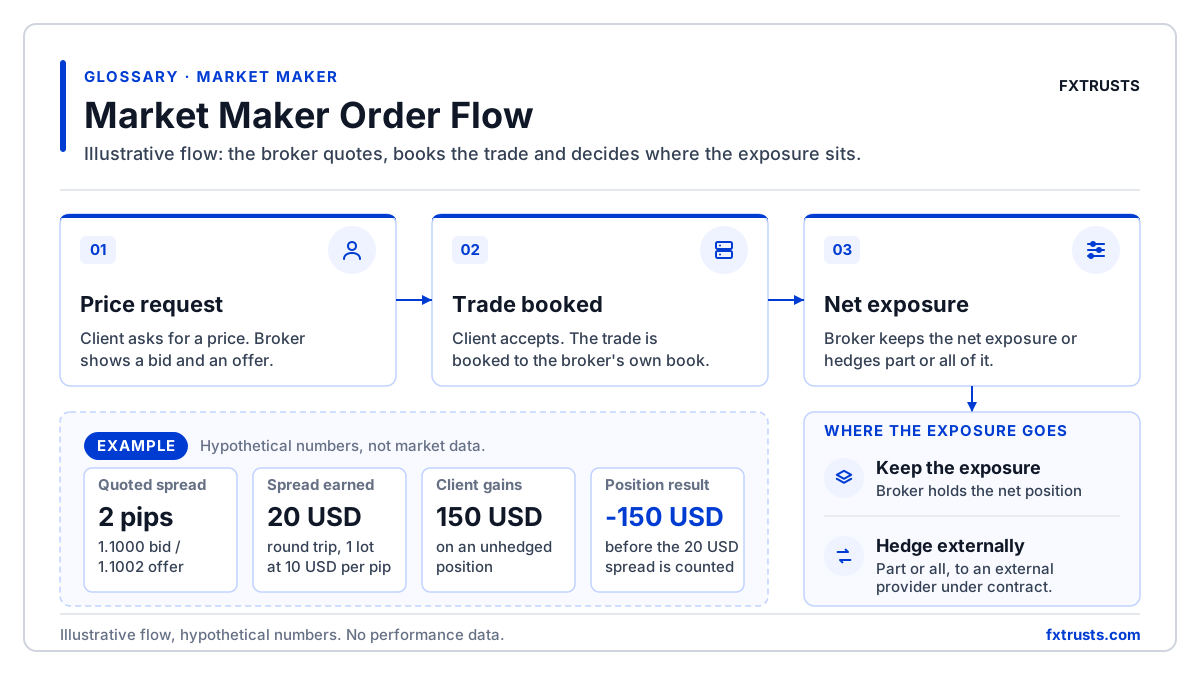
When a client buys, the firm sells to them; when the client sells, the firm buys. It earns the gap between its bid and its offer, which is the spread, and it also holds whatever exposure the trade creates until it closes that exposure, hedges it, or keeps it. The steps below describe a common flow, not a required one.
- The client requests a price, and the firm shows a bid and an offer.
- The client accepts, and the firm books the trade against its own inventory or account.
- The firm keeps the net exposure, hedges part or all of it with an external counterparty, or does a mix of both.
- The spread, any commission and the result of the open exposure decide the outcome for the firm.
The diagram below shows the same order flowing into the broker's own book, with a card that sets out the keep and hedge routes, so the two routes can be compared at a glance.

Keeping a position and passing it on are two different risk choices. Which one applies to a given client, instrument or order size is a policy decision that should be written down, not left to dealing-desk habit.
Market maker vs liquidity provider
The two terms overlap, and the same firm can be both. A market maker describes a trading role: quoting two-sided prices and taking risk on its own account. A liquidity provider describes a relationship: a firm that supplies prices or execution to a broker under a contract. The table sets out the practical differences a broker should check.
| Question | Market maker | Liquidity provider |
|---|---|---|
| Who is the counterparty to the client? | The broker, when it fills orders from its own book | Usually not the client in an agency flow; it deals with the broker |
| What does it provide? | Two-sided quotes and fills from its own capital | Prices, execution or both, under a written agreement |
| Where does the risk sit? | With the firm that holds the position | Depends on the agreement, including last look, credit and settlement terms |
| What should a broker verify? | Its model, client disclosures, conflicts policy and routing rules | Legal entity, quote terms, last look use, credit, rejects and reconciliation |
- Who is the counterparty to the client?Market maker: The broker, when it fills orders from its own bookLiquidity provider: Usually not the client in an agency flow; it deals with the broker
- What does it provide?Market maker: Two-sided quotes and fills from its own capitalLiquidity provider: Prices, execution or both, under a written agreement
- Where does the risk sit?Market maker: With the firm that holds the positionLiquidity provider: Depends on the agreement, including last look, credit and settlement terms
- What should a broker verify?Market maker: Its model, client disclosures, conflicts policy and routing rulesLiquidity provider: Legal entity, quote terms, last look use, credit, rejects and reconciliation
The practical test is simple: ask who takes the other side of the client's order and who holds the resulting position. The answer decides what the broker must disclose and how it documents execution.
The market maker model in forex brokerage
Many retail and prop forex businesses describe their dealing approach as A-book or B-book. In the A-book, client exposure is passed to an external liquidity provider. In the B-book, exposure stays with the broker. The A-book and B-book answers explain the labels in operational terms; they do not show legal capacity, venue or execution method on their own, so each route needs its own written rule. For the prop-firm angle, see A-book vs B-book routing for prop trading.
The client side and the broker side
The client sees a quote and a fill. The broker sees a position. In a B-book flow, a client's losing trade can be a gain for the broker's book, and a winning trade can be a loss, before hedging, fees and other costs are counted. That is the core conflict of interest, and it is why the market maker model is a disclosure and governance topic rather than a marketing feature.
Illustrative example
Hypothetical numbers only, not market data. Suppose EUR/USD is quoted at 1.1000 bid and 1.1002 offer, a 2-pip spread. On a 1-lot position of 100,000 units, each pip is worth 10 USD, so the spread on one round trip is 20 USD. If the client later gains 150 USD on that position and the broker has not hedged it, the book has lost 150 USD on that position before the 20 USD spread is counted.
Last look and quoted prices
Some market makers and liquidity providers use last look, a short check after a client trade request arrives. In its press release on last look, the Global FX Committee describes it as a practice in electronic trading that gives a market participant a final opportunity to accept or reject a trade request.
For a broker, last look changes the meaning of a quote. A price on the screen is not automatically an executable price. The broker should review whether last look applies, how long the window is, how the price check works, and what the client sees when a request is rejected. These are contract and disclosure questions, and the provider should answer them in writing.
A useful control is the reject and slippage record: how often orders are rejected, at which prices, and how fills compare with the quotes shown over a representative period.
What a broker should document
The model can be run in a documented, disclosed and governed way, and those controls are what a broker should be able to evidence. Whether a given setup meets a licence or conduct requirement is for the broker, its legal advisers and its regulator to decide. The list below describes what to evidence, not what a regulator will accept.
- The dealing model for each instrument and account group, with the rules for moving between A-book and B-book routes.
- A conflicts policy that covers the broker's gains and losses on client positions, and who is allowed to change routing.
- Hedging and routing logs with timestamps, so each client trade can be traced to its route.
- Execution and reject records, reconciled against provider statements where an external venue is used.
- Client disclosures that describe the model in plain language and match what the platform actually does.
Written routing rules matter because a stated model and the operating practice can drift apart over time. Reviewing both whenever the platform, a provider or an account group changes is a practical control.
Where FxTrusts fits in a market maker setup
FxTrusts is a technology provider. It is not a broker, bank or regulated financial institution, and it does not offer retail trading accounts. Its liquidity connectivity page covers bridge, gateway and FIX connectivity to a liquidity provider, routing controls for A-book, B-book or hybrid logic, and failure, recovery and reconciliation testing. Any liquidity access from FxTrusts is a separate contracted scope, named in a signed order form.
The counterparty and the routing model remain the broker's decisions, documented in its own agreements. To map a setup, start with the liquidity provider selection guide, then contact FxTrusts to scope the connectivity. Trading CFDs and forex carries risk of loss, and the model you choose changes who bears that loss.
Key takeaways
- A market maker quotes both a buy and a sell price and takes the other side of trades against its own capital.
- A liquidity provider supplies prices or execution under contract. One firm can play both roles, so check the agreement.
- The B-book model keeps client exposure on the broker's book, which is a direct conflict of interest to disclose and govern.
- Last look and quoted prices need written terms, because a quote is not always an executable fill.
- Document routing, hedging and rejects so each trade can be traced. Trading CFDs and forex carries risk of loss.
Frequently asked questions
What is the market maker model in forex?
The market maker model describes a broker that fills client orders from its own book, taking the other side of each trade and then keeping, hedging or passing on the resulting exposure. It is often contrasted with straight-through models, where orders go to an external provider. The model can be used alone or as part of a hybrid policy, and the rules for each route should be written down.
Are all forex brokers market makers?
No. Some forex brokers pass client orders to external providers, which is often described as an agency or straight-through approach. Others run a market maker model for some or all clients, and many use a hybrid policy. The model should be described in client documents, and the applicable rules are for the broker, its advisers and its regulator to confirm.
What is the difference between a market maker and a liquidity provider?
A market maker describes a role: quoting two-sided prices and taking risk on its own account. A liquidity provider describes a contract: it supplies prices or execution to a broker. One firm can be both. The practical question is who is the counterparty to the client trade and who holds the resulting position, and the agreements should answer it.
Does a market maker make money when clients lose?
It can, before hedging and costs, because a client's losing trade can be a gain for a B-book. The reverse also happens. A market maker earns the spread and can gain or lose on open positions, so results vary. Trading CFDs and forex carries a real risk of loss, and this conflict of interest is why disclosure and conflicts controls matter.
Is last look the same as a market maker model?
No. Last look is a check that a liquidity provider or market maker may apply after a client trade request arrives, before it accepts or rejects the trade at the quoted price. It is a feature of execution, not a business model. A broker can use last look in an agency flow, and a market maker can operate without it, depending on its terms.
Related FxTrusts resources
- Liquidity connectivity and routing (FxTrusts)
- A-Book, B-Book and Hybrid Routing answers
- Liquidity provider selection guide
- CFD glossary
- Liquidity bridge vs liquidity provider
Sources
- ESMA, MiFID II Article 4 definitions (point 7, market maker)
- Global FX Committee, press release on last look
Map your market maker or liquidity setup
Share your legal entity, platform, instruments, routing policy and provider status. We will set out the contracts, interfaces and tests that still need approval.
Contact FxTrusts