FIX API Complete Guide
Introduction
Forex brokers and prop firm operators frequently face a common operational headache: latency in trade execution that costs money and frustrates clients. When every millisecond impacts slippage and fill quality, relying solely on retail trading platforms often falls short for serious players. This is where FIX API steps in as the industry-standard solution for reliable, high-speed communication between trading systems and liquidity sources.
FIX API, short for Financial Information eXchange Application Programming Interface, is an electronic communications protocol designed specifically for the real-time exchange of financial trading data. Developed in the 1990s by a group of programmers and formalized through FIX Protocol Limited, it has become the backbone for institutional and professional trading worldwide.
Unlike general-purpose APIs, FIX uses a highly efficient, standardized tag-value messaging format that minimizes bandwidth and processing overhead. This makes it ideal for connecting brokers directly to banks, prime brokers, and liquidity providers without unnecessary intermediaries.
History and Evolution of the FIX Protocol
The FIX protocol emerged from the need for a common language in equity trading during the early days of electronic markets. What started as a volunteer effort evolved into a non-profit standard maintained by FIX Protocol Ltd. Today, versions like FIX 4.4 and FIX 5.0 SP2 dominate forex and multi-asset environments due to their robust support for complex order types and market data.
Brokers transitioning from legacy systems often adopt newer FIX versions to support algorithmic strategies, options, futures, and even crypto derivatives. This evolution reflects the growing demand for seamless connectivity in fragmented global markets.
How FIX API Works: Technical Breakdown
At its core, FIX API operates on a session-based model with two main layers: the session level (handling connections, heartbeats, and logons) and the application level (handling business messages like orders and executions).
Key Message Types Include:
- Logon — Establishes authenticated sessions.
- New Order Single — Submits market, limit, or stop orders.
- Execution Report — Provides real-time fill confirmations and status updates.
- Market Data Request — Pulls quotes and depth of book.
- Order Cancel/Replace — Modifies or cancels existing orders.
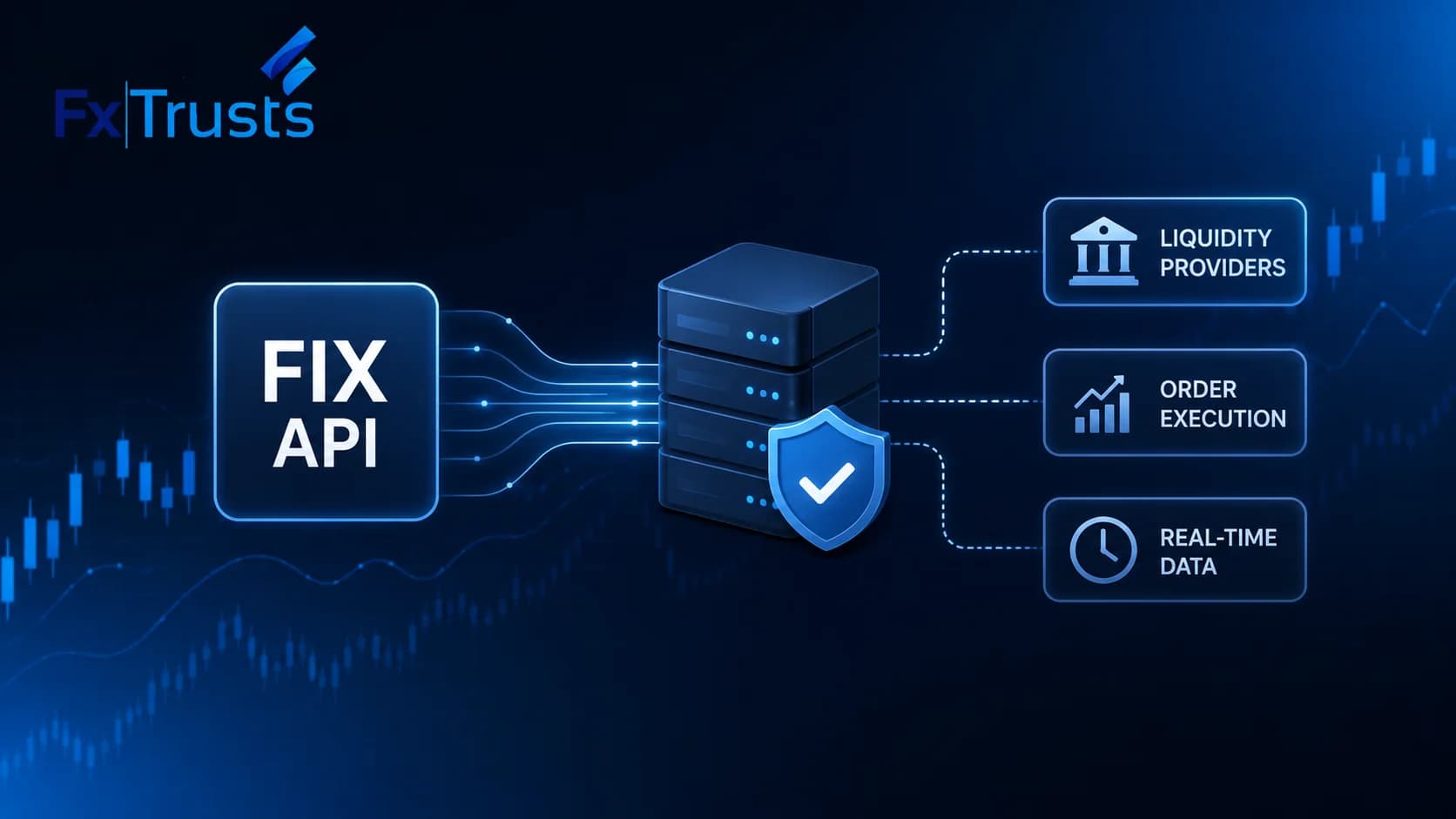
A typical workflow involves a trader’s system sending a FIX message to the broker’s server, which routes it via STP to the liquidity provider. Responses flow back instantly, enabling true low-latency execution. Many implementations use FIX engines (libraries like QuickFIX or commercial solutions) to handle parsing, validation, and reconnection logic automatically.
Key Benefits for Forex Brokers, Prop Firms, and Institutions
Ultra-Low Latency Execution: Direct connectivity bypasses retail platform layers, reducing delays that plague high-volume operations.
Cost Efficiency: Better pricing from tier-1 liquidity due to higher volumes and direct access, often translating to tighter spreads for clients or improved margins.
Customization and Scalability: Build custom trading interfaces, algorithmic engines, or risk tools without being locked into vendor platforms.
Multi-Asset Support: Handle forex, CFDs, equities, futures, and more through a single protocol.
Straight-Through Processing (STP): Minimize manual intervention, reduce errors, and improve operational efficiency in back offices.
For prop firms, FIX API enables precise risk allocation across multiple trader accounts while maintaining real-time visibility. Institutional users and hedge funds value the auditability and standardized reporting it provides.
FIX API vs MT4/MT5 API and REST APIs
| Aspect | FIX API | MT4/MT5 API | REST API |
|---|---|---|---|
| Latency | Excellent (sub-millisecond) | Good | Moderate |
| Standardization | High (industry protocol) | Platform-specific | Flexible but non-standard |
| Use Case | Professional & HFT | Retail & EA development | Web integrations, simple apps |
| Complexity | Higher learning curve | Easier for beginners | Moderate |
| Reliability | Very high for high volume | Reliable for most retail | Depends on implementation |
| Market Data | Full depth, snapshots | Limited | Variable |
FIX excels in high-stakes environments where reliability and speed are non-negotiable. MT4/MT5 APIs remain popular for retail-focused brokers due to their ecosystem of expert advisors and ease of use. REST APIs are often used for supplementary services like account management or reporting. Many modern setups combine them: FIX for core execution and REST for client portals
Implementation Steps for a New Brokerage or Prop Firm
- Assess Requirements — Determine expected volume, asset classes, and latency targets.
- Choose a FIX Engine — Evaluate open-source (QuickFIX) vs. commercial options with support.
- Establish Liquidity Connections — Negotiate with prime brokers or liquidity providers that offer FIX feeds.
- Develop or Integrate — Build middleware if needed to connect with your CRM, back office, and risk systems.
- Testing — Rigorous simulation, including failover and high-load scenarios.
- Go Live — Start with controlled volumes and monitor closely.
- Ongoing Monitoring — Use tools to track message throughput, rejection rates, and session health.
White label providers and turnkey solutions can accelerate this process significantly for startups.
Common Use Cases- Algorithmic and High-Frequency Trading: Automated strategies requiring rapid order placement and cancellation.
- Liquidity Aggregation: Routing orders across multiple providers for best execution.
- Prop Trading Firms: Allocating risk and monitoring trader performance in real time.
- Institutional Offerings: Providing DMA to hedge funds and family offices.
- White Label Enhancements: Adding professional-grade connectivity to existing platforms.
- Risk Management Systems: Feeding real-time position data into custom engines.
Challenges and Limitations
Setting up FIX API requires technical expertise and ongoing maintenance. Message formats are strict—small errors in tags can cause rejections. Session management (heartbeats, sequence resets) demands careful handling to avoid disconnections during volatile periods. Costs for premium engines, dedicated infrastructure, and compliance can add up for smaller operations. Not every liquidity provider offers identical FIX support, leading to integration variances.
Security and Risk Management Considerations
Use secure VPNs or dedicated lines for connections. Implement strong authentication, message encryption where supported, and comprehensive logging for audits. Integrate with risk systems to enforce pre-trade checks, position limits, and automatic hedging. Regular penetration testing and compliance with regulatory standards (e.g., MiFID II reporting) are essential.
Future Outlook
As markets fragment further with crypto and decentralized finance, FIX continues to evolve with extensions for new asset classes. Hybrid models combining FIX with modern event-driven architectures and cloud-native deployments are becoming common. AI-driven smart order routing and predictive risk tools will likely leverage FIX data streams more deeply.
Key Takeaways
- FIX API delivers unmatched speed and reliability for professional trading.
- It bridges retail brokers to institutional-grade infrastructure.
- Successful adoption requires careful planning, testing, and ongoing optimization.
- It complements rather than replaces platforms like MT5 for most businesses.
Conclusion
For brokerage founders and FinTech operators building scalable trading businesses, understanding and leveraging FIX API is no longer optional for staying competitive. It represents a mature, battle-tested technology that enables direct, efficient market participation. By focusing on solid implementation and integration with your broader technology stack, you can deliver better execution quality, attract serious clients, and future-proof your operations in an increasingly automated trading landscape.
Q1: What exactly is FIX API?
FIX API is the standard protocol for exchanging financial trading messages electronically. It allows systems to send orders, receive executions, and get market data in a highly efficient, standardized way.
Q2: Who typically uses FIX API in forex?
Professional traders, algorithmic funds, prop firms, hedge funds, and brokers seeking direct liquidity access use it. Retail traders rarely need it unless running advanced custom systems.
Q3: Is FIX API better than MT5 for brokers?
It depends on needs. FIX offers lower latency and greater flexibility for institutional connectivity, while MT5 excels in retail client acquisition and ease of use. Many brokers run both.
Q4: How long does FIX API integration take?
For experienced teams, basic connectivity can take weeks; full production integration with risk and CRM systems often spans 2–6 months including testing.
Q5: What are the main costs involved?
FIX engine licenses, dedicated servers/VPS, development time, liquidity provider fees, and ongoing maintenance. Costs vary widely based on scale.
Q6: Can small startups use FIX API?
Yes, especially via white label providers or managed solutions that handle much of the heavy lifting.
Q7: How secure is FIX API?
Very secure when properly implemented with encrypted connections and strict access controls, though it requires ongoing vigilance like any trading technology.
Q8: Does FIX API support crypto trading?
Emerging extensions and hybrid setups allow it, though support varies by provider. Traditional FIX focuses on forex, equities, and futures.
Q9: What is the difference between FIX 4.4 and 5.0?
FIX 5.0 offers more advanced features, better multi-asset support, and improvements in areas like post-trade processing.
Q10: How do I monitor FIX API performance?
Use engine dashboards, custom logging, latency tracking tools, and integration with monitoring systems to watch message rates, errors, and session stability.