Forex Broker CRM
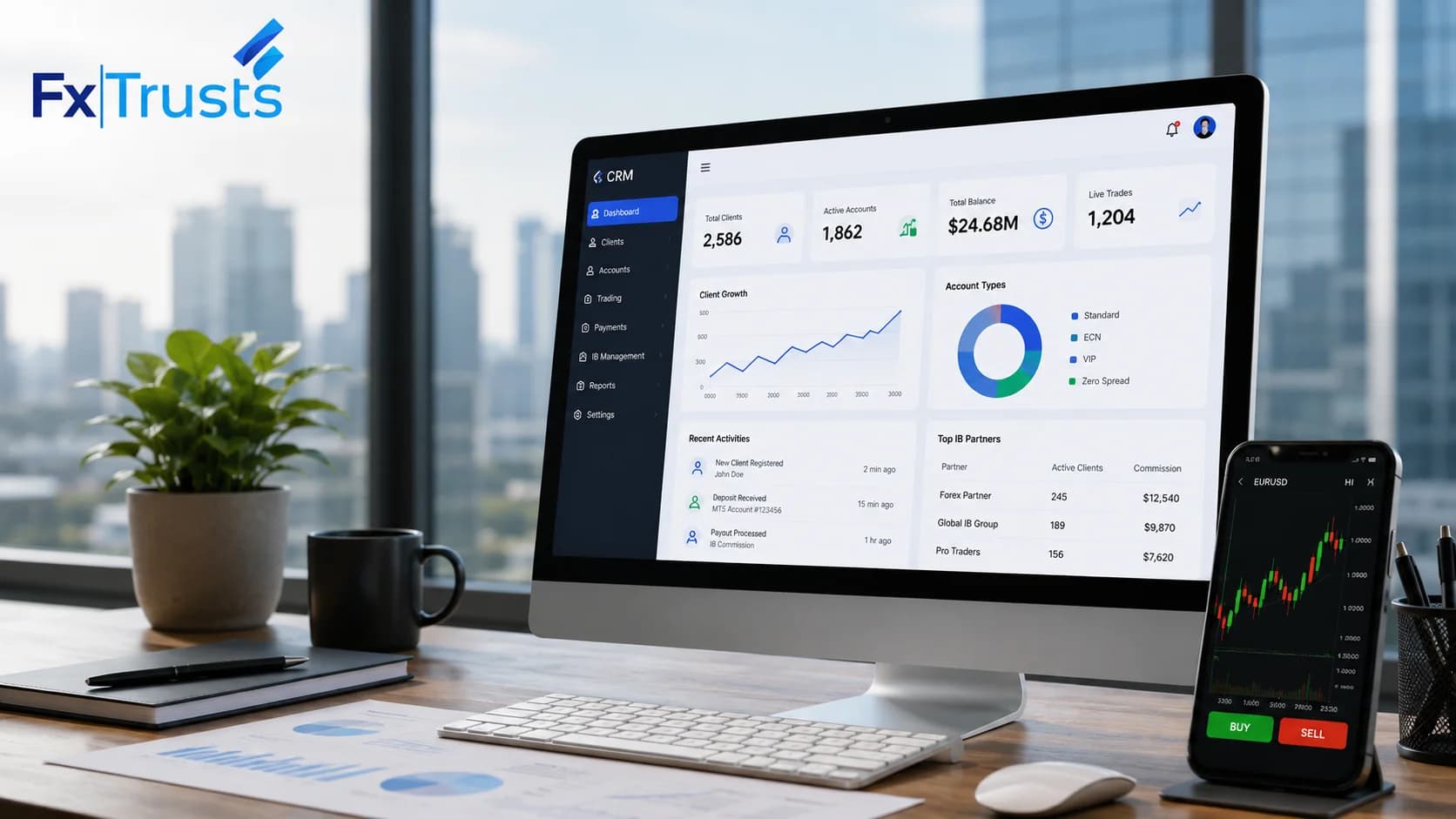
Running a forex brokerage today means juggling client onboarding, trading platform data, compliance checks, partner payouts, and daily operations—all while scaling without chaos. A well-chosen forex broker CRM solves these pain points by acting as a centralized hub that connects everything from leads to funded accounts and beyond.
Brokers who rely on spreadsheets or generic tools quickly hit limits in speed, accuracy, and regulatory demands. A purpose-built forex broker CRM streamlines the client lifecycle, automates repetitive tasks, and provides real-time visibility into business performance. This guide breaks down what it is, why it matters, key features, integration considerations, and practical selection advice.
What Is a Forex Broker CRM?
A forex broker CRM is specialized software designed for forex, CFD, and multi-asset brokerages. Unlike general-purpose tools like Salesforce, it deeply integrates trading activity, payment processing, regulatory workflows, and partner networks into one system.
It manages the full client journey: lead capture, verification, account funding, trading monitoring, support interactions, and retention efforts. For many operations, it also serves as the back office, handling internal reporting and automation.
Why Every Broker Needs a Specialized CRM
New and growing brokerages face intense pressure on client acquisition costs, retention, and compliance. Manual processes create bottlenecks, errors, and regulatory risks. A dedicated forex broker CRM addresses this by:
- Centralizing client and trading data for faster decisions.
- Automating compliance-heavy tasks like KYC.
- Streamlining IB partner programs that drive much of the volume.
- Providing actionable insights through dashboards.
Brokers report significant efficiency gains once implemented, particularly in lead conversion and operational scalability.
Core Features of a Modern Forex Broker CRM
Effective systems share several must-have capabilities:
Lead and Client Management Capture leads from websites, manage pipelines, segment clients by behavior or value, and track interactions across channels.
Automated Onboarding and KYC/AMLDocument upload, identity verification, risk scoring, and jurisdictional rule enforcement reduce manual review time dramatically.
Payment ProcessingIntegration with multiple PSPs for deposits, withdrawals, and multi-currency support with automated reconciliation.
Real-Time Dashboards and Reporting Customizable views of key metrics: deposits, trading volume, churn, IB performance, and compliance status.
Automation Workflows Task reminders, email/SMS campaigns, account status changes, and approval processes.
Security and Audit Trails Role-based access, data encryption, full activity logging for regulators.
Integration with Trading Platforms (MT4/MT5 and RTX5)
Seamless connectivity is non-negotiable. A strong forex broker CRM syncs bi-directionally with MetaTrader 4, MetaTrader 5 and RTX5 servers. This means account creation, balance updates, trade history, open positions, and margin details flow automatically.
Many systems also support cTrader and other platforms. Look for native API connections rather than fragile middleware to avoid sync delays or data inconsistencies during high volatility.
KYC, Compliance, and Risk Management
Regulatory demands vary by jurisdiction but share common needs: thorough client verification, ongoing monitoring, and detailed reporting. Top CRMs automate much of this with AI-assisted checks, configurable rules, and exportable audit reports.
They also tie into broader risk tools—monitoring unusual trading patterns or helping enforce leverage limits.
IB and Partner Management Capabilities
Introducing Brokers (IBs) are a primary growth channel. A capable forex broker CRM supports:
- Multi-level hierarchies with custom commission rules.
- Automated tracking of referred clients and payouts.
- Self-service partner portals for IBs.
- Performance analytics to nurture top partners.
This reduces disputes and speeds up revenue sharing.
Trader's Room and Client Experience
The client-facing portal (Trader's Room) lets users manage accounts, view statements, deposit/withdraw, and access support. A polished, branded version improves retention and reduces support tickets.
Back-Office Operations and Reporting
Beyond clients, the system handles internal workflows: user management, financial reconciliation, marketing attribution, and executive reporting. Scalable solutions grow with volume without performance hits.
How to Choose the Right Forex Broker CRM
Evaluate based on your specific needs:
| Criteria | What to Assess | Why It Matters |
|---|---|---|
| Integrations | MT4/MT5,RTX5 payments, KYC providers | Avoids data silos |
| Customization | Workflows, branding, commission logic | Fits unique business model |
| Scalability | User volume, multi-brand support | Supports long-term growth |
| Compliance Tools | Automation depth, reporting | Reduces regulatory risk |
| Support & Onboarding | Implementation help, training | Faster time-to-value |
| Pricing | Licensing, per-user, transaction fees | Aligns with budget and volume |
Request demos with your real workflows and speak to current users.
Implementation Best Practices and Common Pitfalls
Best Practices:
- Map current processes before migration.
- Start with core modules and expand.
- Train teams thoroughly.
- Test integrations in a staging environment.
- Monitor post-launch metrics closely.
Common Mistakes:
- Choosing based solely on price.
- Underestimating data migration complexity.
- Neglecting change management for staff.
- Ignoring mobile accessibility for clients and IBs.
Key Takeaways
- A forex broker CRM is essential infrastructure, not just a nice-to-have.
- Prioritize deep trading platform integration and compliance automation.
- Focus on IB tools and client experience for growth.
- Successful selection balances features, fit, and support.
Conclusion Selecting and implementing the right forex broker CRM can transform operations from fragmented to efficient. By addressing client management, compliance, partnerships, and insights in one platform, brokerages position themselves for sustainable scaling in a competitive market. Take time to evaluate options against your specific requirements— the payoff in efficiency and control is substantial.
Frequently Asked QuestionsQ1: What is the difference between a generic CRM and a forex broker CRM?
A generic CRM focuses on sales pipelines and basic contact management. A forex broker CRM deeply integrates with trading platforms like MT4/MT5, handles KYC/AML automation, IB commission calculations, payment reconciliations, and regulatory reporting specific to financial services. This specialization prevents data silos and supports brokerage-specific workflows.
Q2: How does MT5 integration work in a forex broker CRM?
Integration typically uses APIs or direct server connections for real-time synchronization of account details, balances, trades, and positions. This allows the CRM to reflect live trading data, automate account management, and provide unified views for sales, support, and compliance teams.
Q3: What are the most important features for IB management?
Look for multi-tier hierarchies, customizable commission plans, automated payout processing, self-service partner portals, real-time performance tracking, and attribution of referred clients. These reduce manual work and disputes while helping nurture productive partners.
Q4: How much does a forex broker CRM typically cost?
Pricing varies widely—some start at a few hundred dollars per month for basic setups, while enterprise solutions with heavy customization can be higher. Factors include user count, transaction volume, and add-ons. Many providers offer tiered plans or white-label options. Always request detailed quotes.
Q5: Is KYC automation worth it in a forex CRM?
Yes. Automation speeds up onboarding, reduces errors, improves client experience, and strengthens compliance. Modern systems integrate with verification providers and apply jurisdiction-specific rules, freeing staff for higher-value tasks.
Q6: Can a forex broker CRM help with client retention?
Absolutely. Through segmentation, personalized communications, activity monitoring, and proactive support triggers, it helps identify at-risk clients and deliver timely engagement that boosts loyalty and lifetime value.
Q7: What should I consider during CRM migration?
Plan data mapping carefully, especially historical commissions and client attribution. Test thoroughly, run parallel systems initially if possible, and ensure minimal downtime for trading and payments. Professional migration support is highly recommended.
Q8: How does a forex CRM support multi-asset or prop firms?
Many systems handle forex alongside CFDs, stocks, or crypto. For prop firms, they often include challenge tracking, payout rules, and risk dashboards tailored to evaluation and funded trader models.
Q9: What security features should a good forex broker CRM have?
Expect encryption, role-based access control, audit logs, regular security audits, GDPR compliance tools, and secure API connections. ISO certifications or similar are strong indicators.
Q10: How long does implementation usually take?
Basic setups can go live in weeks; complex customizations with full data migration may take 1-3 months. Dedicated support from the provider significantly accelerates the process.