
MT5 White Label Vs Full License
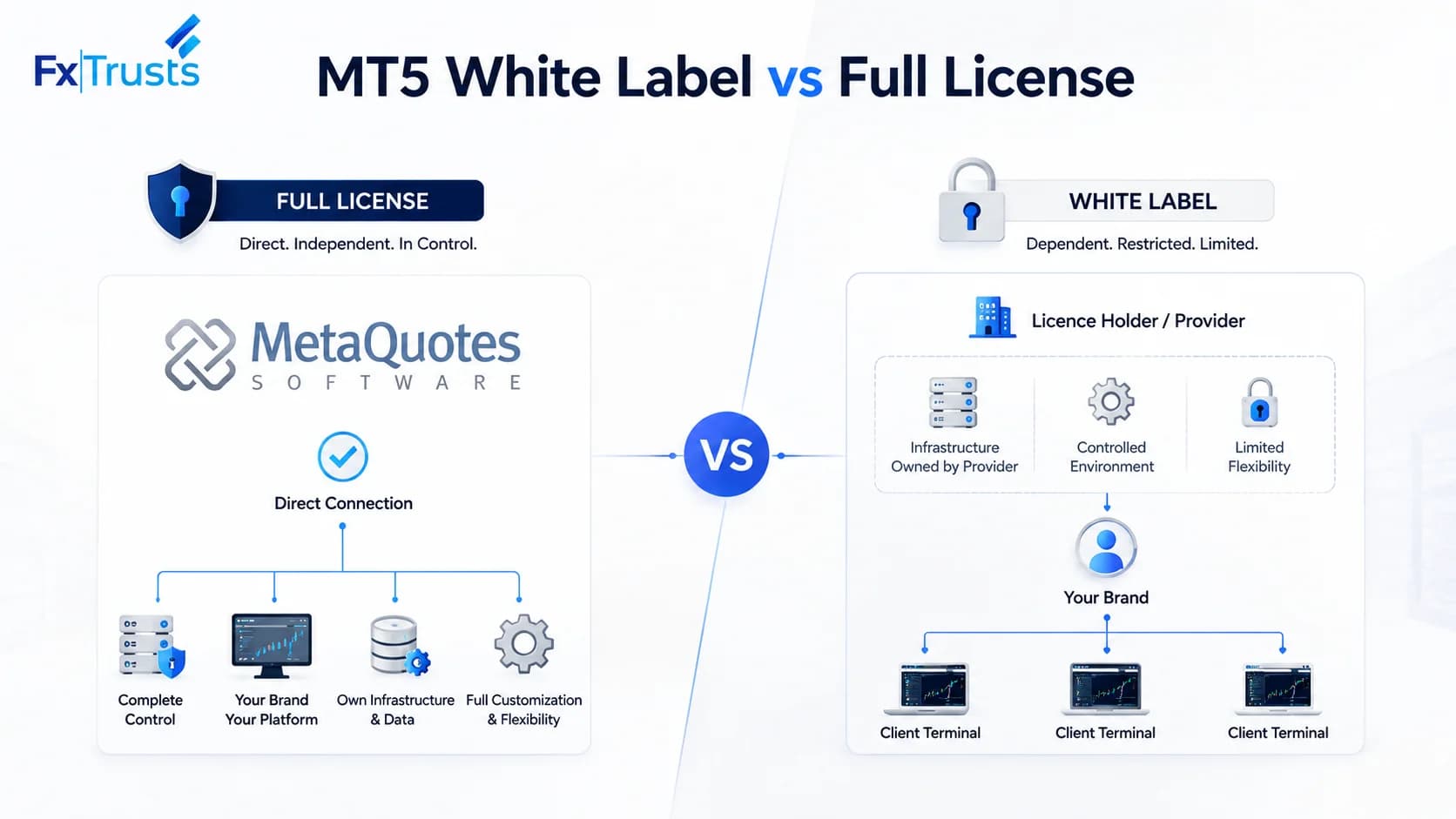
MT5 White Label Vs Full License: License holder and contractual rights
The choice between an MT5 white label and a full MetaQuotes licence is fundamentally a choice about who holds the contractual relationship with MetaQuotes and how much operational and legal control the broker retains.
Both models can support a professional brokerage. They allocate rights, responsibilities, and risk differently. Understanding those differences prevents later disappointment.
Full MetaQuotes Licence – What It Actually Gives You
A full MT5 licence is issued by MetaQuotes Software to an approved entity. The licence holder:
Runs its own trade server (or servers)
Controls the complete Manager and Administrator environment
Decides group structure, symbols, plugins, and API access without intermediary approval
Bears direct responsibility for compliance with MetaQuotes’ technical and commercial terms
Can, in principle, host the platform anywhere that meets performance and security expectations
Obtaining the licence involves an application process, technical review, and a significant upfront fee. Ongoing costs include server infrastructure, market data, and any required support contracts. The timeline from application to production is measured in months, not weeks.
Once licensed, the broker is the direct counterparty to MetaQuotes. Changes in MetaQuotes policy, fee structure, or technical requirements land first on the licence holder.
White Label – What the Broker Actually Receives
In a white-label model the provider (or its upstream master-licence holder) is the MetaQuotes licence holder. The broker receives:
A branded client-facing environment (desktop, web, mobile)
Operational access to a Manager terminal with defined permissions
The ability to configure trading conditions within the boundaries the provider allows
Hosting and basic platform maintenance as a service
The broker does not hold the MetaQuotes licence. Continuity of the platform depends on the provider remaining in good standing with MetaQuotes and on the commercial agreement between broker and provider.
This arrangement dramatically shortens time-to-market and removes the need to negotiate directly with MetaQuotes or to operate trade-server hardware. It also creates a permanent contractual dependency.
Shared versus Dedicated Deployment
White-label environments themselves come in two broad flavours:
Shared / multi-tenant
Multiple brokers share the same underlying trade server or logical instance. Isolation is achieved through group and permission design. Cost is lower; customisation and performance isolation are more limited.
Dedicated
The broker receives its own trade-server instance (or a strongly isolated logical partition). Configuration freedom is higher, performance isolation is better, and the environment more closely resembles a full-licence setup—except that the MetaQuotes licence still sits with the provider.
Most serious B2B white-label offerings for growing brokers lean toward dedicated or strongly segregated instances. Pure shared models are more common at the very low end of the market.
Contractual Rights That Differ
Key rights that change between the two models:
Area | Full Licence | White Label |
|---|---|---|
MetaQuotes relationship | Direct | Via provider |
Ability to change server plugins / core configuration | Full | Limited by provider policy |
Data ownership and export | Clear (your servers) | Defined by contract |
Exit / migration assistance | Self-managed | Contractual obligation of provider |
Hosting location decisions | Your choice | Provider’s infrastructure |
Direct MetaQuotes support | Available | Usually not |
Time to production | Months (application + build) | Weeks (typical white-label timeline) |
Upfront capital requirement | High (licence + infrastructure) | Lower (service model) |
Configuration freedom | Maximum | Bounded by provider’s platform rules |
Operational staffing need | Higher (server & platform ops) | Lower (provider handles core platform) |
Suitability for rapid launch | Lower | Higher |
Suitability for heavy proprietary tech | Higher | Limited |
The white-label contract therefore becomes the critical document. It must address licence continuity, data portability, configuration rights, support obligations, and termination assistance with more precision than a full-licence arrangement requires.
Exit and Migration Realities
Leaving a full-licence environment is primarily a technical project: you already control the servers and the data. Leaving a white-label environment is a contractual and technical project. You need:
Explicit rights to export all account, trade, and configuration data in usable formats
A defined process and timeline for open-position migration or close-out
Clarity on whether the provider will assist with parallel running or cut-over
Financial terms for the exit work
Brokers that treat exit clauses as an afterthought often discover that the practical cost and risk of leaving are higher than expected. Negotiate them while you still have leverage—at the beginning of the relationship.
When a Full Licence Makes Sense
A full licence tends to be the better long-term fit when:
The broker has (or plans) significant proprietary technology that must sit close to the trade server
Regulatory or internal policy requires direct control of the trading platform
Expected volume and complexity justify the higher fixed cost and longer lead time
The organisation has the technical staff to operate and secure a trade server
When White Label Is the Rational Choice
White label is usually preferable when:
Speed to market is a priority
The broker wants to concentrate capital and attention on client acquisition, risk, and product rather than platform operations
Expected scale does not yet justify full-licence economics
The provider offers a clean integration path to the rest of the required stack (CRM, liquidity, payments, KYC)
Many brokers begin on white label and later migrate to a full licence once volume and organisational maturity support the change. That path is viable only if the original white-label contract anticipated it.
Decision Framework
Ask four practical questions:
Who do I want as my direct counterparty for the trading platform—MetaQuotes or a technology provider?
How important is absolute configuration and plugin freedom versus speed and lower operational overhead?
What does my three-year volume and complexity trajectory look like, and which model fits the cost curve better?
How cleanly can I exit if the relationship or the model no longer serves the business?
Answer those honestly and the white-label versus full-licence choice becomes clearer.
Decision Factor | Favours Full Licence | Favours White Label |
|---|---|---|
Need for direct MetaQuotes relationship | Yes | No |
Heavy proprietary server-side technology | Yes | No |
Priority on speed to market | No | Yes |
Limited internal platform operations staff | No | Yes |
Early-stage capital constraints | No | Yes |
Clear contractual exit & data rights already negotiated | Either | Essential |
Expected rapid scaling of client accounts | Either (plan capacity) | Either (watch tier costs) |
Both models are legitimate. The wrong choice is the one made without a clear understanding of who holds the licence and what contractual rights that allocation creates.
Sources:
Frequently Asked Questions
Who is the MetaQuotes licence holder in a white-label arrangement?
The technology provider or its upstream master-licence holder. The broker operates under a commercial service agreement, not under its own MetaQuotes licence.
Can I run my own plugins and server-side code on a white-label MT5?
Only to the extent the provider permits. Full control of server plugins and core configuration is a characteristic of a full licence, not a typical white-label package.
Is a dedicated white-label server the same as a full licence?
No. You may receive strong isolation and greater configuration freedom, but the MetaQuotes licence and the ultimate server relationship remain with the provider.
How difficult is it to move from white label to a full licence later?
Technically feasible but operationally non-trivial. Success depends on data export rights, open-position handling, and the quality of migration assistance defined in the original contract.
Does a full licence remove the need for a liquidity bridge and CRM?
No. A full licence gives you the trading platform. Liquidity connectivity, client portal, CRM, payments, and KYC remain separate decisions (and separate vendors or modules).