A book vs B book forex broker | FxTrusts
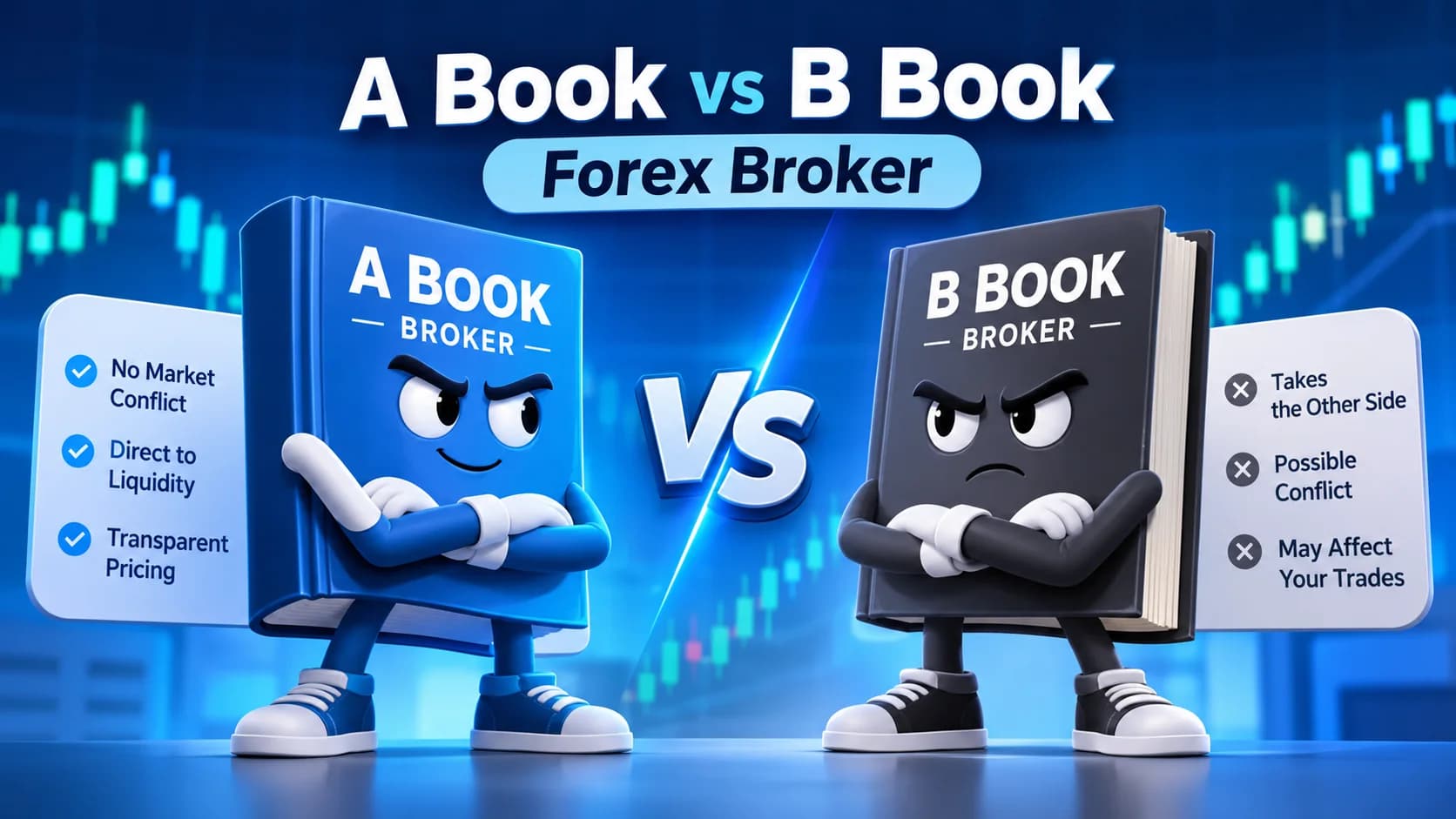
An a book vs b book forex broker uses different approaches to handling client orders: one routes flow externally, while the other internalises exposure. The choice affects revenue, risk management, and infrastructure. Neither label answers every operational question, so launch teams should assess routing controls, liquidity arrangements, and governance together.
FxTrusts is a technology provider, not a financial advisor, law firm, or regulator; this content is informational only and is not financial, legal, or licensing advice. Trading leveraged products such as forex and CFDs carries a high level of risk. Regulatory requirements vary by jurisdiction; consult qualified legal and compliance professionals before launching a brokerage or prop firm.
A book vs B book forex broker: definition and decision context?
An a book vs b book forex broker comparison describes where client orders and related exposure are handled. A-Book routing sends flow to external liquidity providers, while B-Book execution keeps the position on the broker’s own books. The choice therefore connects revenue design with risk control and operational requirements, rather than being only a platform setting. The risk-control framework describes the decision as an operating system for profitability and exposure management.
The distinction should be treated as a starting framework, not a complete assessment. The available research connects routing design with execution quality, internal exposure, and the infrastructure a brokerage needs, but it does not provide a universal cost model or a jurisdiction-specific licensing conclusion. A launch team can use the labels to structure discovery: identify who takes exposure, how orders are routed, how exceptions are governed, and which records the dealing function must retain. Platform overview can provide contextual information about the technology layer, but it does not replace legal or compliance review.
That framing matters because the model or combination of models affects how the brokerage relates to client activity. The execution-model explanation links the choice to revenue, risk management, and client relationships. It is more useful to ask how a proposed design behaves under different flow conditions than to rely on the label alone.
Who should consider a book vs b book forex broker?
Broker founders, prop-firm operators, and fintech teams should consider the distinction when designing order handling, exposure controls, and the supporting stack. It is particularly relevant before selecting liquidity, bridge, dealing, and reporting components. The startup-broker comparison presents the decision as a question of execution model, risk, profitability, and technology requirements.
A team considering A-Book routing should examine its external liquidity relationship and the quality of the execution connection. The supplied evidence describes A-Book flow as externally routed and says the broker’s remaining risk is connected to operational reliability and LP connectivity. The LP connectivity discussion supports that distinction. It does not, however, establish a particular provider, service level, pricing arrangement, or licensing outcome.
A team considering B-Book execution should focus on internal exposure governance. The research states that the broker’s system accepts and internalises the risk. The internalisation explanation makes this a risk-control question as much as a revenue question. For prop-firm operators, the same analytical discipline applies: define the order path, identify who bears exposure, and ensure the technology and oversight model match that decision. Prop firm software is a relevant stack area, not evidence that any particular operating model is suitable.
Benefits and practical limitations
A-Book and B-Book each create a different balance between external execution dependence and internal exposure. A-Book routing can reduce internal market risk because client positions are hedged with an LP, but it depends on external execution quality and the spread or commission structure. The A-Book risk description supports the first point, while the profitability analysis identifies the latter dependencies.
B-Book execution gives the broker responsibility for internalised exposure. That may simplify the order path in one respect, but it places greater importance on exposure limits, monitoring, escalation, and dealing governance. The bundle supports the core fact that the broker’s system accepts the risk; it does not support a general claim that internalisation is inherently more profitable or safer. The B-Book model description should therefore be read as a mechanism explanation, not a performance promise.
Operational trade-offs
Potential advantages
- A-Book routing can reduce direct market exposure when positions are hedged externally.
- A-Book revenue can be framed around spread markup or commission rather than client outcomes, according to the cited model description.
- A hybrid design can give a team more than one routing path to govern.
Limitations and risks
- External routing creates dependence on LP connectivity and execution quality.
- B-Book internalisation leaves the broker responsible for managing exposure.
- The research does not establish universal economics, regulatory approval, or a suitable model for every launch.
The practical safeguard is evidence-led governance. Document the intended order path, define how exposure is observed, and test whether reporting reflects what the policy says happens. Do not present a model choice as a guaranteed commercial outcome.
A book vs B book and the reader decision
The reader decision should not be reduced to a moral choice between a supposedly honest model and a supposedly predatory one. One source notes that the debate is often framed in those terms, while also describing strengths in both approaches and different effects on spreads, slippage, and order handling. The balanced execution comparison supports that caution.
For a launch team, the more useful question is whether the proposed operating controls are visible and coherent. Ask how the broker routes orders, when it may internalise exposure, how exceptions are approved, and how the resulting activity is recorded. Those questions move the discussion from labels to process. They also help technology teams translate a commercial model into workflows for dealing, liquidity, reporting, and client support.
This article does not establish whether one model is legally available in a particular jurisdiction. It also does not provide a regulator’s view, a pricing schedule, or a forecast. The approved research is topic-specific but independent rather than official regulatory material. That limitation should remain visible in internal planning, especially where the operating design could affect client disclosures or licensing obligations. Licensing & compliance is a separate workstream requiring qualified professionals.
A book vs B book brokers and the reader decision
A broker stack should be designed around the chosen order model, not assembled as disconnected software purchases. The research describes the A-Book/B-Book choice as relevant to risk management, technology infrastructure, and operational requirements, and it identifies hybrid routing as an approach discussed in the supplied materials. The infrastructure context supports that connection.
In practical terms, the discovery process should connect the execution policy to the platform, liquidity path, client records, dealing controls, and management reporting. A team using A-Book routing needs to understand the external handoff and its operational dependencies. A team using B-Book execution needs controls that make internal exposure visible. A team considering a hybrid arrangement needs clear segmentation and governance, without assuming that the term alone describes a complete control environment.
Technology selection should follow those requirements. A platform may support workflows, but the available sources do not verify a particular vendor feature set, integration, price, uptime figure, or compliance result. Forex white label may be relevant to a launch discussion, while Payment infrastructure addresses another part of the stack. Neither link changes the need for independent technical, legal, and compliance assessment.
Conclusion
The a book vs b book forex broker decision is best treated as an operating-model decision. A-Book routing generally points toward external liquidity and reduced direct market exposure, while B-Book execution places internalised exposure at the centre of governance. The supplied evidence does not justify declaring one route universally suitable.
For a responsible launch process, document the order path, identify operational dependencies, define exposure oversight, and test the reporting needed by management and compliance teams. Keep commercial assumptions separate from verified evidence. This approach leaves room for a hybrid design where appropriate, without treating hybrid routing as an automatic answer.
Before implementation, seek qualified advice for jurisdiction-specific licensing, client disclosures, and risk controls. Then evaluate the technology stack against the documented policy rather than allowing product labels to drive the architecture.
Sources
- A-Book vs B-Book: Forex Broker Profitability and Risk Controls — aryafx.com, 2026-06-05T00:06:01.000Z
- A-Book vs B-Book Forex Broker: Execution Models Explained — liquidityfinder.com, 2026-06-05T08:18:14.000Z
- A-Book vs B-Book Forex Broker: Which Is Right? — forexplatforms.pro, 2026-07-14T04:23:30.000Z
- A-Book vs B-Book Forex Broker Explained — rannforex.com, 2026-09-17T00:00:00.000Z
- A-Book vs B-Book Brokers: Execution Models — tradingmasterpiece.com, 2026-10-24T15:24:13.000Z