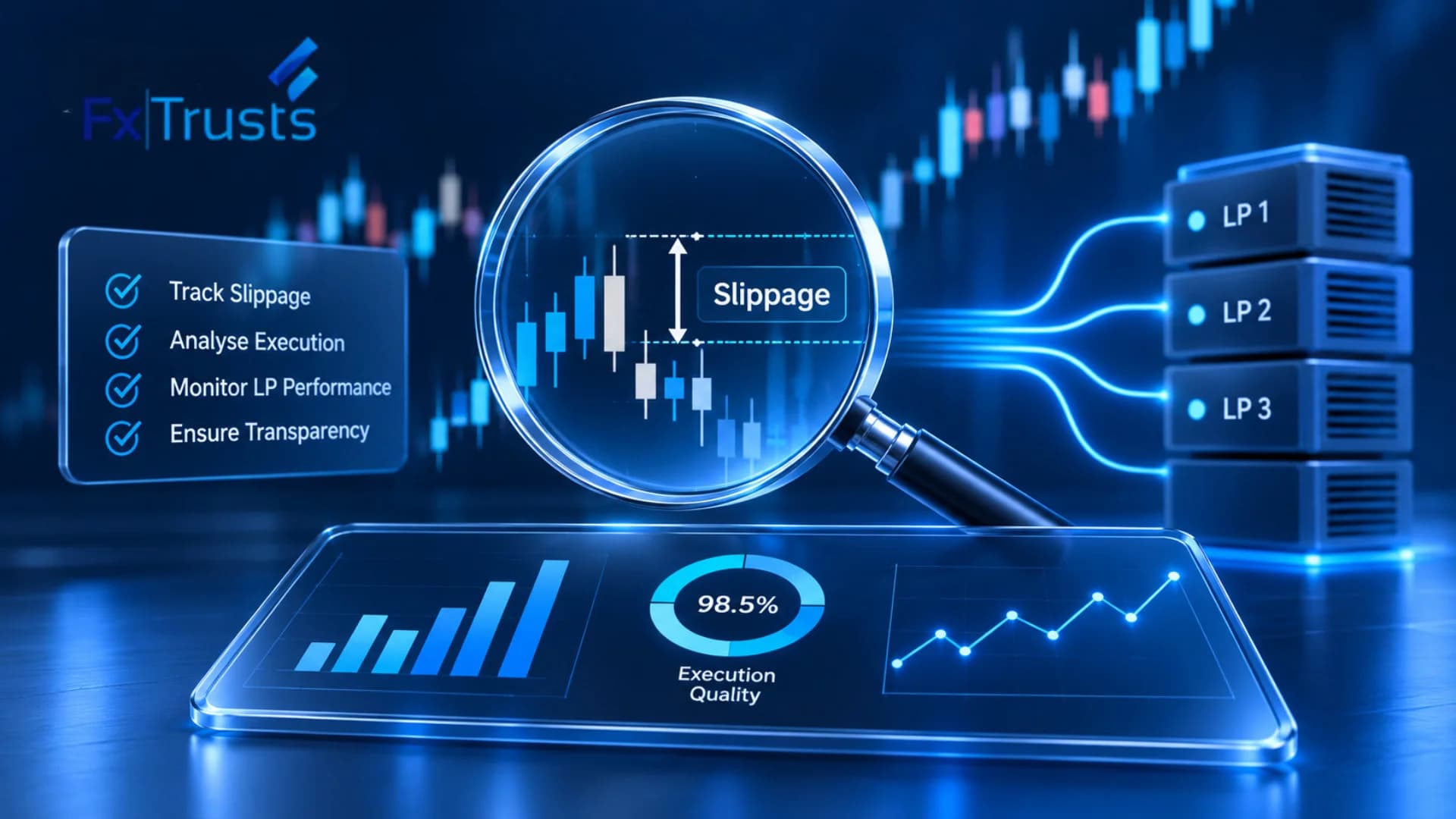
Forex Broker Risk Management Software Guide | FxTrusts
Real-time forex broker risk management software tracks open positions for brokers retaining client flow on their own book while trades remain open. Tools vary widely. Some platforms alert on exposure, while others support toxic-flow checks or automated hedging for B-book operations, though vendor capabilities differ.
Forex broker risk management software: definition and decision context
Real-time forex broker risk management software gives dealing teams live visibility into market exposure when a brokerage keeps client trades on its own book rather than routing every order away while positions remain open. Waiting for end-of-day or next-morning summaries leaves an operational blind spot during fast market moves. Across the brokerage technology market, vendors label these platforms as risk management systems, dealing desk tools, exposure managers, or integrated risk panels.
Although the terminology overlaps, the underlying software architectures serve distinct operational jobs. Some systems focus purely on watching positions and triggering alerts, whereas others intervene directly on trading accounts, execute automated hedges, or operate as features inside a liquidity bridge. Understanding which layer a vendor actually supplies helps founders avoid assuming that every exposure dashboard includes automated execution controls.
For teams planning a brokerage or prop-firm launch, risk tooling cannot be evaluated in isolation from the broader infrastructure stack. Execution routing interacts daily with white-label trading servers, liquidity connectivity, client onboarding, and back-office reporting workflows. Reviewing how a risk module connects to your Platform overview early in the build prevents costly re-integration once client flow scales.
Who should consider forex broker risk management software?
Retail brokerages that retain part or all of their order flow internally are the primary candidates for dedicated risk software across modern retail brokers. Market volatility and shifting client trading behavior place continuous pressure on dealing operations, making manual spreadsheet monitoring impractical once order volume grows. Teams moving from pure pass-through routing toward internal risk retention require structured real-time monitoring and analytics.
Newer broker founders launching on turnkey or white-label infrastructure face this decision sooner than many expect. Even when an operator starts with conservative routing rules, sudden concentrations in single currency pairs or correlated instruments can accumulate unintended net exposure. Evaluating risk visibility alongside Forex white label architecture ensures that dealing staff can inspect positions cleanly from day one.
Multi-asset operations and prop-firm technology teams also benefit when risk tooling supports multiple platforms and asset classes within modular analytics platforms. Rather than stitching together separate exports for each trading server, consolidated reporting helps risk officers review account behavior consistently across books. Operators should confirm early whether a vendor's module fits their exact server setup and internal compliance workflow.
Benefits and practical limitations
Adopting dedicated risk tooling helps brokerages balance higher margin targets from B-booked flow against concentrated market exposure by mitigating operational risk. Modern platforms consolidate live profit and loss, net exposure tracking, Value at Risk calculations, and trade analytics into one workspace. Dealing teams also use toxic-flow alerts and decay analysis to spot trading patterns that create asymmetric losses across multiple asset classes.
At the same time, risk software introduces implementation work, ongoing vendor fees, and configuration responsibility. Onboarding typically involves integration assistance, structured testing, staff training, and continuous support, while commercial pricing ranges from flat fees to volume models. Software alerts also depend on human governance or carefully tested rule sets; poorly calibrated thresholds can disrupt client execution without eliminating underlying market risk.
Operational strengths vs. practical constraints
Strengths
- Provides real-time P&L and exposure visibility to monitor internal books.
- Adds Value at Risk, decay analysis, and automated toxic flow alerts.
- Supports multi-asset and multi-platform oversight through modular deployments.
- Includes vendor-led integration testing, staff training, and ongoing technical support.
Limitations
- B-book retention still exposes capital when market moves exceed risk mitigation thresholds.
- Pricing models vary between flat and volume tiers across competing software vendors.
- Implementation requires dedicated integration and testing cycles before production rollout.
- Analytics alone do not resolve compliance, KYC/AML, or liquidity routing design gaps.
For prop-firm operators running simulated or funded evaluation programs, distinguishing between behavioral analytics and live capital hedging is equally critical. Reviewing how risk analytics integrate with Prop firm software helps teams separate account-rule enforcement from brokerage-book exposure management.
B-book broker risk software and the reader decision
Choosing B-book risk software comes down to deciding whether your dealing desk wants passive visibility, automated account intervention, or bridge-level hedging across established vendor products. A November 2026 comparison of broker risk tools examined Centroid C24, Gold-i Visual Edge, Takeprofit Tech risk modules, Brokeree dealing desk and leverage tools, Spotware cBridge, FXCubic Bridge, and relioops without ranking them based on vendor documentation.
Based on published product descriptions reviewed in that comparison, Centroid C24 and Gold-i Visual Edge operate with an analytics-first design centered on exposure, Value at Risk, client profiling, and alerts for dealing desk oversight. By contrast, Takeprofit Tech, Brokeree, and relioops also state automatic account actions such as closing positions, adjusting leverage, or restricting trading. Automatic hedging is explicitly stated in visible copy for Takeprofit Tech's bridge risk panel and relioops, whereas for the other compared systems it is either unstated or embedded within bridge workflows.
Most of these platforms address toxic flow in some capacity, such as scalper detection documented for Gold-i and Brokeree within vendor feature sets. Operators reading third-party comparisons should note source boundaries: the November 2026 review relied on each vendor's own website copy, and its publisher disclosed selling a competing real-time tool while also deploying Centroid C24, Gold-i Visual Edge, and Tools for Brokers' Broker Business Intelligence (BBI) for clients as an industry integrator.
Comparison of risk management architectures documented in November 2026 vendor copy| Tool / Vendor | Primary Operational Role | Toxic Flow / Profiling | Auto-Hedging / Account Actions |
|---|---|---|---|
| Centroid C24 | Analytics-first exposure, VaR, and alerts per vendor product copy | Client profiling documented | Auto-hedging not stated outside bridge workflow |
| Gold-i Visual Edge | Analytics-first exposure, VaR, and alerts per vendor product copy | Client profiling and scalper detection | Auto-hedging not stated outside bridge workflow |
| Takeprofit Tech | Bridge risk panel and risk modules with automated controls | Covered within risk module | Automatic account actions and automatic hedging stated |
| Brokeree | Dealing desk and leverage tools for account interventions | Scalper detection documented | Automatic account actions stated (leverage, restrictions, closing) |
| Spotware cBridge / FXCubic Bridge | Bridge-integrated risk features inside liquidity routing | Covered in bridge workflow | Risk features tied to liquidity bridge workflow |
| relioops | Real-time risk monitoring and intervention with vendor disclosure | Toxic flow monitoring covered | Automatic account actions and automatic hedging stated |
When a brokerage also offers managed accounts or social replication, net exposure across master and follower accounts adds another layer of concentration. Coordinating dealing-desk exposure rules alongside PAMM/MAM copy trading infrastructure ensures aggregated volume does not bypass book limits.
What risks should readers verify before choosing forex broker risk management software?
Before signing a software contract, brokerage teams should verify how each tool behaves during live execution and whether published marketing terms match actual deployment scope before committing to vendors. Because product names and feature bundles change frequently, relying on summary comparisons without live technical demos creates operational risk. Teams should also confirm whether a product functions purely as an exposure manager or holds direct authority to modify accounts and route hedges inside live trading environments.
- Confirm watch versus action scope: Verify whether the platform stops at exposure alerts or automatically closes trades, modifies leverage, and restricts accounts under dealing desk rules.
- Audit bridge dependencies: Determine if automatic hedging requires a specific liquidity bridge or operates independently across your existing execution venues.
- Validate vendor specifications directly: Re-check every capability stated on vendor websites through sandbox testing, as product specifications evolve over time across releases.
- Align with compliance and treasury controls: Ensure automated account restrictions or leverage adjustments match client agreements, AML escalation rules, and regional regulatory obligations.
Automated account interventions carry legal and operational consequences if applied inconsistently across client tiers. Reviewing your escalation policies with Licensing & compliance specialists and matching settlement flows with Payment infrastructure teams keeps risk controls aligned with regulatory expectations in your operating jurisdiction.
Conclusion
Selecting risk management tooling is a foundational operational choice for any brokerage or prop firm that retains internal trading exposure. Rather than chasing feature checklists, founders should start by mapping how much client flow sits on the internal book, how fast dealing staff can respond to alerts, and whether automated account actions or bridge-level hedging fit their governance model.
Analytics-first tools suit teams that want clear exposure visibility while retaining manual oversight over hedging and client tiering. Platforms combining monitoring with automated account rules or bridge hedging appeal to desks seeking faster mechanical responses, provided every rule is thoroughly tested in a sandbox before production launch.
Finally, treat risk software as one connected piece of your broader stack alongside CRM, KYC/AML controls, liquidity relationships, and payment rails. When you are ready to map how white-label trading, execution routing, and operational oversight fit together for your launch, explore how our team supports brokerage infrastructure at Get started.
Sources
- Trading Risk Management Software for Brokers: 2026 Comparison — relioops.com (retrieved November 25, 2026).
- Forex Broker Risk Management Tools & Hedging Strategies | LiquidityFinder — liquidityfinder.com (retrieved November 25, 2026).