
MT5 White Label Contract: Responsibilities & Exit Terms
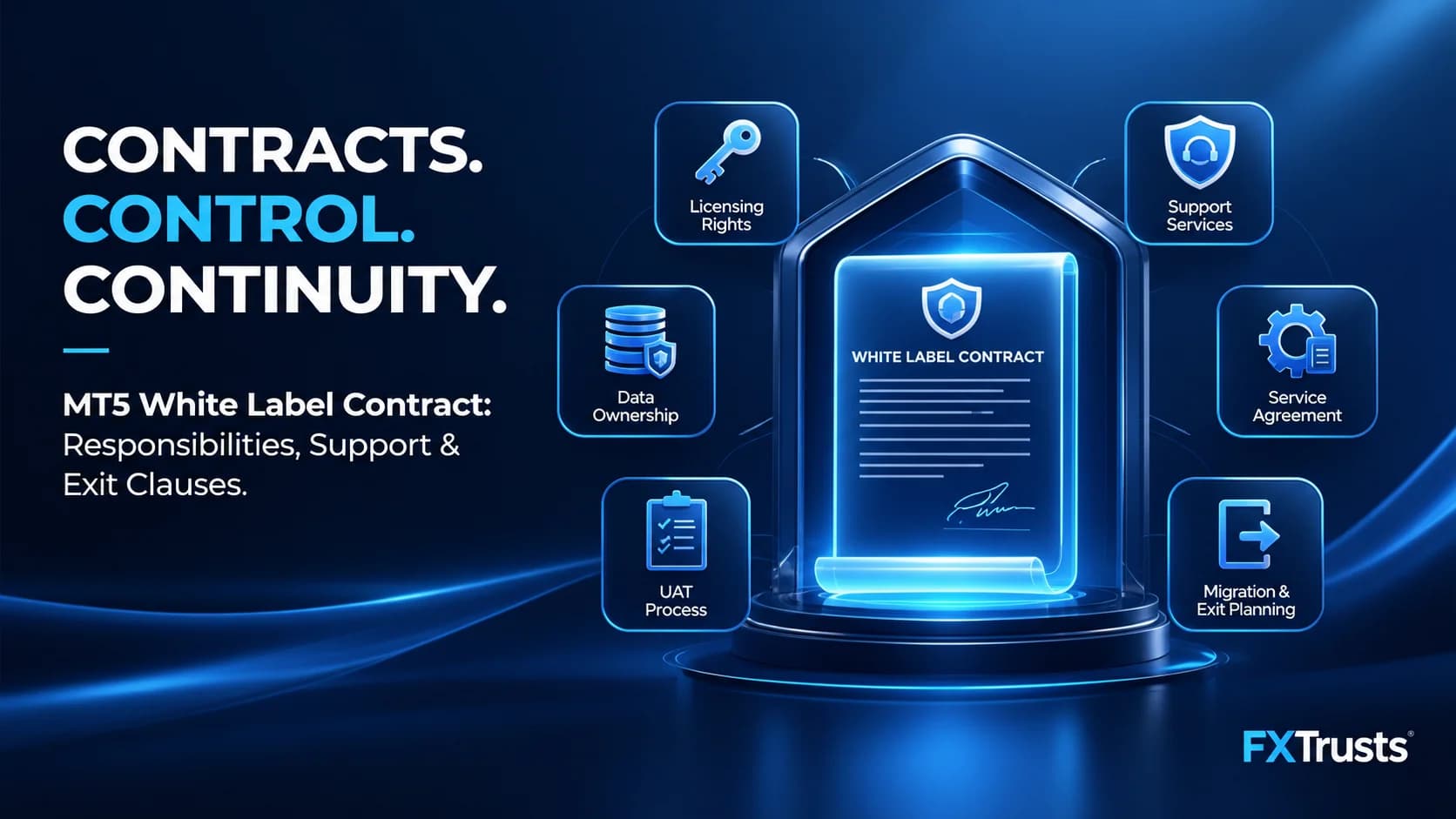
An MT5 White Label Contract defines more than platform access or branding rights. It establishes the responsibilities, service scope, technical support, licensing arrangements, data access, integrations and exit conditions between a broker and its technology provider.
A brokerage may require MT5 hosting, CRM, liquidity connectivity, payment integrations, KYC workflows and client-facing tools. If these services are supplied under one agreement, the contract should clearly explain what is included, who manages each component and what happens if the scope changes.
Before signing an agreement, brokers should review the commercial terms alongside the technical deployment plan, user acceptance testing and long-term operational requirements.
1. Define the Exact Scope of the MT5 White Label Agreement
The first step is to document what the provider will deliver.
A typical agreement may cover:
Branded MT5 trading platform
MT5 server infrastructure
Manager and dealer access
Web and mobile trading
CRM and Trader’s Room
Liquidity bridge and aggregation
KYC and AML integrations
Payment infrastructure
Reporting and monitoring
Technical support
Maintenance and updates
The exact scope depends on the provider and commercial package. FxTrusts currently describes a broader forex white-label technology stack involving MT5, CRM, KYC/AML, payments, liquidity and technical onboarding.
Brokers should review the Forex White Label solution page and compare the listed capabilities against the actual proposal. Marketing descriptions should not replace a written implementation scope.
2. Licensing and Platform Access
The contract should explain the nature of the platform access being provided.
Important questions include:
Who holds the relevant platform licence?
What branding rights are granted?
Is the broker permitted to use desktop, web and mobile access?
Are Manager and Dealer terminals included?
Are additional environments charged separately?
What happens to platform access after termination?
Which third-party licences are excluded?
A white-label arrangement does not automatically mean that the broker owns every underlying technology component. Licensing rights, infrastructure access and branding permissions should be documented separately.
The contract should also identify whether CRM, liquidity bridges, payment tools or other integrations are provided directly by the main technology provider or through third parties.
3. Infrastructure and Hosting Responsibilities
MT5 hosting is a critical part of brokerage operations. The agreement should define who is responsible for the server environment and related infrastructure.
Review the following areas:
Hosting location and environment type
Server provisioning
Maintenance and security patching
Backup frequency and retention
Monitoring and incident response
Disaster recovery arrangements
Planned maintenance windows
Additional server or environment charges
Infrastructure scaling requirements
The Technical Infrastructure solution should be evaluated alongside the MT5 deployment because hosting, reporting, mobile access and other technical services may have separate dependencies.
Avoid relying on broad phrases such as “fully managed” without asking what the provider actually manages and what remains the broker’s responsibility.
4. Support SLA and Incident Management
Technical support terms should be written clearly rather than discussed only during sales calls.
A support section should explain:
Support availability
Contact channels
Severity classifications
Initial response targets
Escalation procedures
Planned maintenance notifications
Incident communication
Service restoration responsibilities
Third-party dependency handling
A response target is not the same as a guaranteed resolution time. The agreement should distinguish between acknowledgement, investigation, workaround and final resolution.
The provider’s Technical support scope should be reviewed against the actual SLA and escalation process.
5. CRM, Trader’s Room and Payment Responsibilities
A modern brokerage usually operates more than a trading terminal. Client onboarding, account creation, deposits, withdrawals and reporting may depend on several connected systems.
The agreement should define responsibility for:
CRM and Trader’s Room
Client registration
KYC workflow
Trading-account creation
MT4/MT5 synchronisation
IB and affiliate management
Client reporting
User permissions
The Trader’s Room and CRM solution should be assessed together with the trading platform to confirm whether the required client and back-office workflows are included.
Payment Infrastructure
Payment responsibilities should cover:
Deposit integration
Withdrawal requests
Payment confirmation
Account balance updates
Reconciliation
Failed transactions
Payment-provider dependencies
The Payment Infrastructure scope should clearly state whether payment providers, transaction fees, compliance checks and reconciliation tools are included or handled separately.
6. Liquidity and Integration Scope
Liquidity connectivity is another area that requires written clarification.
The contract should identify:
Liquidity-provider responsibilities
Bridge configuration
FIX connectivity
Symbol mapping
Routing configuration
A-Book, B-Book or hybrid workflows
Price-feed dependencies
Execution reporting
Failover procedures
A provider may configure the bridge, but the broker may still need to manage commercial relationships with liquidity providers and approve dealing policies.
The Forex White Label solution can be reviewed for the broader liquidity and platform integration scope, but the final agreement should specify which connectivity services are actually included in the selected package.
7. Data Ownership and Access
Data ownership should be discussed before implementation rather than during an exit or migration.
The contract should address access to:
Client records
Trading account information
Trading history
CRM records
Payment and reconciliation data
Reports
Configuration records
Audit logs
Integration credentials
The broker should confirm which data can be exported, in what format and within what timeframe.
Access rights should also be reviewed for employees, administrators, APIs and third-party integrations. Sensitive credentials should not be shared without appropriate controls, and access should be revoked when staff or vendors no longer require it.
8. User Acceptance Testing and Go-Live Approval
The contract should define how the broker confirms that the deployment is ready for production.
A practical UAT process may include:
Platform Testing
Client login
Desktop, web and mobile access
Account groups
Trading instruments
Leverage and trading conditions
Manager and Dealer permissions
Execution Testing
Market and pending orders
Stop orders
Order modifications
Rejections
Routing
Spread and commission settings
Execution reports
Operational Testing
Client registration
KYC verification
Account creation
Deposits and withdrawals
CRM synchronisation
Reporting
Backup and recovery
The agreement should identify who approves UAT, how defects are recorded and whether unresolved issues prevent production launch.
The MT5 White Label Setup process should be aligned with these acceptance requirements so configuration changes are tested before the cut-over.
9. Change Requests and Additional Charges
Brokerage technology requirements can change during implementation.
The agreement should explain how change requests are handled, including:
New trading instruments
Additional account groups
New liquidity providers
CRM customisation
Payment integrations
Additional server environments
Branding changes
API requirements
New reporting functions
Each change should have a defined scope, estimated impact, approval process and commercial treatment.
Brokers should avoid assuming that every future modification is included in the original package. The contract should distinguish between standard maintenance, configuration changes and separately chargeable development work.
10. Termination, Migration and Exit Planning
Exit terms are often overlooked when selecting a technology provider.
The agreement should clarify:
Notice period
Termination conditions
Outstanding payment obligations
Data-export process
Data retention period
Access during transition
Third-party licence termination
CRM and payment disconnection
Migration support
Decommissioning responsibilities
Applicable termination charges
There is no universal exit process for every white-label arrangement. The actual terms depend on the provider, contract and third-party dependencies.
A structured migration plan should identify the systems that need to be transferred or disconnected, including trading records, client information, CRM integrations, payment connections and liquidity infrastructure.
11. How to Review an MT5 White Label Provider Contract
Before signing, brokers should review the agreement across six key areas:
Commercial scope: What is included and excluded?
Licensing: What platform and branding rights are provided?
Infrastructure: Who manages hosting, monitoring and recovery?
Support: What are the escalation and response procedures?
Acceptance: What tests must pass before go-live?
Exit: How will data, access and integrations be handled after termination?
The Technical Support service scope should be checked against the actual SLA, while the fxtrusts platform and CRM pages should be reviewed to ensure the advertised features match the commercial proposal.
Common Contract Mistakes
Brokers should avoid the following mistakes:
Signing without a detailed scope of work
Assuming every feature is included
Ignoring third-party licensing
Failing to define data-export rights
Accepting unclear support responsibilities
Skipping UAT acceptance criteria
Not documenting change-request costs
Ignoring payment and liquidity dependencies
Leaving migration planning until termination
Treating marketing claims as contractual guarantees
A written responsibility matrix can reduce confusion between the broker, technology provider, liquidity partners and payment vendors.
Conclusion
An MT5 White Label Contract should define the complete commercial and technical relationship between a broker and its technology provider.
The agreement should cover platform access, infrastructure, CRM, liquidity, payments, support, data ownership, UAT, change requests and exit planning. Clear documentation helps the broker understand its operational responsibilities and reduces uncertainty during implementation and future migration.
Brokers evaluating an MT5 White Label should request a scoped demonstration and a written implementation responsibility matrix before finalising the agreement.
Frequently Asked Questions
What should an MT5 White Label Contract include?
An MT5 White Label Contract should cover platform access, branding rights, infrastructure, CRM, liquidity, payments, technical support, UAT, pricing, data access, maintenance and termination terms. The agreement should distinguish between included services, third-party dependencies and separately chargeable changes.
Who owns the data in an MT5 White Label arrangement?
Data ownership and access rights depend on the commercial agreement and applicable obligations. Brokers should confirm access to client records, trading history, CRM data, reports and configuration information, along with export formats, retention periods and access procedures.
Should UAT be included in the contract?
Yes. The contract should define the testing scope, acceptance criteria, responsible parties, defect-handling process and go-live approval. Testing should cover platform access, trading workflows, CRM, payments, liquidity connectivity, reporting and operational permissions.
What happens when an MT5 White Label agreement ends?
The outcome depends on the termination and exit clauses. These should explain notice periods, data export, retention, migration assistance, third-party integrations, access removal and decommissioning. Brokers should confirm these terms before signing.
How can brokers compare MT5 White Label providers?
Brokers can compare providers by reviewing licensing, infrastructure, integrations, support, UAT, data access and exit terms. A detailed scope of work and implementation responsibility matrix can make differences between providers easier to evaluate.