
MT5 White Label Contract: Scope, License & Service Terms
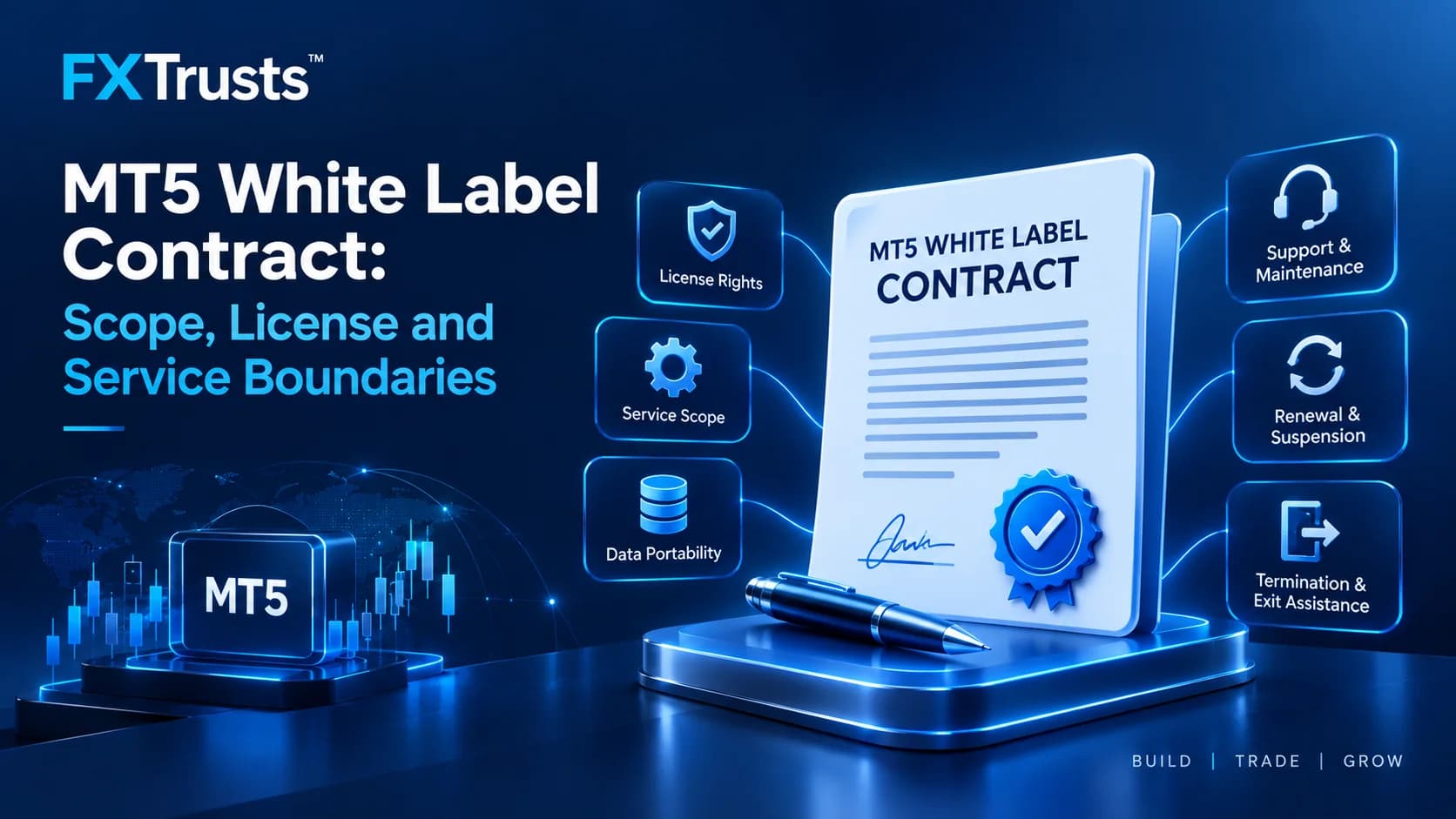
An MT5 White Label Contract defines the scope of a brokerage technology arrangement, including platform access, licensing rights, service responsibilities, support obligations and exit conditions. Before signing, brokers should understand which services are included, who controls each technology component and how data and operations will be handled if the agreement is suspended, renewed or terminated.
A white-label arrangement may include an MT5 environment, branding, hosting, CRM, liquidity connectivity and client-facing workflows. However, these components should not be assumed to be included simply because they appear in a provider's general marketing materials.
The contract should establish a clear relationship between the agreed technology scope, commercial terms and implementation responsibility matrix.
1. Define the Scope of the White Label Service Agreement
A white-label service agreement should clearly identify the products, services and environments being supplied.
The scope may include:
MT5 platform access and branding
Server hosting and maintenance
Manager and Dealer terminal configuration
Web and mobile trading access
CRM and Trader’s Room
Liquidity bridge and integrations
Payment and KYC workflows
Reporting and technical support
Testing and production deployment
FxTrusts currently describes an integrated brokerage technology offering covering MT5, CRM, KYC/AML, payments, liquidity and technical onboarding through its Forex White Label solution.
However, the actual contract should state which modules are included in the selected package, which are supplied by third parties and which require additional commercial approval.
Questions to clarify
Which services are included in the initial scope?
Which features require separate integrations?
Are development and customisation included?
Who is responsible for configuration and testing?
What is the process for approving scope changes?
A detailed scope of work can prevent disagreements when implementation requirements expand.
2. MT5 License Rights and Branding Permissions
The contract should explain the rights granted to the broker under the MT5 white-label arrangement.
Important areas include:
Platform access rights
Branding and logo permissions
Domain and application branding
Desktop, web and mobile access
Manager and Dealer access
Server and environment permissions
Third-party licensing dependencies
Restrictions on sublicensing or transferring access
A branded platform does not automatically mean that the broker owns the underlying trading technology or all related licences. The agreement should distinguish between platform access, branding rights, operational control and intellectual property ownership.
Brokers should also clarify whether the selected package includes only MT5 or other terminal options. Where RTX5 is being considered, the current RTX5 White Label documentation states that the signed order form determines the relevant tier, applications, hosting, support, integrations and pricing.
This distinction is important because a platform's product ownership, documentation and implementation responsibility may involve different organisations.
3. Service Boundaries and Responsibility Allocation
The contract should define responsibility across the complete technology stack.
Area | Questions to clarify |
|---|---|
Platform | Who manages access, configuration and updates? |
Hosting | Who handles infrastructure, backups and monitoring? |
CRM | Who manages client workflows and account synchronisation? |
Liquidity | Who handles bridge configuration and LP connectivity? |
Payments | Who manages integrations, reconciliation and failures? |
Support | Which team investigates technical incidents? |
Compliance | Which activities remain the broker’s responsibility? |
The broker should not assume that one provider is responsible for every connected service. A CRM provider, liquidity partner, payment processor and platform supplier may each have separate obligations.
The Trader’s Room and CRM page can help brokers review the operational workflow, but the signed agreement should define the actual services, dependencies and responsibilities.
4. Renewal and Service Suspension Clauses
Renewal and suspension provisions should be reviewed before the agreement is signed.
The contract should explain:
Initial contract duration
Renewal process
Renewal notice period
Changes to commercial terms
Non-payment consequences
Service suspension rights
Suspension notice requirements
Emergency suspension procedures
Restoration conditions
Access to data during suspension
Service suspension may affect trading operations, client access, CRM workflows or reporting. Therefore, the agreement should distinguish between a temporary suspension, a technical incident and a formal termination.
Brokers should ask whether a payment dispute or breach involving one module can suspend the entire service stack. The contract should also explain how the parties will communicate during a suspension and what steps are required for service restoration.
5. Data Portability and Access Rights
Data portability is a core part of a sustainable brokerage technology agreement.
The contract should address access to:
Client registration information
KYC documentation
Trading account data
Trading history
CRM records
Payment and withdrawal records
Reports and audit logs
Configuration data
API and integration records
The agreement should specify the available export formats, processing timelines, access permissions and applicable costs.
Brokers should also confirm whether they can retrieve their data during a service suspension or after termination. Data access should not be left undefined until the relationship ends.
A practical data-portability clause may address:
Data categories covered by the export.
Export format and delivery method.
Verification of the exported information.
Retention and deletion timelines.
Responsibility for migration-related assistance.
The purpose is to make the exit process predictable without assuming that every provider offers the same export functionality.
6. Liability Allocation and Third-Party Dependencies
A white-label arrangement can involve several external systems. The contract should explain how liability is allocated when a service depends on another vendor.
Review the responsibilities related to:
Platform availability
Hosting infrastructure
Liquidity provider connectivity
Payment processor interruptions
Third-party API failures
Data security incidents
Incorrect configuration
Unauthorised access
Regulatory or operational obligations
The agreement should avoid vague language that assigns all operational risk to one party without identifying the actual cause or responsible service provider.
Brokers should seek professional legal advice on liability limitations, indemnities, governing law and regulatory obligations applicable to their jurisdiction. These terms depend on the contract and operating model and should not be treated as universal legal requirements.
7. Support, Maintenance and Change Requests
Support obligations should be documented separately from general product descriptions.
The agreement should explain:
Support hours and communication channels
Incident severity levels
Response and escalation procedures
Maintenance notifications
Software updates
Configuration changes
Security patching
Third-party incident handling
Additional development charges
The Technical Infrastructure scope should be reviewed alongside the support agreement when hosting, mobile applications, report servers or data services are included.
A change-request process is equally important. Adding a new liquidity provider, payment integration, trading instrument or CRM workflow may require additional configuration, testing and approval.
Every significant change should have a documented scope, responsible party, timeline and commercial treatment.
8. UAT and Production Acceptance
User acceptance testing should be linked to the contract rather than handled informally.
The acceptance process may cover:
Login and account creation
Account groups and trading conditions
Symbol configuration
Order execution workflows
Liquidity bridge connectivity
CRM synchronisation
KYC and onboarding
Deposits and withdrawals
Reporting and permissions
Backup and recovery procedures
The agreement should define who approves UAT, how defects are recorded and whether unresolved issues prevent production deployment.
A successful demonstration does not necessarily confirm that every contracted integration is ready for production. Brokers should request evidence of the relevant workflow and verify each claimed feature against current vendor documentation.
9. Termination Assistance and Exit Terms
Termination assistance should be defined before the agreement begins.
The contract should clarify:
Termination notice requirements
Termination for breach
Outstanding payment obligations
Data export and transfer
Access during the transition period
Migration assistance
Third-party service disconnection
Data retention and deletion
Decommissioning responsibilities
Additional exit-related charges
Termination assistance may involve coordination between the broker, technology provider, liquidity partners, CRM supplier and payment vendors. The agreement should identify which party is responsible for each step.
A broker should also confirm whether assistance is limited to data export or includes technical migration, documentation, configuration support and transition meetings.
10. Brand and Technology Ownership Boundaries
Clear ownership disclosure is important when multiple brands or technology products are involved.
For this project’s editorial framework:
FxTrusts — integrated broker and prop technology procurement and implementation.
ORRNN — trading-engine product depth.
RTX5 — terminal product documentation and related product scope.
Tradecopier.org — standalone copier user workflows.
YoPips — trader evaluation products.
These relationships should not be presented as interchangeable ownership of every technology component. Cross-links should be used only where the destination is relevant, verified and useful to the reader.
For example, an RTX5 discussion should clarify the product and contractual boundaries rather than imply that every connected CRM, liquidity or payment service belongs to the terminal product itself.
11. Contract Review Checklist
Before signing an MT5 White Label Contract, brokers should confirm:
- Full service scope and exclusions
- MT5 license and branding rights
- Hosting and infrastructure responsibilities
- CRM, liquidity and payment dependencies
- Support and escalation terms
- Renewal and suspension clauses
- Data access and portability
- UAT and production acceptance criteria
- Liability and third-party responsibility
- Termination and migration assistance
This checklist should be reviewed with the provider’s commercial proposal and technical implementation documentation.
Conclusion
An MT5 White Label Contract should establish clear boundaries between platform access, licensing rights, infrastructure, integrations, support and exit responsibilities.
Brokers should review renewal and suspension clauses, confirm data portability, understand liability allocation and define termination assistance before signing. Each integration and feature should be verified through current documentation and, where possible, a demonstrated workflow.
Brokers evaluating an MT5 White Label should request a scoped demonstration and a written implementation responsibility matrix before finalising the agreement.
Resources:
Frequently Asked Questions
What is an MT5 White Label Contract?
An MT5 White Label Contract is an agreement defining the platform access, branding permissions, technology services, support obligations and commercial responsibilities between a broker and its technology provider. It should also explain data access, service suspension, renewal and termination procedures.
What are MT5 license rights?
MT5 license rights describe the platform access and permissions granted under the agreement. They may include branding, application access, server usage and operational permissions. The contract should clarify which rights are granted, restricted or dependent on third-party licensing.
Why are service suspension clauses important?
Service suspension clauses explain when a provider may temporarily restrict services, how notice is provided and what conditions apply to restoration. Brokers should understand whether a suspension affects one module or the complete operational technology stack.
What does data portability mean in a white-label agreement?
Data portability means the ability to access and transfer relevant business data from the provider’s systems. The contract should define the data categories, export format, delivery process, retention period and any migration assistance or additional charges.
What is termination assistance?
Termination assistance refers to the support provided when a technology agreement ends. It may include data export, documentation, migration coordination, access transition and service disconnection. The exact obligations should be stated in the contract.