
What Is a MetaTrader Server in a Broker Setup?
A MetaTrader server is the back-end software that runs a MetaTrader platform for a broker. A MetaTrader 5 server runs trade and history servers that process client orders and account data. Manager interfaces let staff administer accounts, the gateway integrates other trading systems, and the report API extends trade-server reports. Confirm in writing who licenses and runs it.
FxTrusts supplies brokerage technology, so this guide includes our commercial perspective. It is general information, not legal, tax or investment advice. Leveraged trading in CFDs and FX carries a high risk of losing money quickly.
On this page
What a MetaTrader server does
In a broker setup, the MetaTrader server is where the platform's core back-end work runs. Client terminals on desktop, web and mobile connect to it to send orders, receive prices and view their accounts. Broker staff connect through a manager interface to set trade conditions. MetaQuotes lists margin requirements, swaps, spreads and commissions among the conditions a broker can set.
Think of the server as the engine rather than the storefront. Your brand, sign-up flow and payment screens sit on top of it, and account onboarding often lives in a separate CRM. The server answers the questions that decide what a client can trade and what an account holds at a given moment.
Components of a MetaTrader 5 server
MetaQuotes describes MetaTrader 5 as a distributed back end, in which different functions run on different servers and capacity can be added where load grows. Its broker page names several component groups. The diagram below shows how they connect to client terminals and to other trading systems.

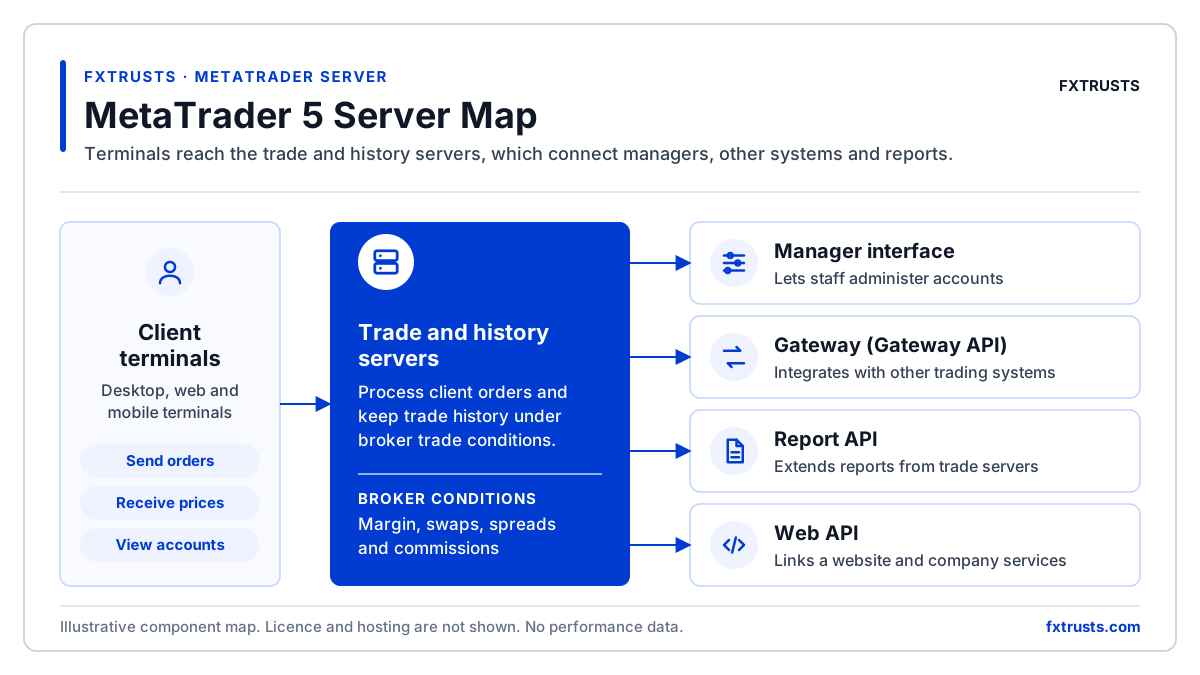
| Component | Role on the broker side | Question to put to the provider |
|---|---|---|
| Trade and history servers | Process client orders and keep trade history under the broker trade conditions | Which servers serve my entity, and where are they hosted? |
| Manager interface (Manager API) | Lets staff administer accounts and settings; MetaQuotes says the API can support custom manager terminals | Which manager roles and permissions does each staff member receive? |
| Gateway (Gateway API) | Integrates the server with other trading systems and creates custom data feeds | Which external systems and counterparties are connected, and who approves each one? |
| Report API | Extends the reports produced by the trade servers | Which reports are standard, and which need custom work? |
| Web API | Connects the platform to a website and other company services | Who builds, tests and supports each integration? |
- Trade and history serversRole on the broker side: Process client orders and keep trade history under the broker trade conditionsQuestion to put to the provider: Which servers serve my entity, and where are they hosted?
- Manager interface (Manager API)Role on the broker side: Lets staff administer accounts and settings; MetaQuotes says the API can support custom manager terminalsQuestion to put to the provider: Which manager roles and permissions does each staff member receive?
- Gateway (Gateway API)Role on the broker side: Integrates the server with other trading systems and creates custom data feedsQuestion to put to the provider: Which external systems and counterparties are connected, and who approves each one?
- Report APIRole on the broker side: Extends the reports produced by the trade serversQuestion to put to the provider: Which reports are standard, and which need custom work?
- Web APIRole on the broker side: Connects the platform to a website and other company servicesQuestion to put to the provider: Who builds, tests and supports each integration?
Vendors and contracts do not always use the same labels. Ask for the exact component list in the agreement rather than relying on a general term such as back end.
How the server fits with the rest of the stack
The server is one layer of a brokerage. Client records and balances usually sit in a CRM, payments run through processors, and liquidity arrives through a gateway or bridge. A neat diagram can hide the handoffs that fail, so map each one to a named owner. Our technical infrastructure page covers the wider layers.
Account data must agree across these systems. If the CRM shows a deposit that the server has not credited, the difference needs a documented reconciliation step rather than a manual guess.
Who licenses and runs the server
MetaQuotes offers MetaTrader 5 to brokers in three licence types, Entry, Standard and Enterprise, which differ in the number of real accounts and the components included. The vendor says a broker deploys the software on its own hardware and that it does not offer SaaS or similar solutions. Those statements decide who holds the licence and who answers for the machine.
A hosted arrangement is a different contract. The hosted platform access page describes a model in which the provider deploys and manages a trading environment, and it says licence ownership depends on the contracted deployment model. Read that clause before you rely on the arrangement.
Running a server does not by itself give a firm permission to carry on regulated activity. In the UK, for example, the FCA says firms must not start performing regulated activities while an authorisation application is under review, unless an exemption or temporary permission applies. Other regulators set their own rules. Our reading is that permission to operate and the technology licence are separate workstreams, and each needs its own advice.
Scope and cost lines to request
The server is only one budget line. Ask for the licence, hosting, CRM, gateway connections, support and any setup fee as separate items. The pricing page lists Hosted MT5 Manager Access at $3,500 per month, which is a hosted arrangement and not a direct MetaQuotes purchase.
Illustrative example
A hypothetical broker budgets twelve months of a $3,500 monthly hosted scope, which equals $42,000 before any CRM, gateway or support quote. The arithmetic shows how one line adds up. It is not a market price or a complete budget.
Keep server costs apart from regulatory capital and client funds. Those amounts follow the rules that apply to your entity and activity, not the terms of a server contract.
Questions to ask before you sign
- Which legal entity holds the MetaTrader licence, and is it the same entity named in your permissions?
- Which components are included: trade and history servers, manager access, gateway connections and reporting?
- Where is each server hosted, who maintains it, and who can reach the environment?
- Which manager roles and API permissions do you receive, and how are their changes audited?
- How can account and trade data be exported if the agreement ends?
- What dated acceptance test report proves the environment works before any client trades?
Terms that get confused
- Trade server and MetaTrader server are often used loosely. In MetaQuotes material the trade server is one component of the wider back end.
- MT4 and MT5 run different server software. A setup guide for one platform does not transfer to the other.
- Gateway and liquidity provider are not the same. The gateway is the technical connection, and the provider is the counterparty that quotes or executes orders.
- Hosting and licensing answer different questions. A provider can host a server you do not license, and you can license a server you host yourself.
For how the platform fits into a wider launch, read our white-label MT5 solutions guide and the MT5 Manager API overview.
Key takeaways
- A MetaTrader server is the back end that processes client orders, accounts and trade conditions.
- For MetaTrader 5, MetaQuotes lists trade and history servers, manager, gateway, report and web interfaces as separate components.
- Confirm who holds the licence, who hosts the machine and who holds manager access before you sign.
- Treat hosted access as a contract with its own clauses, not as a shortcut past licensing.
- Budget and verify each component separately, backed by a dated acceptance test report.
Frequently asked questions
What is a MetaTrader server?
A MetaTrader server is the back-end software that runs a MetaTrader trading environment for a broker. Clients connect with desktop, web or mobile terminals, and the server handles orders, accounts and trade conditions. For MetaTrader 5, the MetaQuotes broker page lists the trade and history servers, manager, gateway and report interfaces as separate components.
What is the difference between a MetaTrader server and a MetaTrader terminal?
The terminal is the client application that traders use to view prices, place orders and check their accounts. The server runs on the broker side and processes those requests. A terminal fault usually affects one user, while a server fault can affect every client, so the two need different testing and support arrangements.
Can a broker run a MetaTrader 5 server without a direct MetaQuotes licence?
FxTrusts' own pricing notes say that not every deployment requires a direct MetaQuotes licence. Whether a hosted or provider arrangement is permitted depends on the contract and on who holds the licence, which must be confirmed in writing. FxTrusts describes its hosted access as a hosted arrangement, not a direct MetaQuotes purchase. Take legal advice on the licence and on your permissions.
Do I need a separate server for each brand?
The answer depends on the contract, the licence tier and the deployment design. Some operators run several brands on shared infrastructure, while others keep separate environments for legal or operational reasons. Ask the provider to show in writing how brands, accounts and manager permissions are separated, and test that separation during acceptance.
Is a gateway the same as a liquidity provider?
No. A gateway is the technical connection between the server and external venues or counterparties. A liquidity provider is the counterparty that quotes or executes orders. The gateway carries the connection, while the commercial agreement with the provider sets prices, limits and rejection rules.
Related FxTrusts resources
- Hosted platform access and deployment scope
- Forex white-label scope and responsibilities
- MT5 Manager API for forex brokers
- Licensed deployment responsibilities for MT5
- How to start a forex broker
Sources
Ask for a written server responsibility statement
Share your entity, target markets and platform requirements. Before you commit, ask for a written statement of the licence holder, server responsibilities and acceptance tests.
Contact FxTrusts