
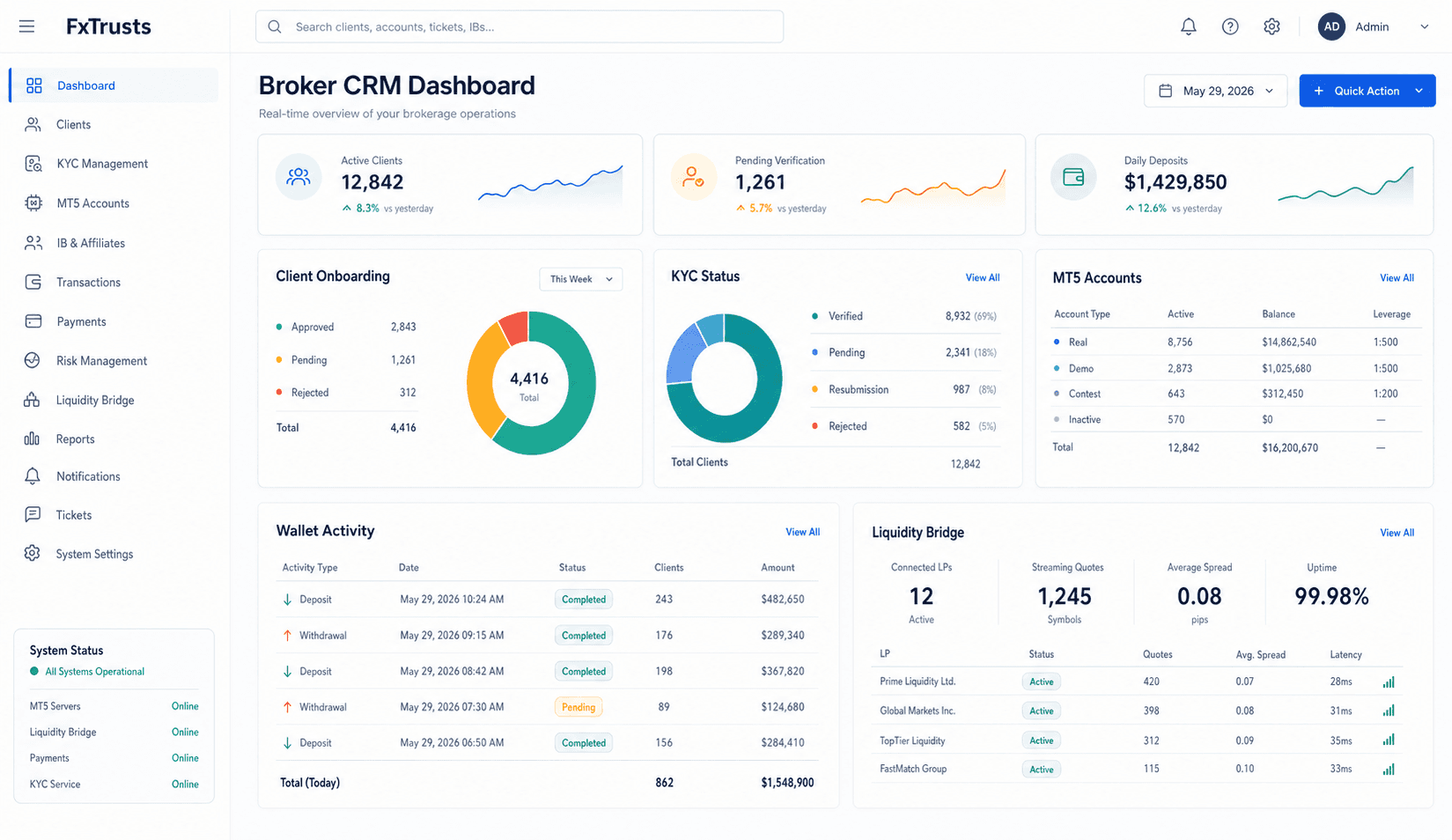
Direct answer: A social trading platform is the public layer a broker runs on top of its trading infrastructure. It lists approved strategy providers, shows their performance and rankings, lets clients follow or copy a provider, and applies risk limits and fee rules to every copy. FxTrusts scopes these social features alongside its copy engine.
Last updated: 9 November 2026
What a Social Trading Platform Does for a Broker
Strategy providers publish profiles, clients browse performance and rankings, and followers choose a provider to follow or copy. The broker keeps the controls: which providers are listed, which metrics are shown, what followers may set and how fees are calculated.
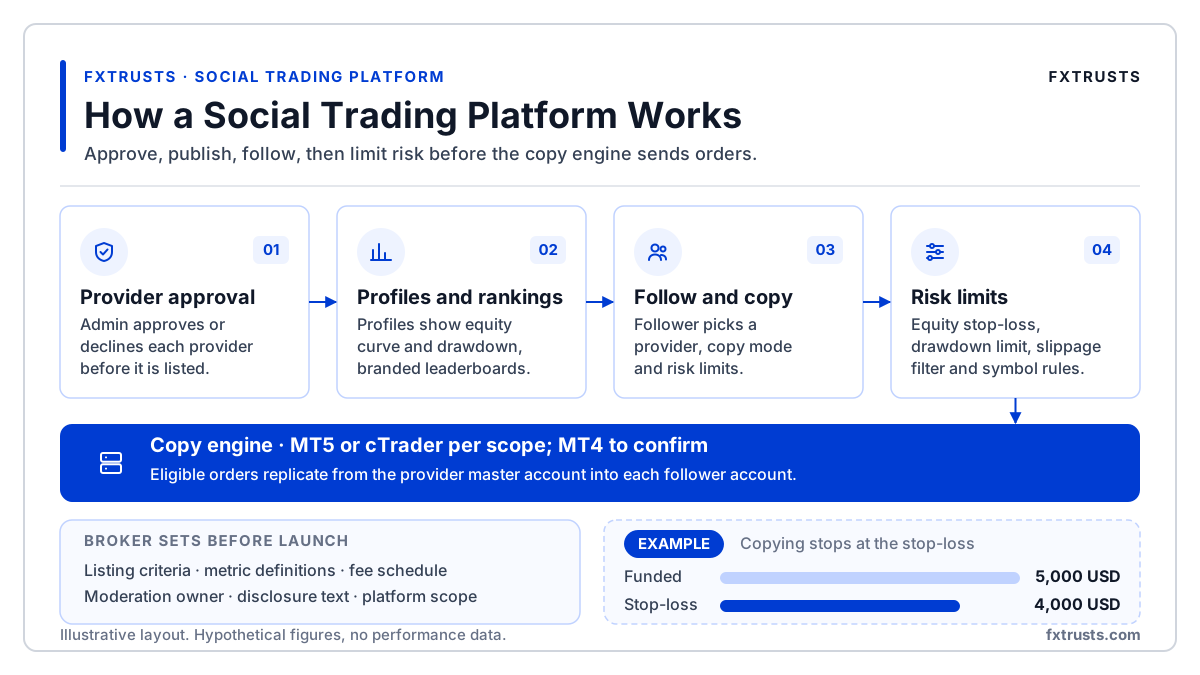
FxTrusts scopes the social features beside the copy engine. The copy engine replicates orders; the social features decide who is visible, how results appear and what followers control. The figure below shows that split.

Social Trading Platform Modules and Requirements
The table lists the modules in the social trading package and the decision the broker must make for each one before launch. Treat this list as a checklist. Each module is confirmed against the signed proposal, and no deployment includes every option by default.
| Module | What the scope covers | Broker decision before launch |
|---|---|---|
| Strategy marketplace | Branded portal for provider profiles, equity curves, Sharpe ratio, drawdown statistics and style tags. | Which providers are listed and which metrics each profile shows. |
| Provider feed and social tools | Provider updates to followers, plus comments, likes and strategy descriptions. | Whether comments are switched on, and the moderation rules for them. |
| Leaderboards | Branded public leaderboard widgets for the broker website or client portal. | The ranking formula and the time period it covers. |
| Follow and copy | A follower picks a provider, a copy mode and risk limits. Copying then runs through the copy engine. | The copy modes and symbols followers may choose. |
| Follower risk controls | Equity stop-loss, maximum drawdown limit, slippage filter and symbol restrictions. | The permitted range for each limit. |
| Admin moderation | Approve or decline providers, feature strategies and manage fees from the admin dashboard. | The approval rules and the person who signs off each listing. |
| Fee billing | Performance fees, subscriptions and per-trade commissions calculated and distributed automatically. | The fee schedule and the owner of fee reconciliation. |
| Branded notifications | Branded alerts for followers, weekly performance reports and fee deductions. | Templates, sender details and disclosure wording. |
MT5 and cTrader connectors are scoped per project, and an MT4 connector is to be confirmed for each deployment. Copy modes and symbol rules are set for each route and should be tested on demo accounts first.
Strategy Profiles, Leaderboards and Social Features
The strategy marketplace is the storefront. Each provider profile can show a bio, a trading style, an equity curve, a Sharpe ratio, drawdown statistics and style tags. A profile appears only after approval, and only the metrics the broker has defined are shown beside it.
Leaderboards rank providers on a formula the broker sets. A ranking can use profit, return on investment, a risk-adjusted measure or a consistency score. The ranking is only as meaningful as the definition behind it, so write the formula, the period and the data coverage into the metric library before the first ranking goes live.
- Branded leaderboard widgets: public rankings embedded in the broker website or client portal.
- Provider updates: the copy trading scope lists provider updates that followers see beside the profile. Confirm the posting rules in the proposal.
- Social interaction tools: the copy trading scope lists comments, likes and strategy descriptions. Whether they are switched on, and who moderates them, is a decision to write into the proposal.
Time-limited contests with entry rules and prize logic are a separate requirement to scope. For prop programmes, the prop firm software page covers leaderboard workflows alongside evaluation and payout.
How Follow and Copy Links Work with the Copy Engine
A follow action creates a link between a follower account and an approved provider. Once the link exists, the copy engine replicates eligible order events from the provider master account into the follower account, under the sizing, symbol mapping and risk rules that apply to that link.
The copy mechanics, including proportional, fixed lot, multiplier, partial close sync and reverse modes, are covered on the copy trading, PAMM and MAM page. This page covers what sits around them: discovery, public presentation, ranking and moderation.
Do not treat a marketplace as the same thing as a pooled model. PAMM and MAM pool or allocate a manager's activity across investor accounts, which is a different structure with different licensing and disclosure questions. The PAMM, MAM and copy trading page sets out the difference.
Follower Risk Controls Before a Copy Goes Live
Followers set their own limits inside the range the broker permits. The main controls are:
- Equity stop-loss: a level at which the follower account stops copying.
- Maximum drawdown limit: a cap on the loss the follower accepts from the copied account.
- Slippage filter: the maximum deviation from the provider entry price that a copy may accept.
- Symbol restrictions: copying can be blocked in symbols the broker or follower excludes.
Illustrative example: a follower funds a copy account with 5,000 USD and sets an equity stop-loss at 4,000 USD. If the account falls to 4,000 USD, copying stops under that rule. These are hypothetical figures. They are not market data and say nothing about how any provider performs.
Set the permitted range for every limit before launch, so no follower can choose a limit the broker risk policy forbids.
Admin Moderation and Provider Approval
Moderation starts before a provider is listed. The broker reviews each provider and decides what is published. The approval flow is:
- Provider review: The broker reviews the provider profile and the trading history submitted for approval.
- Profile publication: Only approved content and documented metric formulas appear to followers.
- Featuring and fees: The admin dashboard lets the broker feature a strategy and manage the fee settings.
Removal rules, comment moderation and escalation are not fixed by the software. The broker writes them down, names the person who applies them, and tests them before the first provider is listed.
Records, Reports and Disclosures for Each Provider
Every ranking and profile needs a record behind it. The broker should keep the metric definitions, the provider disclosures and the fee statements on file, so that any figure shown to a follower can be traced to the calculation that produced it. The same records make review easier when a complaint, a dispute or a regulator's question arrives.
Followers receive branded alerts, weekly performance reports and fee-deduction notices. These are client communications, so the wording, the sender details and the disclosure text should be approved by the broker before they are switched on.
Records matter as much as the display. Write into the proposal how follower settings, copy history and fee records are backed up, how long each record type must be kept and who can export it.
A Staged Launch Sequence for the Social Features
A social trading platform should not go live in one step. A staged sequence limits the damage from a configuration error and gives the team time to check each module:
- Specification: agree the listing criteria, fee schedule, copy modes and risk ranges in writing.
- Connector test: link the copy engine to a test environment and confirm the symbol mapping and copy modes on demo accounts.
- Branding: apply approved colours, names and templates to the marketplace, leaderboard and notification surfaces.
- Pilot providers: onboard a small group of approved providers and check profile data, rankings and fee statements line by line.
- Public launch: open the marketplace to followers once the pilot records reconcile, with the moderation rota already in place.
Timelines depend on the connector, the branding scope and the number of providers, so this page does not set a launch date.
Buyer Requirements to Scope Before Launch
Before a social trading platform goes live, a broker should settle the decisions that software cannot make on its behalf:
- Listing criteria, including the trading history a provider must show and how long it must have run.
- Metric definitions, periods and the disclosure text shown beside each ranking.
- Comment and feed moderation rules, and the person responsible for them.
- The fee schedule, and who reconciles provider and platform fee statements.
- The licensing and disclosure review for each market, including whether a copy product or a managed-account structure applies.
- Platform coverage: which terminals and connectors are confirmed for the deployment.
The published packages and their notes are on the pricing page. For the wider launch decisions, read the guide on white label trading platforms, and the copy trading and PAMM answers for short definitions.
Risk: followers can lose money on copied trades. A provider's past results do not guarantee future results. Social and copy products may need their own licensing or disclosure review, so confirm the position with counsel and the regulator in each market before launch.
Frequently Asked Questions
A social trading platform is a broker-run system that lists approved strategy providers, publishes their performance and lets clients follow or copy them. The broker sets the rules for listing, copying, follower risk limits and fees. The copy engine does the order replication, and the social features control what is visible and who can take part.
Copy trading software is the copy engine. It replicates eligible orders from a master account into follower accounts under sizing, symbol mapping and risk rules. A social trading platform adds the public layer around it: the strategy marketplace, provider profiles, leaderboards, feed, social tools and moderation. The copy trading, PAMM and MAM page covers the copy mechanics, and this page covers the social features.
No. A leaderboard only ranks what the broker chooses to measure. Write the ranking formula, the period and the data coverage into the metric definitions before the first ranking goes live. Show the disclosure that past results do not guarantee future results next to every ranking.
Yes. The admin dashboard supports approving or declining each provider, and featuring strategies, before the profile is listed. The broker still needs to define the approval criteria, such as the history a provider must show, because the software does not decide who should be listed.
Treat this as a requirement to write into the scope. Decide whether followers can pause copying, unfollow a provider and close individual copied trades, and what happens to open positions in each case. Then confirm the behaviour in a test environment with your own provider and follower accounts before you describe it to clients.
It depends on the market and the product model. Regulators and counsel in each market decide whether a copy or social product needs a licence, a disclosure or an investor-mandate review. FxTrusts is a technology provider, not a regulated financial institution, and does not give legal advice, so confirm the position before launch.