CRM for Forex Brokers
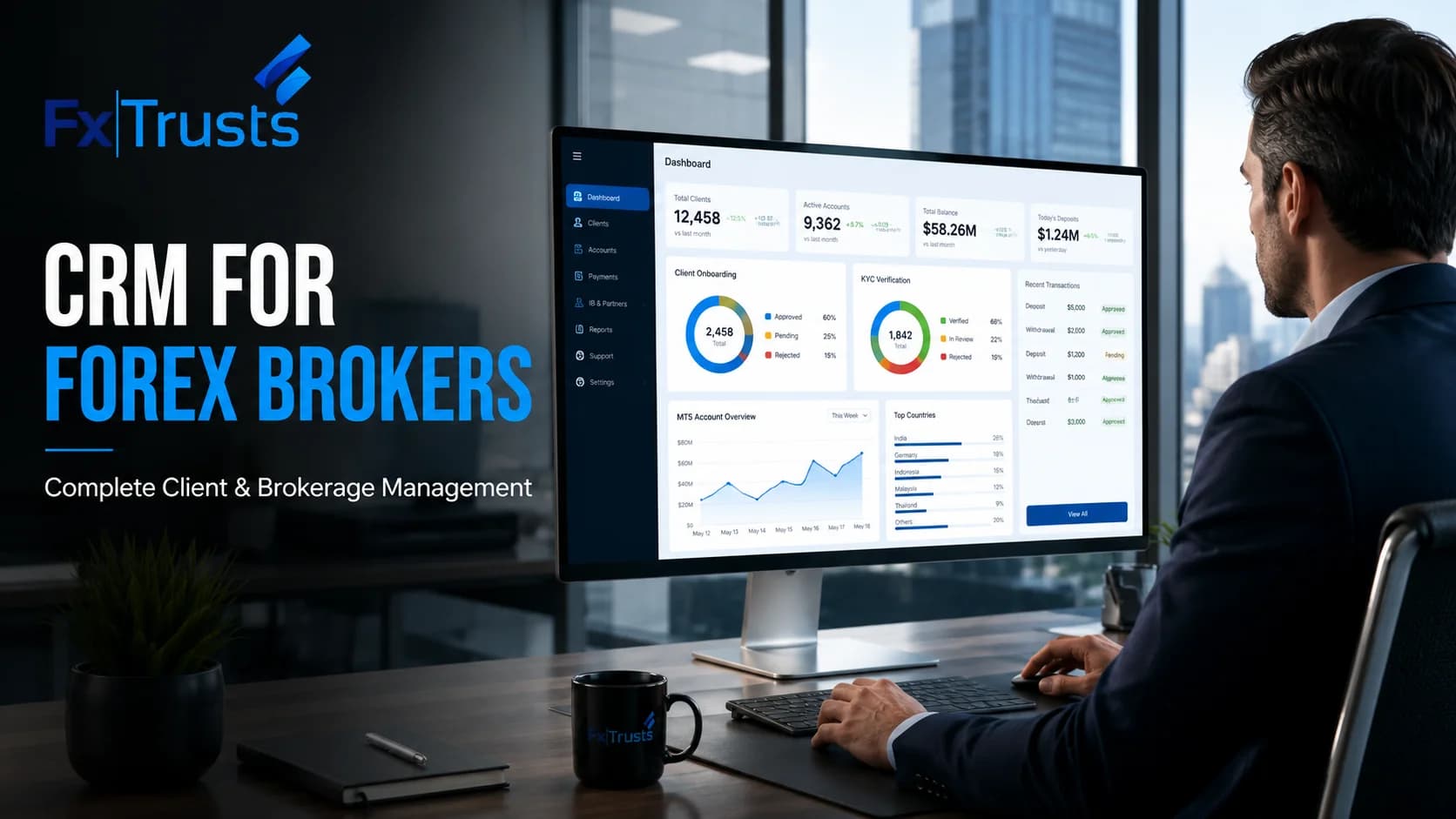
CRM for Forex Brokers: Operational Control That Scales With Your Brokerage
Running a forex brokerage without a dedicated CRM quickly turns into spreadsheet chaos, delayed KYC, missed deposits, and frustrated clients. Sales teams chase leads in one tool, risk officers monitor accounts in another, and support agents dig through email threads. The result is slower onboarding, higher operational cost, and revenue leakage.
A purpose-built CRM for forex brokers solves exactly these problems. It sits at the center of client acquisition, account management, payments, risk flags, IB commissions, and support—while staying tightly connected to MetaTrader 4, MetaTrader 5, and your payment stack.
Ready to see how a forex-native CRM works in practice?
Book a 30-minute live demo. We will walk through real client journeys, MT5 account sync, KYC automation, and IB commission tracking with your own data scenarios.
→ Request Live Demo
Solving Operational Pain Points with a CRM for Forex Brokers
Most brokerages hit the same bottlenecks once they move past a few hundred active clients:
- Manual KYC document collection and review creates multi-day delays.
- Deposit and withdrawal requests sit in email or chat queues.
- Sales cannot see live equity or open positions when speaking to a client.
- Introducing brokers dispute commission calculations because data is scattered.
- Risk teams discover problem accounts only after a margin call or unusual volume spike.
- Support agents lack a single view of trading history, tickets, and previous deposits.
A properly configured forex broker CRM removes these friction points by creating one source of truth for every client record and linking it directly to trading platforms and payment gateways.
Generic CRM vs Forex-Native CRM
| Feature | Generic Sales CRM | Forex Broker CRM |
|---|---|---|
| Trading account creation | No | Yes (MT4/MT5 API) |
| Live equity & margin view | No | Real-time |
| KYC/AML workflow | Basic document storage | Full status + provider hooks |
| IB commission calculation | Manual or external | Automated from trades |
| Deposit/withdrawal rules | Not native | Built-in + payment gateways |
| Risk flagging | Limited | Configurable trading rules |
| Client + IB portals | Limited | White-label ready |
Core Capabilities & Technical Features
Client Onboarding & KYC Automation
The CRM captures leads from landing pages, partner links, or IB portals. It then guides the applicant through document upload, identity verification, address proof, and questionnaire steps. Status updates move automatically: Pending → Under Review → Approved → Account Created. Risk or compliance officers receive only the cases that need human judgment. Approved clients receive login credentials and can fund accounts without further manual intervention.
Real-Time Trading Account Sync
Bidirectional integration with MetaTrader 4 and MetaTrader 5 keeps the CRM updated with balance, equity, margin level, open positions, and trade history. Sales and support teams see the same numbers the client sees on the terminal. This eliminates the need to log into multiple manager terminals during a call.
Deposit, Withdrawal & Wallet Management
Clients request deposits or withdrawals inside the CRM portal or via integrated payment gateways. The system applies your rules (minimum amounts, verification status, country restrictions) and routes approved requests to the relevant payment provider. Multi-currency wallets and internal transfers between accounts are handled in the same interface.
Introducing Broker (IB) & Affiliate Tracking
Every client is linked to an IB or affiliate source. Commission structures—CPA, revenue share, hybrid—are calculated automatically from closed trades or deposited volume. IBs log into a dedicated portal to view their clients, commission statements, and marketing materials. Disputes drop because both sides see the same numbers.
Risk Flags & Compliance Dashboards
Configurable rules surface accounts that show rapid equity growth, unusual leverage usage, or patterns that match known risk profiles. Compliance teams can freeze accounts, request additional documents, or escalate to risk management without leaving the CRM. Audit trails record every status change and user action.
Support Ticket & Communication Layer
Tickets, live chat, and email are tied to the client profile. Agents see full history—previous tickets, deposits, trades, and notes—before they reply. Templates and macros speed up common responses while maintaining a professional tone.
Role-Based Access & Security
Sales, retention, risk, compliance, finance, and IB managers each receive only the modules and data they need. Two-factor authentication, session controls, and detailed activity logs meet the security expectations of regulated environments.
Platform & API Integrations
A modern CRM for forex brokers is built API-first. Typical connections include:
- MetaTrader 4 / MetaTrader 5 Manager API and Web API for account creation, balance updates, and trade data.
- cTrader and other platform APIs where multi-platform support is required.
- Payment gateways (card processors, local payment methods, crypto rails) for deposit and withdrawal automation.
- KYC/AML providers for document verification and screening.
- Email, SMS, and push notification services for transactional messages.
- Accounting or ERP systems for financial reconciliation.
- Liquidity bridge or risk systems for deeper exposure data when needed.
Open REST and WebSocket endpoints allow custom dashboards or third-party tools to pull or push data without brittle screen-scraping.
Want to test the integrations with your current stack?
Schedule a technical walkthrough. We map your MT4/MT5 setup, payment providers, and KYC flow to the CRM in a live session.
→ Book Technical Demo
Tailored Use Cases
New Forex Broker Startups
Launch with automated onboarding, basic risk rules, and IB tracking from day one. Avoid building internal tools that will be discarded later.
Growing Multi-Asset Brokers
Manage forex, CFDs, and crypto clients in one system. Segment by product, region, or risk profile while keeping a unified client view.
Prop Firms
Track challenge and funded accounts, payout requests, and trader performance metrics. Link evaluation rules directly to account status changes.
Introducing Broker Networks
Give IBs transparent portals and accurate commission reports. Scale partner acquisition without proportional growth in back-office staff.
Enterprise & Multi-Brand Operations
Run several white-label brands or regional entities from a single CRM instance with brand-specific portals, rules, and reporting.
Deployment Roadmap & Onboarding
Typical implementation follows four phases:
- Discovery & Configuration – Map your current client journey, risk rules, commission structures, and platform versions.
- Integration & Data Migration – Connect MT4/MT5, payment gateways, and KYC providers. Import existing client records with history.
- User Training & Parallel Run – Train sales, risk, and support teams. Run the CRM alongside existing processes for a short validation period.
- Go-Live & Optimization – Switch primary workflows to the CRM. Fine-tune automation rules and dashboards based on real usage.
Most mid-sized brokerages complete core deployment in weeks rather than months when platform APIs and payment providers are already in place.
Frequently Asked Questions
What makes a CRM for forex brokers different from a generic sales CRM?
Generic CRMs track leads and deals. A forex-specific CRM also manages trading accounts, KYC status, deposits, withdrawals, IB commissions, risk flags, and live platform data. The difference is the depth of operational and regulatory workflows.
Can the CRM create and manage MetaTrader 5 accounts automatically?
Yes. Once a client is approved, the CRM can call the MT5 Manager API to open the account, set group, leverage, and initial parameters, then push login credentials to the client portal.
How does IB commission calculation work?
You define CPA, revenue-share, or hybrid rules. The CRM pulls closed trade volume or deposit data from the trading platform and applies the rules. IBs see statements in their portal; finance teams export reports for payouts.
Is the system suitable for regulated brokers?
The CRM provides audit trails, role-based access, document storage, and configurable compliance workflows. Final regulatory responsibility remains with the broker, but the platform is designed to support common KYC/AML and record-keeping requirements.
How long does integration with existing payment gateways take?
Most standard gateways connect via existing APIs or plugins. Custom or local payment methods may require additional development. A technical scoping call clarifies the timeline for your specific stack.
Can we white-label the client and IB portals?
Yes. Logos, colors, domain, and email templates are customized so clients and partners interact with your brand, not a third-party interface.
What happens to historical client data during migration?
Existing records, documents, and notes can be imported. Trading history remains on the platform servers; the CRM links to it rather than duplicating every tick.
Does the CRM support multi-currency and multi-wallet setups?
Clients can hold balances in several currencies and move funds between wallets or trading accounts according to the rules you set.
How is support handled after go-live?
Standard packages include ticketing, knowledge base access, and scheduled review calls. Higher tiers add dedicated account management and priority response.
Can risk rules be adjusted without developer involvement?
Most common rules (equity thresholds, country restrictions, document expiry) are configurable by admin users. Complex custom logic may still need technical input.
Ready to Get Started?
A CRM for forex brokers is no longer optional once client volume grows. It reduces manual work, shortens onboarding time, improves IB transparency, and gives every team a shared view of the client.
The fastest way to evaluate fit is a live demonstration with your actual workflow scenarios—onboarding steps, risk rules, IB structure, and platform versions.
Take the next step.
Request a personalized demo or pricing discussion. Tell us your current client volume, platforms, and main operational pain points. We will show the exact configuration that matches.
→ Contact / Request Demo