FIX API Trading: Order Flow & Broker Guide | FxTrusts
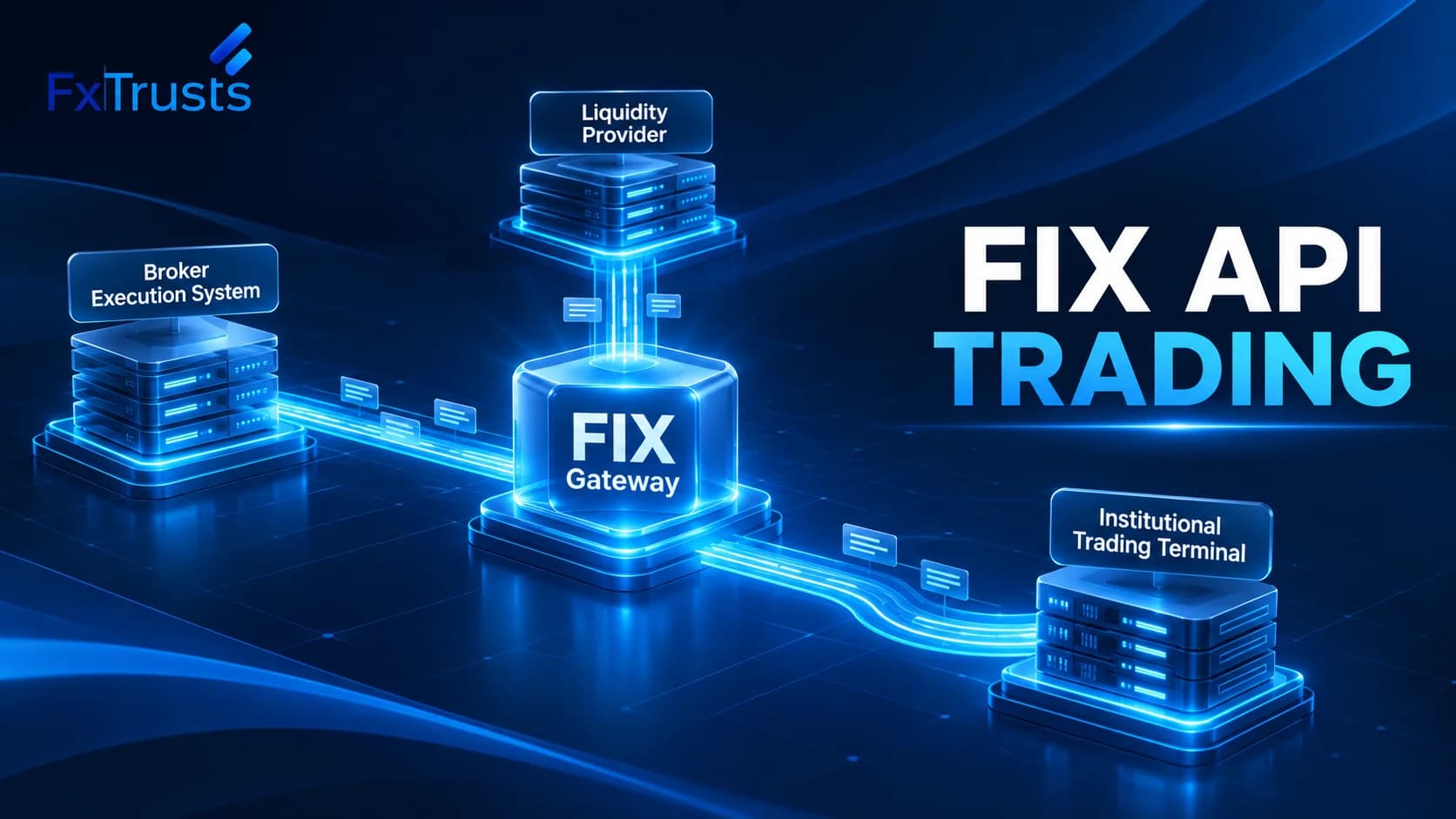
FIX API trading relies on a text-based, low-latency protocol for order routing, execution, and market data across liquidity provider connections. Protocol design shapes recovery. Broker and trading teams must document authoritative order states across live order flows and own API connectivity as core infrastructure for systematic execution reliability.
Fix API trading: definition and decision context?
FIX API trading is programmatic market access built on an execution infrastructure stack rather than a retail point-and-click interface, and not every API broker is engineered to support systematic strategies reliably. For brokerage founders, prop-firm operators, and fintech engineering teams, the decision goes beyond offering a generic developer endpoint. An API functions as core trading infrastructure that an operator or systematic desk must own and maintain to support automated execution at a meaningful scale.
How does fix API trading work in practice?
In practical terms, programmatic trading separates strategy logic or routing software from the broker terminal so orders, cancellations, and price feeds flow through a defined programmatic interface. According to the August 2026 broker infrastructure assessment, marketing claims around API availability often obscure meaningful differences in data quality and execution reliability. When evaluating a broker or designing a Platform overview architecture, teams must inspect how the underlying interface handles throughput, historical data integrity, and order routing under live market load.
Choosing an unsuitable API layer creates hidden operational drag that only surfaces during live trading. Selecting the wrong interface introduces unaccounted latency, data gaps missed during strategy testing, and rate limits that break automated execution at critical moments. For B2B operators launching a brokerage or prop-firm environment, understanding these failure modes early prevents costly mid-launch re-architecture.
Core components and setup requirements for fix API trading
A dependable programmatic setup combines a documented messaging interface, consistent market-data feeds, sandbox testing access, and resilient connectivity between client applications and broker servers. Multi-asset providers built for systematic participants typically expose multiple programmatic API types—such as REST, FIX, proprietary gateways, and WebSockets—alongside free paper-trading environments. Before committing engineering resources, technical leads should verify that sandbox conditions mirror production behavior, confirm rate-limit policies, and validate whether the target stack matches internal maintenance capacity.
Who should consider fix API trading?
Teams running latency-sensitive systematic strategies, multi-venue routing engines, or institutional liquidity bridges benefit most from dedicated programmatic connectivity, whereas casual discretionary workflows rarely justify the engineering complexity. As the 2026 algorithmic broker review notes, evaluating an API broker requires balancing breadth of asset access against technical complexity. Brokerage operators designing a Forex white label product suite face a parallel question: deciding which client tiers require raw programmatic endpoints versus standard desktop, web, or mobile terminals.
When is fix API trading the right fit?
Dedicated API access makes sense when automated systems need deterministic message handling, continuous price consumption, and strict control over order submission without human terminal intervention. Systematic traders evaluating multi-asset broker APIs such as Interactive Brokers—which provides REST, FIX, TWS, and WebSocket access across stocks, options, futures, forex, and bonds with free paper trading and a zero minimum deposit—still have to weigh whether gateway complexity is justified by their asset-class breadth. Similarly, a fintech or prop-firm team should adopt direct API connectivity only when its internal engineering desk can manage session monitoring, schema updates, and execution troubleshooting.
Operational trade-offs and cost considerations
Programmatic execution shifts responsibility from a turnkey front-end vendor onto the engineering team operating the client or bridge. Rather than relying solely on a broker's marketing summary, operators should assess execution reliability and data quality across both testing and production environments before allocating capital or onboarding clients. Key operational trade-offs include onboarding engineering hours, ongoing infrastructure monitoring, and the need for disciplined change management whenever upstream endpoints evolve.
Benefits and practical limitations
FIX connectivity delivers deterministic order flow and mature session-recovery primitives for institutional routing, yet it demands strict sequence discipline and carries higher integration overhead than managed bridges. When connecting a brokerage stack to a bank or Prime of Prime liquidity provider, the EBS FinTech protocol guide highlights that FIX suits high-frequency order flow, multi-LP aggregation, and exchange or ECN connectivity. Conversely, one-off or low-touch order flows are often better served by managed bridges rather than custom session engineering, a distinction that matters directly when scoping Prop firm software infrastructure.
What limitations or risks apply to fix API trading?
The primary operational risks stem from session state mismatches, sequence-number drift, and unthrottled order loops rather than the transport syntax itself. According to documented LP integration practices, session and sequence discipline is the number-one blocker preventing teams from going live smoothly. Without automated sequence recovery and clear weekend-reset procedures, a temporary network drop can stall order routing or leave positions unmonitored during volatile sessions.
FIX Connectivity Strengths and Limitations
Strengths
- Provides direct, deterministic order flow compared with standard REST or WebSocket gateways for liquidity provider links.
- Supports rich execution states, including partial fills, rejects, and cancellations during live routing.
- Includes mature risk and session primitives such as heartbeats and message resends for session integrity.
Limitations
- Session and sequence discipline frequently becomes the primary technical blocker during production launch with liquidity providers.
- Less practical for low-touch or one-off flows where managed bridges reduce build complexity for smaller operators.
- Requires dedicated engineering for risk throttles, kill-switches, network hardening, and failover testing before live deployment.
Practical safeguards before committing
Before routing live volume, engineering teams must build day-one risk throttles, automated kill-switches, observability logging, and tested disaster-recovery runbooks around every liquidity connection. As the 2025 LP connectivity playbook outlines, running conformance tests and negative failure scenarios before launch verifies how the stack behaves when messages arrive out of order, connections drop mid-fill, or liquidity feeds pause.
API trading platform with fix connectivity pricing and the reader decision
Evaluating an API trading platform with FIX connectivity pricing requires separating commercial fee structures—which providers do not standardize publicly—from the architectural costs of order-state recovery and interface ownership. As the November 2026 Trading Technology analysis explains, FIX, REST, and WebSockets are not interchangeable order protocols because each handles confirmation and failure recovery differently. Latency figures matter, yet recovery rules and operational ownership frequently decide whether an interface is safe for a live brokerage order path, including multi-account routing such as PAMM/MAM copy trading.
Which teams or buyers benefit from fix API trading?
Teams that operate multi-interface broker architectures—where one channel submits instructions, another returns fills, and a third reconciles state after disconnects—need rigorous clarity on protocol guarantees. In a structured order lifecycle, engineering teams must separate four distinct events: submission with a stable client order identifier, acknowledgement of receipt or rejection, execution reports covering fills or cancellations, and post-disconnect reconciliation. Crucially, broker acknowledgement confirms receipt only and does not mean execution venue routing has occurred.
Because an HTTP response, a FIX ExecutionReport, and a WebSocket event carry different guarantees, buyers evaluating platform pricing should ask vendors which interface serves as the authoritative record of order state. Treating fills and cancellations as formal state transitions rather than isolated alerts prevents duplicate orders or phantom balances when connections reset.
Protocol Comparison for Broker Order Flow Architecture| Protocol | Transport & Messaging Model | Acknowledgement & Order State | Operational & Recovery Considerations |
|---|---|---|---|
| FIX | Messaging protocol with defined session rules and an application layer for trading workflows. | Uses structured messages such as FIX ExecutionReport for fills, partial fills, and cancellations across order states. | Requires explicit documentation of accepted, routed, and authoritative state transitions plus reconciliation after disconnects. |
| REST | HTTP API design typically following a request-and-response pattern for client requests. | A successful HTTP response can confirm receipt without guaranteeing venue routing or execution status. | Often paired with separate status or reconciliation endpoints to verify state after timeouts or dropped responses. |
| WebSockets | Persistent, full-duplex transport channel for bidirectional updates. | Requires its own custom message format, authentication layer, and order semantics for confirmations. | Needs explicit client-side recovery rules because transport persistence alone does not guarantee authoritative reconciliation. |
Practical checklist before selecting an option
When comparing vendor proposals and connectivity pricing tiers, look past headline latency numbers, because published same-region benchmarks measure submission to application acknowledgement rather than guaranteed service levels. Internet distance, broker processing, venue routing, and load all move real-world response times. Require written documentation specifying which message confirms acceptance, which confirms venue routing, and which serves as the authoritative state source after a restart or timeout.
API-native trading platform for institutional broker dealer services and the reader decision
Institutional broker-dealers adopting an API-native trading stack must align commercial scope, technical FIX specifications, and compliance logging before establishing a live liquidity socket. According to EBS FinTech integration guidance, reliable production deployments depend on documenting commercial and operational parameters—including symbols, venues, session windows, and supported order types such as Market, Limit, Stop, Stop-Limit, IOC, FOK, GTD, and GTC—long before coding begins. Technical teams consulting API docs during architecture planning should treat commercial terms and technical protocols as a single checklist.
Key factors shaping fix API trading outcomes
Economic and operational alignment prevents disputes once client flow hits external liquidity venues. Before going live, the pre-integration checklist recommends locking down spreads, commissions, minimum ticket sizes, rollover and swap rules, reject policies, and Cancel On Disconnect behavior. Teams also need clear service-level agreements covering network operations center hours, escalation ladders, change windows, and weekend session resets so support staff know how to respond during an outage.
What to verify in documentation before adopting
On the technical side, documentation must confirm supported FIX trade versions—typically FIX 4.x—alongside network security hardening, market-data subscription limits, and audit-ready observability. Verify whether the provider supplies sample configurations, tag cheat-sheets, and a negative-testing plan so your engineering team can validate reject handling, throttle limits, and failover paths before routing institutional client orders.
Conclusion
Selecting and operating FIX-based infrastructure is an engineering and operational ownership decision as much as a connectivity choice. For brokerage founders, prop-firm operators, and fintech product leads, the right path depends on matching internal engineering capacity to the exact demands of your order flow, execution model, and client base.
Before committing budget or signing a liquidity agreement, map your entire order lifecycle from submission through post-disconnect reconciliation, confirm how failures are detected and contained, and establish clear operational escalation paths. Where turnkey simplicity and faster time to market outweigh custom protocol control, managed connectivity and white-label brokerage stacks provide a structured alternative while keeping compliance and risk controls centralized.
Sources
- FIX API 101: Best Practices for Connecting to Liquidity Providers - EBS FinTech — 2025-10-29T02:42:14.000Z — ebsfintech.com (published 2025-10-29; retrieved 2026-11-23).
- FIX vs REST vs WebSockets for trading | Trading Technology — 2026-11-12T13:33:46.000Z — tradingtechnology.org (published 2026-11-12; retrieved 2026-11-23).
- Best API Brokers for Algorithmic Trading (2026) — 2026-08-29T05:49:57.000Z — allinallspace.com (published 2026-08-29; retrieved 2026-11-23).