Forex CRM Reporting: Data Sources & Reconciliation Plan
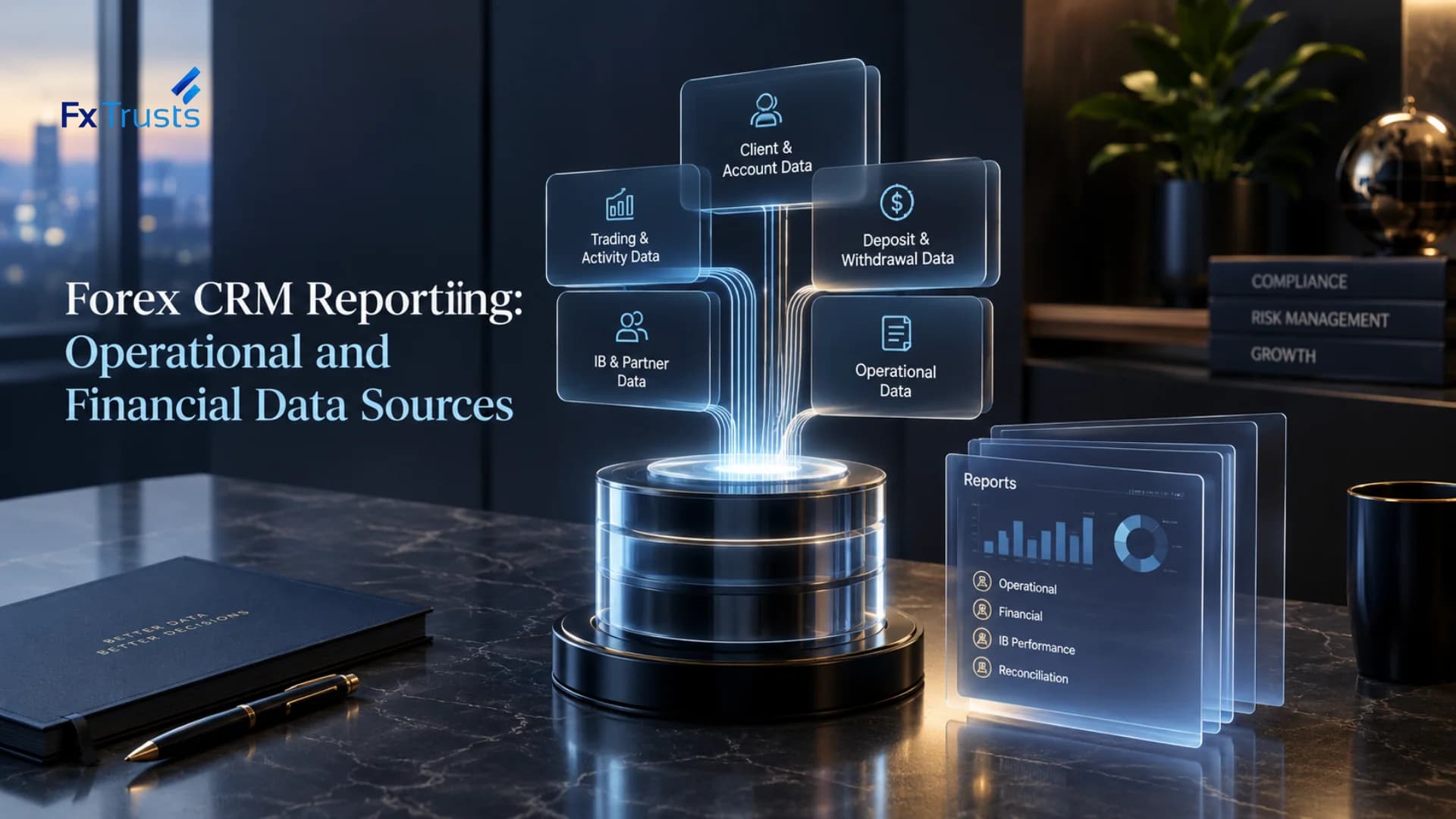
Forex CRM reporting brings operational and financial information into a structured reporting environment so brokers can understand client activity, deposits and withdrawals, IB performance, reconciliation and other business processes.
A broker CRM can contain a large amount of information, but simply storing data does not create reliable reporting. The important questions are where each report gets its data, which system is authoritative, how records are reconciled and who can access or export them.
For a brokerage, this becomes particularly important when operational records and financial information originate from different systems. A reporting dashboard may combine CRM activity with account, transaction or partner data, but the relationship between those sources needs to be clearly defined.
What Is Forex CRM Reporting?
Forex CRM reporting is the process of organising CRM and related brokerage data into reports that support operational monitoring, financial review and management decisions.
A broker reporting dashboard might show client activity, onboarding progress, account information, sales performance or other operational indicators. Financial reporting can involve deposits, withdrawals, balances, transactions or defined partner metrics.
The CRM does not necessarily need to become the source of truth for every category of data.
For example, the CRM may own client relationship information while another brokerage system provides authoritative transaction or account data. The reporting layer then needs a clearly documented method for combining those records.
This distinction prevents reports from becoming difficult to reconcile later.
Operational and Financial Data Sources
A reporting implementation usually starts by identifying where each required data point originates.
Operational data may include client profiles, onboarding status, KYC progress, lead ownership, sales activity and account-management records. Financial data may include deposits, withdrawals, transaction information, account balances or partner-related financial calculations.
The implementation should establish:
Which system owns each data field
How records are identified across systems
How frequently information is synchronised
What happens when records do not match
Who can view or export each report
A source-of-truth matrix can be particularly useful because it prevents different teams from interpreting the same metric differently.
For brokers building the client and account-management layer alongside CRM reporting, the Forex CRM & Trader's Room can provide the wider context for client onboarding, account management, KYC and related operational workflows.
Deposit and Withdrawal Reports
Deposit and withdrawal reports require particular attention because financial records may originate outside the CRM.
A CRM can display payment-related information, but the reporting design should clearly identify whether it is showing payment requests, processed transactions, confirmed transactions or another defined state.
For example, a withdrawal request should not automatically be treated as a completed withdrawal if the underlying financial workflow has not reached its final status.
This is where Payment & Financial Infrastructure becomes relevant. Payment providers, wallet or ledger records, funding events and payout workflows need clearly defined ownership and reconciliation rules before their data is used in CRM reporting.
IB Performance Reporting
IB performance reporting introduces another layer of complexity because partner attribution can affect how results are grouped.
Depending on the brokerage's model, reports may need to connect IB relationships with referred clients, account activity, trading-related measures, commissions or other defined partner metrics.
The calculation rules should be documented before the dashboard is built.
For example, a report should make clear whether "IB performance" means referred clients, active clients, trading activity, revenue contribution, commissions or a combination of these measures.
Clear definitions are more important than simply adding more metrics to the dashboard.
Report Reconciliation
Report reconciliation is the process of comparing related records across systems to identify differences.
| Reporting Area | Primary Data Consideration | Reconciliation Check |
|---|---|---|
| Client records | CRM identity | Client IDs and status |
| Accounts | Trading/account system | Account ownership and status |
| Deposits | Financial/payment source | Transaction ID, amount and status |
| Withdrawals | Financial/payment source | Request, approval and completion state |
| IB reporting | CRM + account/commission data | Partner attribution and calculated values |
The exact sources depend on the broker's technology architecture.
The important principle is that every report should have a defined source and reconciliation method where multiple systems contribute information.
Reporting Permissions and Access Control
Not every employee should have access to every report.
Operational users may need client and workflow information, while finance teams may require access to financial reports. Senior management may need aggregated business metrics without access to every underlying record.
Reporting permissions should therefore be defined alongside the report structure.
Export permissions deserve particular attention. A user who can view a report does not necessarily need permission to download the underlying dataset.
The implementation should document who can view, filter, export, modify or administer each report.
Data Reconciliation and Exception Handling
A reliable reporting architecture should not assume that every system will always agree.
Records can fail to synchronise, identifiers can be missing, transactions can change status and corrections can occur after an initial report has been generated.
Instead of hiding these differences, the reporting process should identify exceptions.
An exception report can show records that require investigation, such as unmatched transaction IDs, missing account relationships or inconsistent statuses.
This gives operations teams a controlled way to resolve discrepancies rather than manually searching through unrelated systems.
Technical Infrastructure Behind Reporting
Reporting also depends on the infrastructure supporting the data layer.
The Forex Broker Technical Infrastructure solution is relevant where the reporting environment requires dedicated infrastructure, data storage, monitoring, backups, restore testing or connections to other operational components.
The technical scope should define the reporting source, schema, retention requirements, query or export requirements and responsibility for monitoring and recovery.
This is especially important for brokers that expect reporting workloads to grow alongside client accounts and transaction history.
Reporting Across a White-Label Brokerage Stack
For brokers launching or expanding a branded brokerage environment, reporting is one component of a wider technology stack.
The Forex White Label environment can bring together CRM, KYC/AML workflows, payments, liquidity planning, platform access and technical onboarding under one implementation scope.
That broader architecture makes reporting responsibility particularly important. When several systems contribute data, the implementation plan should specify which system owns the source record, which system consumes it and how discrepancies are handled.
The official MetaTrader 5 brokerage guidance also illustrates that establishing a brokerage involves multiple technology and operational components rather than one standalone application.
What Should Be Tested Before Reporting Goes Live?
Reporting should be tested using realistic records and scenarios rather than only checking whether the dashboard loads.
The test process should verify totals, record relationships, transaction states, date ranges, permissions, exports and reconciliation exceptions.
A broker should also test what happens when a source record changes after a report has already been generated.
Useful testing questions include:
Does the report use the intended source of truth?
Are duplicate records handled correctly?
Are deposits and withdrawals shown using the correct status?
Can users export only the information they are authorised to access?
Can financial and operational totals be reconciled?
Are calculation and field-definition changes documented?
These checks help establish whether the reporting environment is operationally reliable rather than simply visually complete.
Questions to Ask Before Implementing Forex CRM Reporting
Before selecting or configuring a reporting solution, brokers should ask which systems provide the source data, how records are linked, how often data is updated and who owns reconciliation.
They should also clarify whether reports are configurable, how exports work, how historical changes are handled and what happens when an integration fails.
Most importantly, reporting requirements should be documented before implementation begins.
A scoped demonstration and implementation responsibility matrix can show exactly which reports will be delivered, where their data comes from, how reconciliation works and which party is responsible for each integration and reporting component.
Final Takeaway
Effective Forex CRM reporting is less about creating attractive dashboards and more about establishing trustworthy data relationships.
Operational reports, CRM exports, deposit and withdrawal reports and IB performance reporting all depend on clearly defined sources, permissions and reconciliation rules.
For brokers planning a new reporting architecture or improving an existing CRM setup, the next practical step is to request a scoped demonstration and implementation responsibility matrix covering operational data sources, financial reporting, reconciliation, permissions, exports and change control.
Sources
-
MetaTrader 5 — How to Start a Brokerage Business
Official MetaTrader guidance covering brokerage infrastructure, CRM, payment providers, marketing analytics, client onboarding and reporting-related operations. MetaTrader 5 — How to Start a Brokerage Business -
FxTrusts — Forex CRM & Trader's Room
Current FxTrusts documentation covering CRM/back-office workflows, deposits, withdrawals, IB performance reports, account management, reporting and API/integration scope. FxTrusts — Forex CRM & Trader's Room -
MetaTrader 5 — Brokers
Official documentation describing MetaTrader 5 brokerage infrastructure, backend functionality and API connectivity for trading and post-trading systems. MetaTrader 5 for Brokers -
FxTrusts — Forex Trader Room: Client Onboarding & Management
Relevant FxTrusts article covering the relationship between Trader's Room, CRM, client onboarding and broader brokerage infrastructure. FxTrusts — Forex Trader Room: Client Onboarding & Management
Frequently Asked Questions
What is Forex CRM reporting?
Forex CRM reporting organizes operational and financial data into structured reports for monitoring client activity, payments, IB performance, reconciliation and management decisions.
What data sources can a Forex CRM reporting system use?
Depending on the implementation, reporting may use CRM records, client and account data, trading activity, deposit and withdrawal records, IB data and other connected brokerage systems.
Why is reconciliation important in Forex CRM reporting?
Reconciliation helps identify differences between systems, such as unmatched transaction IDs, incorrect statuses, missing account relationships or inconsistent financial values.
What should brokers consider when exporting CRM reports?
Brokers should define date ranges, data ownership, update timing, transaction status, timezone, export permissions and how historical changes are represented.
How should access to Forex CRM reports be controlled?
Access should be based on staff responsibilities. Operations, finance, sales and management may require different report permissions, while export access should be separately controlled.