PAMM vs MAM vs Copy Trading: Key Differences
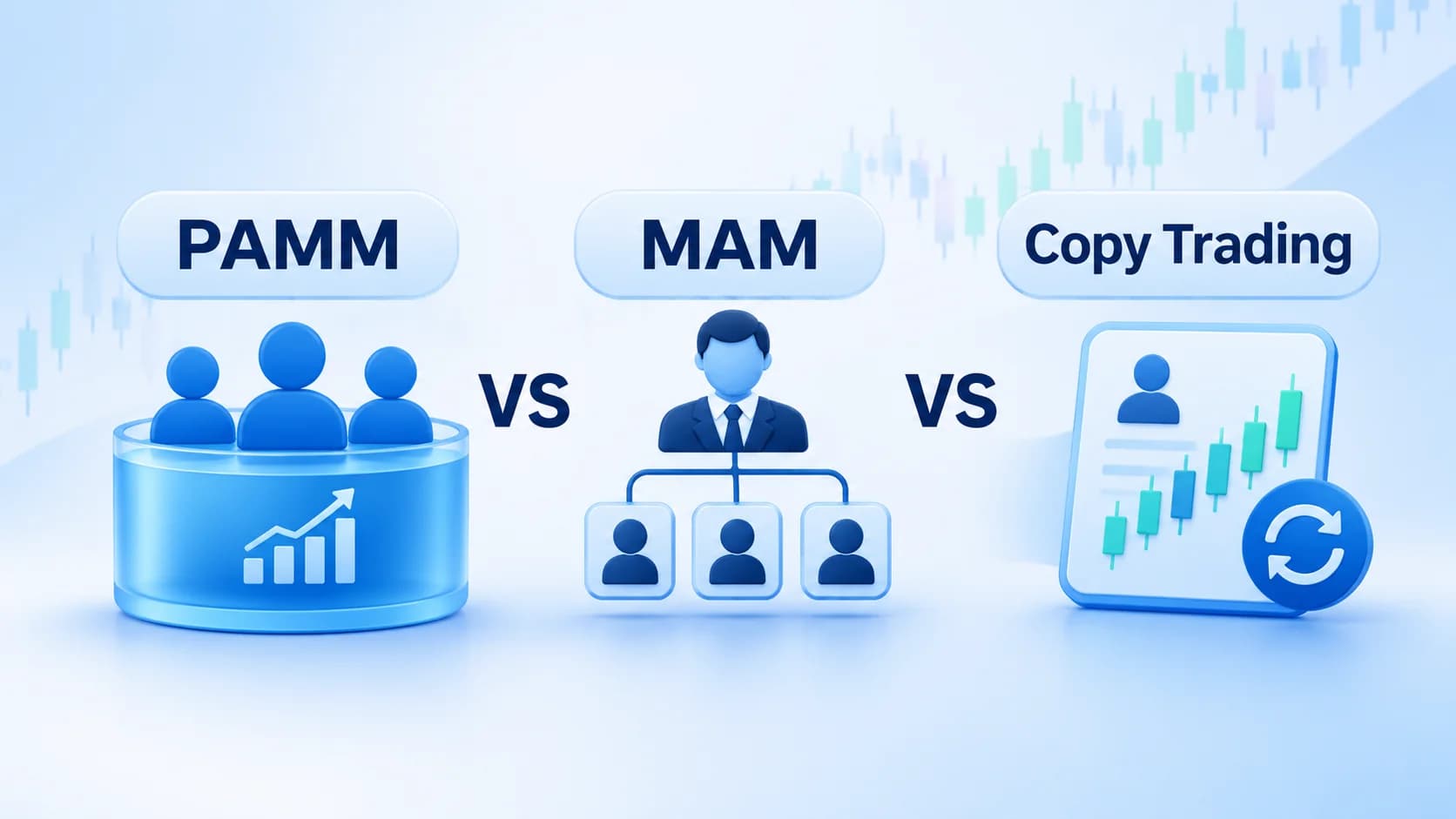
PAMM vs MAM vs Copy Trading: What's the Difference?
PAMM, MAM, and copy trading are often used as if they mean the same thing. They don't. Each represents a different way of managing investor capital, allocating trades, and giving clients access to trading strategies.
For forex brokers, money managers, and fintech businesses, choosing the wrong model can create operational complexity, limit investor flexibility, or introduce unnecessary risk.
The difference comes down to three questions: Where does the investor's capital sit? How are trading decisions executed? And how much control does the investor retain?
Get those distinctions clear, and choosing the right investment model becomes much easier.
This guide breaks down PAMM vs MAM vs copy trading in plain terms, explains how each model works, and highlights what brokers should consider before implementing one.
The One Distinction That Matters Most
All three models allow investors to benefit from another trader's strategy without necessarily placing every trade themselves.
However, they differ in how capital is structured, how trades are allocated, and how much control investors have over their individual accounts.
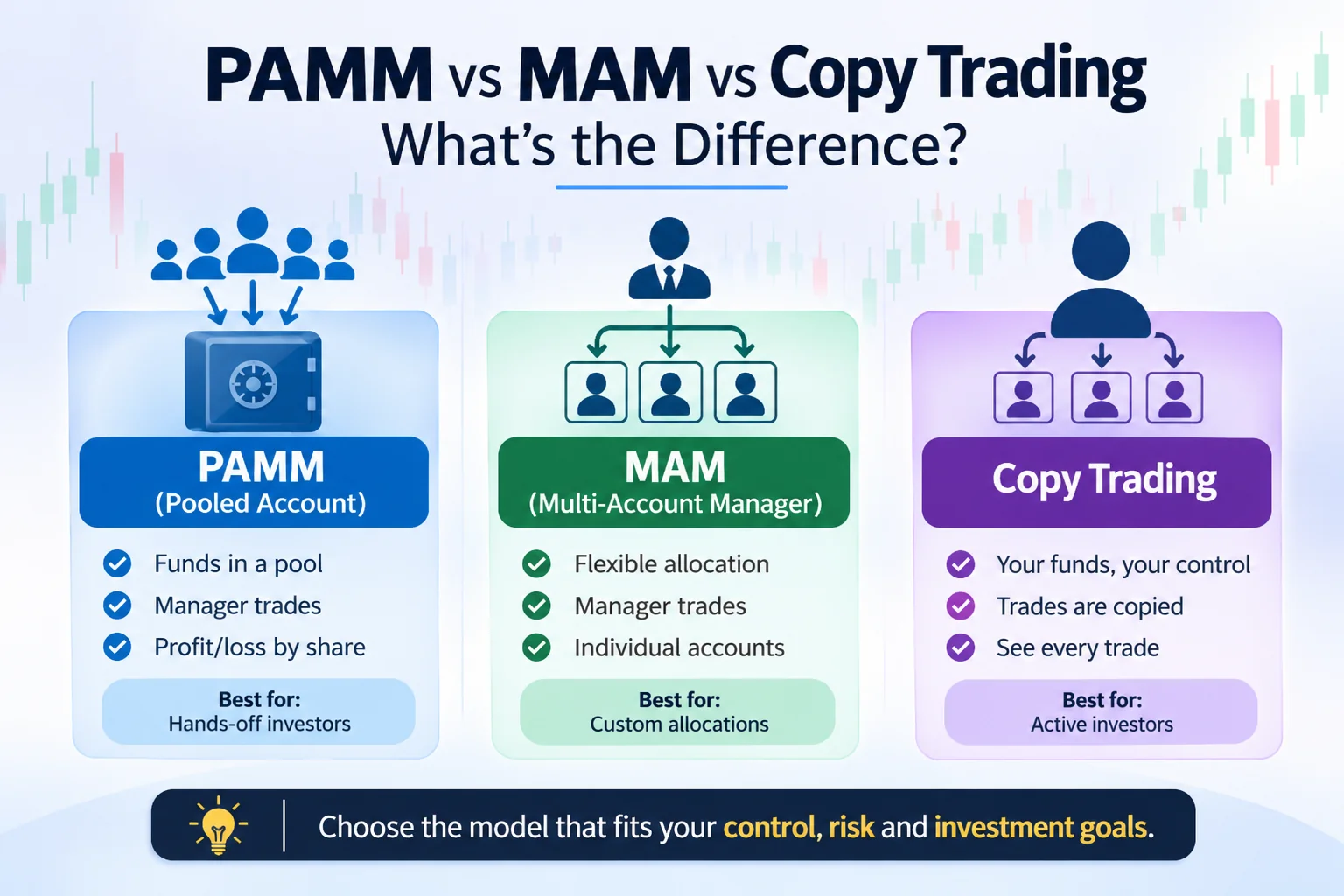
PAMM: Investor capital is pooled into a managed account. A money manager trades the pool, and profits or losses are allocated according to each investor's share.
MAM: A manager executes trades across multiple investor accounts using configurable allocation methods. Investors generally retain separate account records.
Copy Trading: Investors follow a selected trader or strategy, and trading activity is replicated into their individual accounts according to configured copying and risk rules.
The distinction is important because a managed-account structure, a social trading platform, and a trade replication engine solve different operational problems.
For brokers building these services, the underlying technology must support the chosen account structure, allocation logic, reporting requirements, and investor experience.
PAMM Accounts Explained
A PAMM (Percentage Allocation Management Module) account allows a money manager to trade a pooled account funded by multiple investors.
Each investor contributes capital to the pool. The manager executes trades on the combined capital, and profits or losses are allocated according to each investor's percentage share.
For example, if an investor contributes 10% of the pool, they generally receive 10% of the pool's eligible profit or loss, subject to the account's fee and allocation rules.
The manager makes the trading decisions. Investors select the manager and their investment amount, but they do not independently control each trade.
A PAMM system typically needs to manage investor allocation, deposits and withdrawals, performance calculations, fees, and reporting.
FxTrusts provides PAMM and MAM investment infrastructure for brokers that want to offer managed-account services through their own trading environment.
Best for: Brokers and investment businesses offering pooled, professionally managed trading to clients who prefer a hands-off approach.
The trade-off: Investors have limited control over individual trades. The pooled structure also requires clear rules for capital movements, fee calculations, reporting, and reconciliation.
MAM Accounts Explained
A MAM (Multi-Account Manager) account allows a manager to execute trading decisions across multiple investor accounts.
Unlike a traditional PAMM structure, investor accounts remain individually recorded, and the manager can allocate trades using different methods.
Depending on the platform and configuration, allocation can be based on:
Fixed lot sizes.
Investor balance.
Investor equity.
Percentage allocation.
Equity-based risk settings.
For example, a manager may execute one trading instruction and allocate different lot sizes to three investor accounts based on their respective balances and risk preferences.
This flexibility makes MAM suitable for businesses that need more account-level customization than a standard pooled model.
A MAM system also needs to handle order allocation, partial closes, account restrictions, individual performance records, and fee calculations.
FxTrusts offers MAM technology and managed-account allocation for brokers and money managers requiring configurable allocation across individual investor accounts.
Best for: Brokers and professional managers who need individual investor accounts with flexible allocation and account-level reporting.
The trade-off: The manager still controls trading decisions. More flexible allocation also means more operational complexity, particularly when handling different account sizes, risk limits, and execution outcomes.
Copy Trading Explained
Copy trading allows investors to follow a selected trader or strategy and automatically replicate eligible trades in their own brokerage accounts.
Instead of placing every trade manually, the investor chooses a provider and configures how the provider's trading activity should be copied.
Depending on the system, investors may be able to select proportional copying, fixed lots, multipliers, or other risk settings.
The key distinction is that copy trading does not necessarily require investors to pool their capital or delegate full account management to a money manager.
Each follower's account can maintain its own balance, trade history, and risk configuration.
For example, a strategy provider opens a trade on their account. The copy trading system receives that trading event and creates a corresponding order in each eligible follower account according to its configured rules.
The follower's execution price, lot size, and final result may differ from the provider's because of account settings, market conditions, and execution differences.
FxTrusts provides copy trading and social trading infrastructure for brokers looking to offer branded strategy marketplaces, provider profiles, follower controls, and automated trade replication.
Best for: Brokers that want to offer strategy following, social trading, and automated trade replication while maintaining individual follower accounts.
The trade-off: Copying trades does not eliminate investment risk. Followers remain exposed to the strategy's losses, and replication can produce different results from the original account. Risk settings and execution monitoring are essential.
Trade Copier Explained
A trade copier is a technical system that replicates trading activity from a source account to one or more destination accounts.
It is closely related to copy trading, but the two terms are not always interchangeable.
Copy trading often includes a broader investor-facing experience, such as strategy discovery, provider profiles, performance reporting, subscriptions, and follower management.
A trade copier focuses primarily on the technical replication of trading activity.
For example, a broker or signal provider may need to replicate trades from one MT4 account to several MT5 accounts. A copier can handle the replication according to configured rules, including symbol mapping and lot sizing.
Trade copiers may also support different platforms, depending on the specific connectors and deployment.
FxTrusts offers cloud-hosted trade copier infrastructure for brokers, signal providers, and trading businesses that need automated trade replication.
Best for: Businesses that need to replicate trading activity across accounts or platforms without necessarily requiring a complete investor marketplace.
The trade-off: A copier does not automatically provide the complete account management, investor reporting, fee billing, or legal structure of a managed-account solution.
Side-by-Side Comparison
| Factor | PAMM | MAM | Copy Trading |
|---|---|---|---|
| Account structure | Pooled managed account | Individual investor accounts | Individual follower accounts |
| Who makes decisions? | Money manager | Money manager | Strategy provider |
| Capital allocation | Percentage of pool | Flexible per account | Configured copying rules |
| Investor control | Generally low | Generally low | Depends on platform and permissions |
| Individual trade visibility | Depends on reporting setup | Account-level records | Copied trade history |
| Allocation flexibility | Primarily percentage-based | High | Proportional, fixed lot, multiplier, etc. |
| Account-level risk settings | Depends on structure | Configurable | Configurable follower controls |
| Public strategy marketplace | Not inherent | Not inherent | Commonly supported |
| Best suited for | Pooled investment management | Customized managed accounts | Social and strategy-following services |
Important: The exact features, execution behavior, allocation rules, and investor permissions depend on the platform, broker configuration, and applicable agreements.
Which One Should You Choose?
The right model depends on the service you want to offer and how your investors will interact with it.
Choose PAMM if your business offers pooled investment management and investors participate according to their share of the pool.
Choose MAM if your business requires managed trading across individual investor accounts with more flexible allocation methods.
Choose copy trading if your business wants investors to select strategies and replicate trades in their own accounts, with configurable follower controls.
Choose a trade copier if the main requirement is technical trade replication across accounts or supported trading platforms.
For brokers building a broader investment offering, these solutions do not always need to operate independently. A business may require more than one model to support different investor types or trading services.
FxTrusts' investment and social trading suite brings these models together under a configurable infrastructure approach.
Common Mistakes When Choosing
1. Confusing account structure with trading performance
A PAMM, MAM, or copy trading model does not determine whether a strategy will be profitable.
The structure determines how trading activity and results are allocated. Performance depends on the underlying strategy, market conditions, and execution.
2. Ignoring allocation and execution differences
Even when the same trading instruction is used, investors may receive different results.
Account size, allocation rules, minimum lot requirements, slippage, rejected orders, and execution timing can all affect the outcome.
Brokers should test these scenarios before offering a managed-account or copying service.
3. Assuming copy trading and trade copying are identical
Copy trading may include strategy discovery, investor onboarding, performance reporting, and social features.
A trade copier primarily replicates trading activity.
Choosing a copier when the business needs a complete investor-facing marketplace can leave important functionality missing.
4. Overlooking risk controls
Allocation flexibility is useful, but it does not automatically protect investor capital.
Brokers should consider account-level risk limits, equity protection, drawdown monitoring, and controls for failed or delayed trade replication.
5. Treating technology as a substitute for regulatory review
Managed accounts, investment services, and social trading can involve different regulatory obligations depending on the jurisdiction and business model.
A technology provider's capabilities do not establish that a broker or manager is authorized to offer a particular service.
Review the applicable licensing, client agreements, disclosures, and operating requirements before launch.
The Takeaway
PAMM, MAM, and copy trading all provide ways to connect investors with trading strategies, but they serve different purposes.
PAMM is built around pooled capital and percentage-based allocation. MAM provides managed trading across individual accounts with more flexible allocation. Copy trading allows investors to follow strategies and replicate trades according to their own account settings.
A trade copier, meanwhile, focuses on the technical replication of trading activity.
The right choice is not simply about which model is more popular. It is about matching the account structure, investor experience, allocation rules, and operational requirements to the service your business intends to offer.
For brokers, the technology behind these models matters just as much as the model itself.
Build the Right Investment Infrastructure with FxTrusts
FxTrusts provides technology and implementation support for forex brokers, prop trading firms, and fintech businesses.
Explore the PAMM, MAM, Copy Trading, and Trade Copier solutions to understand how different investment models can fit your brokerage's requirements.
For broader platform and infrastructure options, visit the FxTrusts trading platform solutions or review the pricing and deployment scope.
The right investment model starts with the right infrastructure.