Prop Firm Platform Providers

Prop Firm Platform Providers: How to Choose
Choosing prop firm platform technology is a narrower decision than choosing a full white label solution — it's specifically about the challenge engine, risk monitoring, and payment processing that power the funded-trader business model, evaluated on its own merits rather than as part of a broader launch guide. This is a focused evaluation framework for that specific decision.
What a Prop Firm Platform Provider Actually Supplies
At minimum, a prop firm platform includes: a configurable challenge engine (profit targets, drawdown limits, trading day requirements), trading platform integration (typically MT4/MT5 or similar), risk monitoring and anti-abuse detection, and payment processing for challenge fees and funded-account payouts. Some providers bundle this with broader white label brokerage infrastructure; others offer it as a standalone product.
Evaluation Criteria
| Criterion | What to Check |
|---|---|
| Challenge engine flexibility | Can profit targets, drawdown rules, and trading day requirements be fully customized to your specific challenge design? |
| Multi-platform support | Does it integrate with MT4, MT5, cTrader, or other platforms you plan to offer? |
| Anti-abuse tooling | Does it include real-time correlation scoring and risk-signal detection, or only basic rule enforcement? |
| Payout automation | Can funded-account payouts be processed automatically based on configured rules, reducing manual review overhead? |
| Payment processing for fees | Does it handle challenge fee collection directly, or require separate payment integration? |
| Reporting and analytics | Can you track pass rates, payout ratios, and challenge revenue in real time |
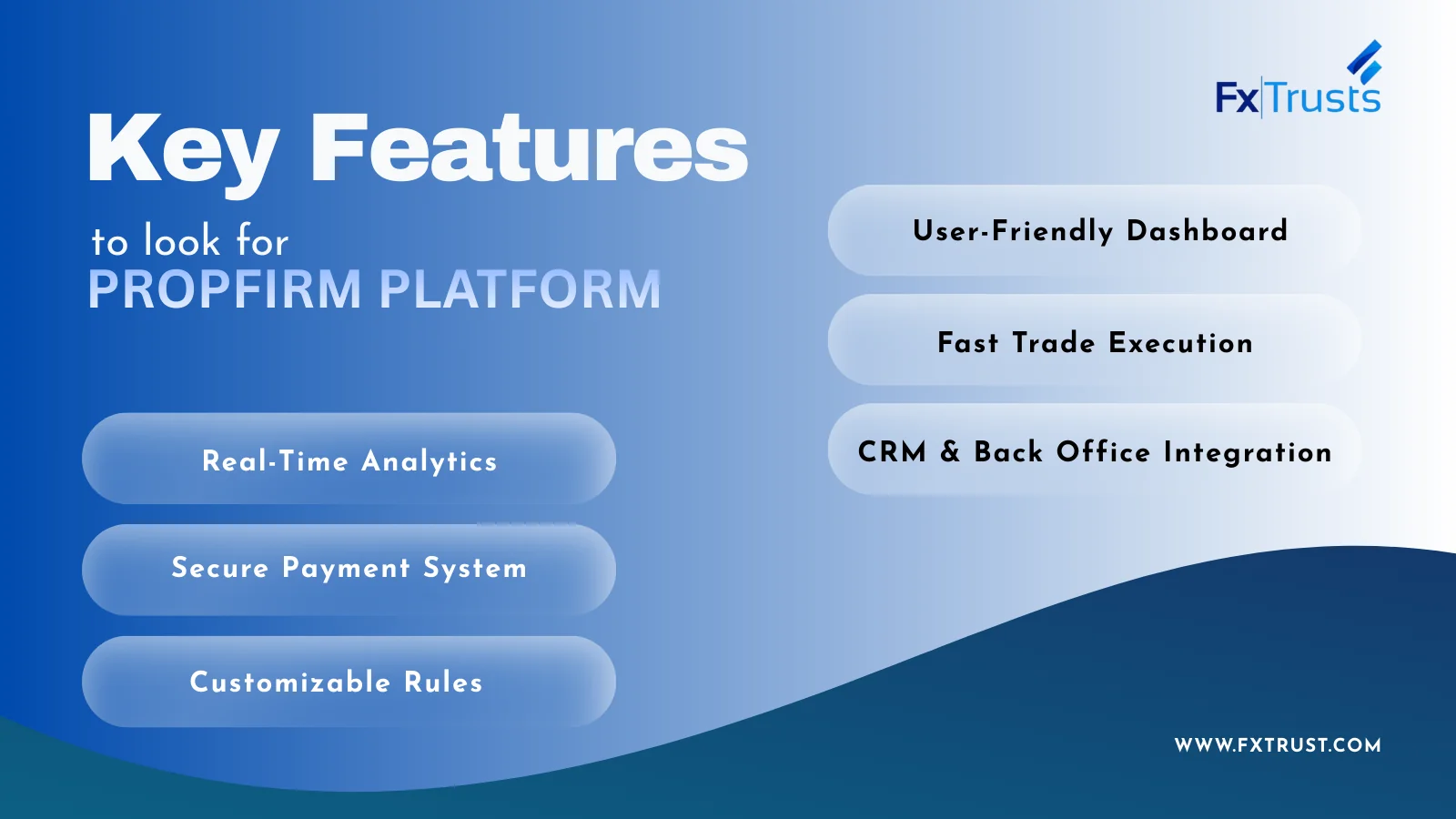
Challenge Engine Flexibility: The Most Important Criterion
Of everything on this list, challenge engine flexibility deserves the most scrutiny, because challenge structure is the core lever a prop firm has over its own profitability and pass rates. A platform that only supports a few rigid, pre-built challenge templates limits a firm's ability to differentiate its offering or adjust rules based on real performance data after launch. Confirm during evaluation whether custom rule combinations (unusual drawdown structures, scaling plans, specific instrument restrictions) are actually configurable, not just theoretically possible.
Anti-Abuse Tooling: Don't Treat This as Optional
Because prop firms are disproportionately targeted by exploit attempts, a platform provider's anti-abuse capability should be evaluated with the same seriousness as the core challenge engine, not treated as a secondary nice-to-have. Ask specifically whether correlation scoring runs in real time, how many risk indicators the system tracks, and whether flagged accounts route to a review queue rather than triggering an automatic, potentially incorrect account closure.
Bundled vs. Standalone Prop Firm Technology
Some providers, like FxTrusts, offer prop firm platform tooling bundled with broader white label brokerage infrastructure — useful for firms considering both business lines or wanting shared CRM/payment infrastructure. Others offer prop firm technology as a standalone, platform-agnostic product for firms that specifically only need challenge-engine tooling without a broader brokerage stack. Neither is universally better; the right choice depends on whether a firm's plans extend beyond pure prop trading.
Related reading:
· Prop Firm Software
· How to Launch a Prop Trading Firm
· How Prop Firms Detect Abuse
Frequently Asked Questions
What's the most important feature to evaluate in a prop firm platform provider?
Challenge engine flexibility, since this directly determines a firm's ability to design and adjust its core product (the challenge itself) based on real performance data after launch.
Should anti-abuse tooling be a dealbreaker if it's weak?
It's worth treating as a serious factor, given how disproportionately prop firms are targeted by exploitation attempts — a platform with only basic rule enforcement and no real-time detection leaves a firm more exposed than one with genuine correlation-scoring capability.
Can a prop firm switch platform providers after launching?
Yes, though migration involves transferring challenge and funded-account data, which requires planning — it's generally easier to switch during a lower-volume period with advance client communication.
Is a bundled or standalone prop firm platform better?
It depends on business plans — bundled options suit firms considering broader brokerage operations alongside prop trading; standalone platforms suit firms focused purely on the prop trading model without other infrastructure needs.