Prop Firm Software Guide | FxTrusts
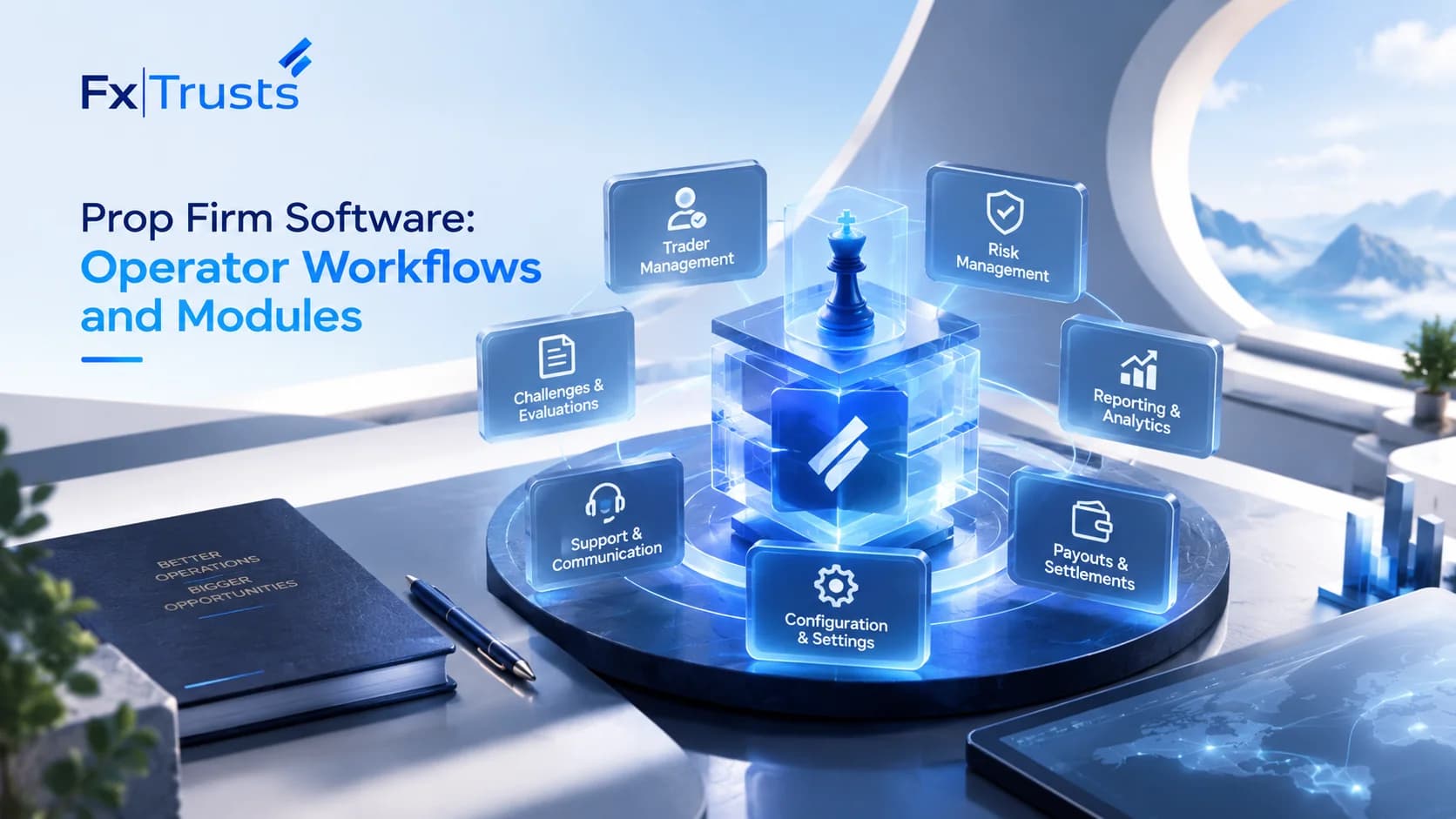
Prop firm software: operator workflows and modules can organize participant onboarding, rule administration, account operations, reporting, and support in one operating framework. The right choice depends on the firm’s model, controls, integrations, and oversight needs. Start with documented workflows, then test how each module handles exceptions and operational risk.
Prop firm software: operator workflows and modules: definition and decision context?
Prop firm software: operator workflows and modules refers to the connected tools and processes used to administer a proprietary trading business. It can cover participant intake, rule configuration, account administration, monitoring, reporting, communications, and support.
The useful question is not whether a platform has many modules. It is whether those modules reflect the firm’s actual operating model. A firm should be able to describe how a participant moves from initial registration through verification, account allocation, rule monitoring, review, and any later support or decision point. That description becomes the basis for software evaluation.
Some teams may need a broad operating layer, while others may already have separate systems for payments, identity checks, trading connectivity, or customer relationship management. In either case, the evaluation should focus on handoffs, ownership, auditability, and the way information moves between systems. A Platform overview can help frame those questions without replacing technical or compliance review.
Terminology can also create confusion. A module may be marketed as a workflow, dashboard, CRM, rule engine, or reporting layer while performing overlapping functions. Ask what the component actually records, what it can change, who can access it, and how an operator can review a disputed or unusual case.
Who should consider prop firm software: operator workflows and modules?
Teams should consider this type of software when manual processes, disconnected tools, or unclear ownership make daily administration difficult to control. It may be relevant to a new prop-firm operator, an established business replacing spreadsheets, or a fintech team coordinating several technology providers.
New operators should begin with process design rather than assuming that a platform will define the business for them. Before comparing products, document the participant journey, the firm’s rules, the events that require review, and the records that must be retained. This exposes gaps that a product demonstration can otherwise hide.
Existing operators may have a different need. They may be looking for fewer manual handoffs, clearer reporting, better support queues, or a consistent way to manage rule-related cases. In that situation, the central question is whether a new layer will simplify operations or add another source of conflicting data.
Teams with broader brokerage ambitions should separate prop-firm requirements from broker infrastructure requirements. A Forex white label may address a different operating context than a participant-management system. Similarly, payment, identity, compliance, and trading components may require separate diligence. The decision should follow the intended business model, not the vocabulary used in a sales presentation.
Benefits and practical limitations
A connected operating layer can make responsibilities easier to assign and can give teams a shared place to review participant activity, account status, communications, and operational exceptions. It may also help teams standardize recurring tasks, provided the underlying workflow is designed clearly.
Those benefits are not automatic. A platform can preserve a poorly designed process just as efficiently as a sound one. Configuration choices, permission design, data quality, and staff training all affect the usefulness of the system. A visually polished dashboard does not by itself demonstrate that the records are complete or that a disputed outcome can be reconstructed.
Potential advantages
- Centralizes related operational tasks and reduces unnecessary handoffs.
- Creates a clearer structure for participant support and case review.
- Can make recurring reporting and internal ownership easier to organize.
Practical limitations
- Requires careful configuration of rules, permissions, and escalation paths.
- May create integration dependencies with trading, payment, identity, or CRM systems.
- Does not replace legal, compliance, operational, or security judgment.
Teams should therefore test the complete workflow, including failure states. Ask what happens when information is incomplete, a payment is disputed, an account needs review, a participant raises a complaint, or two systems show different statuses. These scenarios often reveal more than a standard demonstration.
For firms that also operate broader trading services, it may be useful to compare the workflow with the firm’s wider prop firm software requirements. The goal is not to collect modules. It is to build a controlled operating process.
Prop firm compliance & reporting software and the reader decision
Compliance and reporting software should be assessed as part of an operating control framework, not as a substitute for professional advice. The system should support the records, review steps, permissions, and reporting routines that the firm has identified with qualified legal and compliance professionals.
Start by listing the decisions that need evidence. These may include participant onboarding, identity or eligibility checks, account changes, rule-related reviews, payment events, communications, complaints, and management reporting. The precise obligations depend on the firm’s structure and jurisdictions, so the software review should not assume that one configuration fits every operation.
Reporting also needs a defined audience. An operator may need a queue for unresolved cases, a manager may need an overview of operational exceptions, and a compliance professional may need records that can be reviewed in context. A system that produces attractive summaries but makes underlying records difficult to inspect may not meet the practical need.
Integration questions matter here. Teams should ask which system is authoritative for each data type, how changes are synchronized, how failed exchanges are surfaced, and whether access can be limited by role. If the firm uses a wider compliance or licensing workstream, its Licensing & compliance planning should be considered alongside the software assessment.
Payment operations should be reviewed in the same disciplined way. A connection to Payment infrastructure may affect onboarding, reconciliation, support, and case handling. Treat each integration as an operational dependency that needs ownership and testing.
What risks should readers verify before choosing prop firm software: operator workflows and mo
Readers should verify how the system handles data ownership, permissions, exceptions, integrations, record retention, support, and changes to business rules. These are practical risk areas because a workflow can appear complete while leaving unclear responsibility at its boundaries.
Begin with access control. Identify which users can view participant records, change rules, approve actions, resolve cases, or export information. Then ask whether those permissions can be reviewed and adjusted as responsibilities change. Avoid assuming that a role label alone proves adequate separation of duties.
Next, examine data continuity. Ask how the platform handles a failed integration, a duplicate record, a delayed update, or a disagreement between systems. The answer should describe an operator action, not merely a technical status message. Teams should also establish who investigates the issue and how the resolution is documented.
Commercial and operational dependency deserves attention as well. Clarify what is included, what requires another provider, how support is delivered, and how changes are communicated. Review the available documentation and test the workflows that matter most before making a commitment. The site’s API docs can be relevant when integration responsibilities need technical clarification.
Finally, keep regulatory framing general unless qualified professionals have assessed the specific model and jurisdictions. This article does not determine whether a firm may operate, what permissions it needs, or how its controls should be implemented.
Conclusion
Prop firm software should be evaluated as an operating system for workflows, controls, records, and support rather than as a collection of isolated features. The practical starting point is a documented participant journey with clear ownership at every handoff.
From there, compare rule administration, account operations, reporting, integrations, permissions, exception handling, and support. Give limitations equal attention to potential efficiencies, and test realistic failure scenarios before relying on a platform in production.
Teams can use the PAMM/MAM copy trading resource when adjacent trading infrastructure is part of the wider technology discussion. The appropriate next step is a structured technical, operational, legal, and compliance review based on the firm’s own model.
Sources
Frequently Asked Questions
What is prop firm software: operator workflows and modules?
Prop firm software: operator workflows and modules is an operating framework for organizing participant onboarding, rule administration, account operations, reporting, communications, and support. Its value depends on how well the configuration reflects the firm’s actual processes. Teams should assess permissions, integrations, exceptions, and records rather than relying on feature labels alone.
Is prop firm software: operator workflows and modules suitable for the target audience?
It may suit prop-firm operators and fintech teams that need to coordinate recurring workflows, records, support, and reporting. Suitability cannot be determined from a general description alone. The team should compare the system with its business model, existing technology, operational responsibilities, and professional compliance requirements before making a decision.
How should readers evaluate prop firm software: operator workflows and modules safely?
Evaluate it through documented workflows and realistic exception scenarios. Review access permissions, data ownership, integrations, support arrangements, reporting, record handling, and rule changes. Ask qualified legal and compliance professionals to assess the intended model and jurisdictions, because software selection does not determine whether a business may operate or what obligations apply.