
Multi-Asset Brokerage: Model, Asset Classes and Technology Needs
A multi-asset brokerage gives clients access to more than one class of tradable instrument, such as forex, CFDs on indices, precious metals, cryptoassets and shares, through a shared client and back-office core. Each asset class still needs its own instrument specification, liquidity source, risk settings and permission check.
FxTrusts supplies brokerage technology and implementation services, so this guide includes our commercial perspective. It is general information, not legal, tax or investment advice. Trading CFDs and other leveraged products carries a high risk of losing money quickly.
On this page
- What a multi-asset brokerage offers
- Asset classes and the technology each one needs
- Instrument setup for each asset class
- Liquidity, pricing and execution across asset classes
- Risk, leverage and regulatory treatment by product
- One back office for several asset classes
- Scoping a multi-asset launch
- Key takeaways
- Frequently asked questions
What a multi-asset brokerage offers
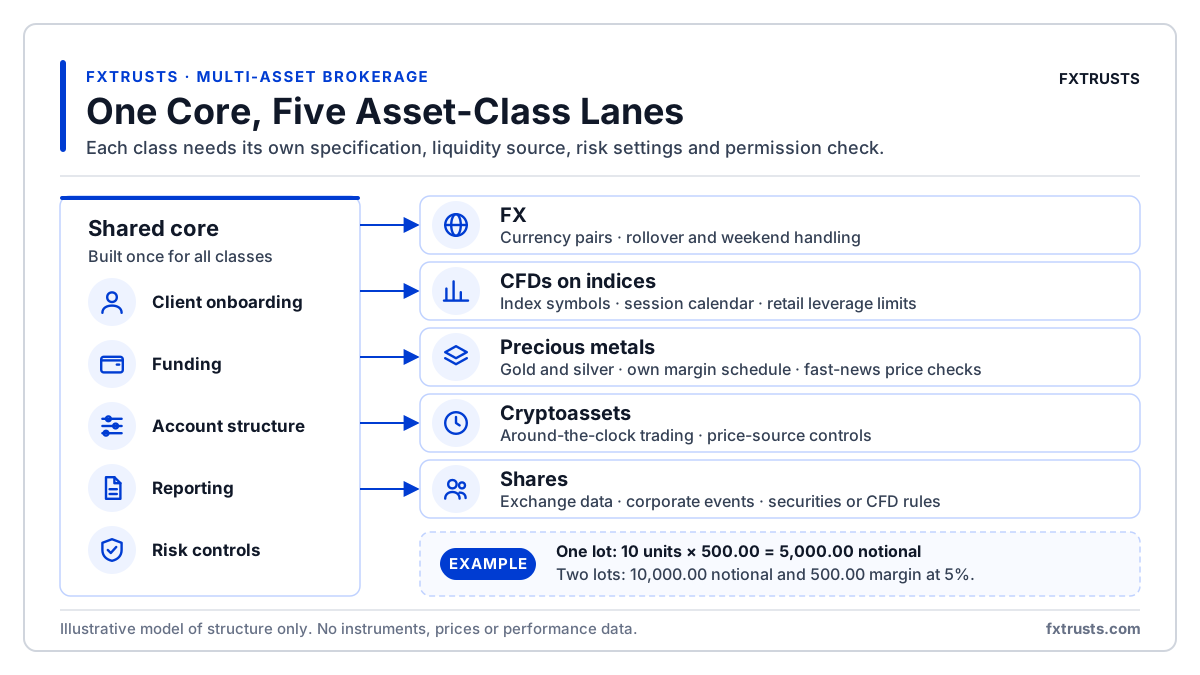
A multi-asset brokerage lets clients access more than one class of tradable instrument, such as forex pairs, CFDs on indices, precious metals, cryptoassets and shares, through one brokerage business. The model is less about a single trading screen and more about a shared core: client onboarding, funding, account structure, reporting and risk controls that serve every asset class, with separate connections for each market.
The model differs from a single-asset forex broker in three ways. Instrument specifications multiply, so each product needs its own contract size, tick value, trading hours and margin rule. Liquidity and market data come from different sources. Regulatory treatment can change by product, so a permission for one class does not automatically cover another.
The diagram separates the shared core from the asset-class lanes. The core is built once. Each lane needs its own checks before a product goes live, and the table in the next section lists those checks for each class.

Asset classes and the technology each one needs
The table sets out the common asset classes and the technology and operations work each one adds. Treat it as a planning checklist, not a statement of what any provider or jurisdiction permits. Confirm the instrument, permission and contract terms for each class before you offer it to clients.
| Asset class | What clients trade | Technology and operations need | Verify before listing |
|---|---|---|---|
| FX | Currency pairs, often offered as spot or rolling spot contracts | Symbol specification, quote feed, margin and swap rules, rollover and weekend handling | Entity permission for leveraged FX, execution model and liquidity terms |
| CFDs on indices | Contracts that track an index price | Index symbol mapping, session calendar, contract sizing and provider handling of index events | Retail leverage limits and standardised risk warnings in each target market |
| Precious metals | Spot-style contracts such as gold and silver | Metal contract specification, separate margin schedule, price-feed checks during fast news moves | Provider terms and whether the product may be offered in the client’s market |
| Cryptoassets | Cryptoasset CFDs or spot crypto, where permitted; the UK bans crypto derivatives for retail clients | Trading around the clock, price-source controls, and wallet and payment flows only if you hold assets | Product classification, applicable crypto rules and the policy of your payment partner |
| Shares | Shares or share CFDs | Exchange data and trading hours, corporate-event handling, custody or CFD treatment | Whether the product is a securities service or a CFD, and which market rules apply |
- FXWhat clients trade: Currency pairs, often offered as spot or rolling spot contractsTechnology and operations need: Symbol specification, quote feed, margin and swap rules, rollover and weekend handlingVerify before listing: Entity permission for leveraged FX, execution model and liquidity terms
- CFDs on indicesWhat clients trade: Contracts that track an index priceTechnology and operations need: Index symbol mapping, session calendar, contract sizing and provider handling of index eventsVerify before listing: Retail leverage limits and standardised risk warnings in each target market
- Precious metalsWhat clients trade: Spot-style contracts such as gold and silverTechnology and operations need: Metal contract specification, separate margin schedule, price-feed checks during fast news movesVerify before listing: Provider terms and whether the product may be offered in the client’s market
- CryptoassetsWhat clients trade: Cryptoasset CFDs or spot crypto, where permitted; the UK bans crypto derivatives for retail clientsTechnology and operations need: Trading around the clock, price-source controls, and wallet and payment flows only if you hold assetsVerify before listing: Product classification, applicable crypto rules and the policy of your payment partner
- SharesWhat clients trade: Shares or share CFDsTechnology and operations need: Exchange data and trading hours, corporate-event handling, custody or CFD treatmentVerify before listing: Whether the product is a securities service or a CFD, and which market rules apply
Cryptoassets and shares can fall under different legal and operational rules from FX, so one permission or platform agreement rarely covers them all. Ask advisers how each product is classified before it goes on your price list.
Instrument setup for each asset class
A trading platform must hold a complete instrument specification for each product, not only a symbol name. MetaQuotes describes MetaTrader 5 as supporting different asset classes, including forex and futures, and says brokers can run their business across forex, stock exchange and futures markets. That page does not present CFDs or cryptoassets as platform categories, so confirm how each product is configured and what your contracting provider allows.
FxTrusts’ platform page lists the MT5 white label, mobile app and CRM and back-office components. For the scope of a particular deployment, read the hosted platform access page and the signed proposal rather than a general product list.
Each symbol needs a contract size, tick size and value, margin requirement, trading session and swap or financing rule. A change to any of these changes the client’s exposure, so store them under change control with a named approver.
Illustrative example
Imagine a hypothetical index CFD with 10 units per lot, a quoted price of 500.00 and a margin requirement of 5% of notional. One lot has a notional value of 5,000.00, so two lots carry 10,000.00 of notional and 500.00 of required margin. These numbers only show the arithmetic. They are not market data, not a product offered in any market and not a margin rule to copy.
Liquidity, pricing and execution across asset classes
Each asset class draws on a different liquidity source. FX and metals may be routed to a bridge or liquidity provider. Indices and shares may depend on exchange or CFD counterparties. Cryptoasset prices often come from several venues with different trading hours. Map each product to its counterparty and record who carries the market risk of the client’s position.
Price sourcing changes between classes as well. A feed that is accurate for major FX pairs may not show the trading hours, price precision or corporate-event handling that shares need. Keep one symbol-mapping table for all classes, and test quote quality product by product rather than across the whole book.
- Map each instrument to its liquidity source, price feed and trading session.
- Set price precision and tick rules per symbol, and test the displayed price against the source.
- Report execution outcomes by asset class, so a problem in one market is not hidden by an average.
- Document whether each class is internalised, routed externally or split, because the disclosure may differ.
FxTrusts’ forex liquidity connectivity page covers bridge, gateway and FIX links to a forex liquidity provider. It does not cover index, share or crypto liquidity, so each of those classes needs its own counterparty scope. Funding flows are common to every asset class, so review the payment infrastructure page for the deposit and withdrawal side as well.
Risk, leverage and regulatory treatment by product
A multi-asset brokerage can carry more risk than a single-product business, because a problem in one class can reach a client’s overall balance and the firm’s own exposure. Leveraged products carry a high risk of losing money quickly, and the disclosure has to say so for every class you offer.
In the UK, the FCA’s retail CFD rules cap leverage between 30:1 and 2:1 depending on the underlying asset. They require firms to close a position when the client’s funds fall to 50% of the margin needed to keep it open, and to protect clients so they cannot lose more than the funds in their account. A standardised risk warning is also required. These rules apply to CFDs sold to retail clients in the UK. Crypto derivatives are a separate case: the FCA banned their sale to UK retail consumers from 6 January 2021, so the CFD leverage range above does not make crypto CFDs available to UK retail clients. These rules are one example, not a template for other markets.
The same product can carry different rules in different markets. Check each target country for leverage limits, marketing rules and client categorisation. The CFD glossary entry explains the product type.
One back office for several asset classes
The shared core is where a multi-asset model saves effort, but only if the data model separates clients from instruments. A client account should hold identity, KYC status and funding once. Each trading account then needs its own asset-class permissions, instrument group and risk limits, so approval for FX does not switch on shares.
| Back-office area | Single-asset setup | Multi-asset requirement |
|---|---|---|
| Account types | One trading group for one product set | Groups by asset class, leverage limit and client category |
| Reporting | One profit and loss view | Profit, exposure and margin by asset class, currency and client |
| Commissions and introducers | One rate structure | Rules per asset class, because contract sizes and fees differ |
| Reconciliation | Balances and trades matched daily | Trades, swaps, fees and corporate events matched per instrument type |
| Access control | One product team | Separate rights to list, price and change each instrument |
- Account typesSingle-asset setup: One trading group for one product setMulti-asset requirement: Groups by asset class, leverage limit and client category
- ReportingSingle-asset setup: One profit and loss viewMulti-asset requirement: Profit, exposure and margin by asset class, currency and client
- Commissions and introducersSingle-asset setup: One rate structureMulti-asset requirement: Rules per asset class, because contract sizes and fees differ
- ReconciliationSingle-asset setup: Balances and trades matched dailyMulti-asset requirement: Trades, swaps, fees and corporate events matched per instrument type
- Access controlSingle-asset setup: One product teamMulti-asset requirement: Separate rights to list, price and change each instrument
FxTrusts’ Trader’s Room page covers the CRM and client portal side. Test it with a client who holds two asset classes, because permission and reporting errors usually appear where two products meet.
Scoping a multi-asset launch
Start with the list of products and countries, not the platform. For each product, answer the permission question, the instrument specification, the liquidity source, the risk settings and the client disclosure. Then choose the technology that supports the approved list.
- Confirm the entity and the permissions for each product and each client country.
- Write an instrument specification sheet per product, signed off by operations and risk.
- Agree in writing which platform and provider scope covers the approved instruments.
- Agree liquidity and payment routes per asset class, with the counterparty terms.
- Test each asset class in a sandbox, then pilot a small product set before wider listing.
The answer on selecting brokerage instruments sets out the questions to settle before you commit. For the wider sequence of approvals and dependencies, read how to start a forex broker. The pricing page lists FxTrusts’ published scope, including Hosted MT5 Manager Access at $3,500 per month, which depends on written platform and host authorisation. That line does not cover your permissions or your asset-class list.
Key takeaways
- A multi-asset brokerage shares one client core, but each asset class needs its own specification, liquidity source and risk check.
- A permission for one product does not cover another. Check each asset class and each client country separately.
- Keep instrument specifications as governed data with a named approver, not as a loose symbol list.
- Test an account that holds two asset classes before you open the second class to clients.
- Scope platform, CRM and liquidity in writing, and treat published prices as scope lines, not as a full launch budget.
Frequently asked questions
What is a multi-asset brokerage?
A multi-asset brokerage offers clients more than one class of tradable instrument, such as forex, CFDs on indices, metals, cryptoassets and shares. It usually runs a shared client, funding and reporting core, with separate product setup, liquidity and risk controls for each asset class. Whether a product can be offered depends on the firm’s permissions in each market.
How does a multi-asset brokerage differ from a forex broker?
A forex broker typically offers currency pairs and closely related products. A multi-asset brokerage adds other instrument classes, each with its own specification, trading hours, data and counterparties. The operational difference is usually larger than the marketing difference, and the regulatory treatment depends on the product.
Does MetaTrader 5 support every asset class?
Not automatically. MetaQuotes describes MetaTrader 5 as supporting different asset classes, including forex and futures, but platform capability is only one part of the answer. The instruments you can offer depend on the platform configuration, the provider scope, your liquidity arrangements and the permissions that apply in each client country. Ask for a written instrument list before you rely on it.
Which asset class is hardest to add to a brokerage?
It depends on your permissions and counterparties. Cryptoassets often raise payment, custody and price-source questions. Shares add exchange data, corporate events and possibly securities rules. Indices and metals are often simpler on the technology side. Score each class against the same checklist before you decide the order.
What does it cost to run a multi-asset brokerage?
The cost depends on the asset classes, platform route, CRM and liquidity scope, and your permissions. FxTrusts publishes Hosted MT5 Manager Access at $3,500 per month, a hosted arrangement that depends on written platform and host authorisation. Its prop-firm CRM, risk and admin package is $1,000 per month, excluding the trading-platform licence and third-party API charges. That package is not a general brokerage CRM price. Budget regulatory capital, client funds and working capital separately.
Related FxTrusts resources
- FxTrusts MT5 white label platform
- How to start a forex broker: routes and timeline
- CFD: definition and retail rules
- Hosted trading platform access scope
Sources
- FCA: contracts for difference (CFDs), retail rules
- FCA: ban on the sale of crypto-derivatives to retail consumers
- MetaQuotes: MetaTrader 5 for brokers
Scope your asset-class list with FxTrusts
Share the entity, client countries and asset classes you plan to offer, and we will explain what the scope covers.
Contact FxTrusts