Forex CRM Software Comparison: Compare Client Journeys
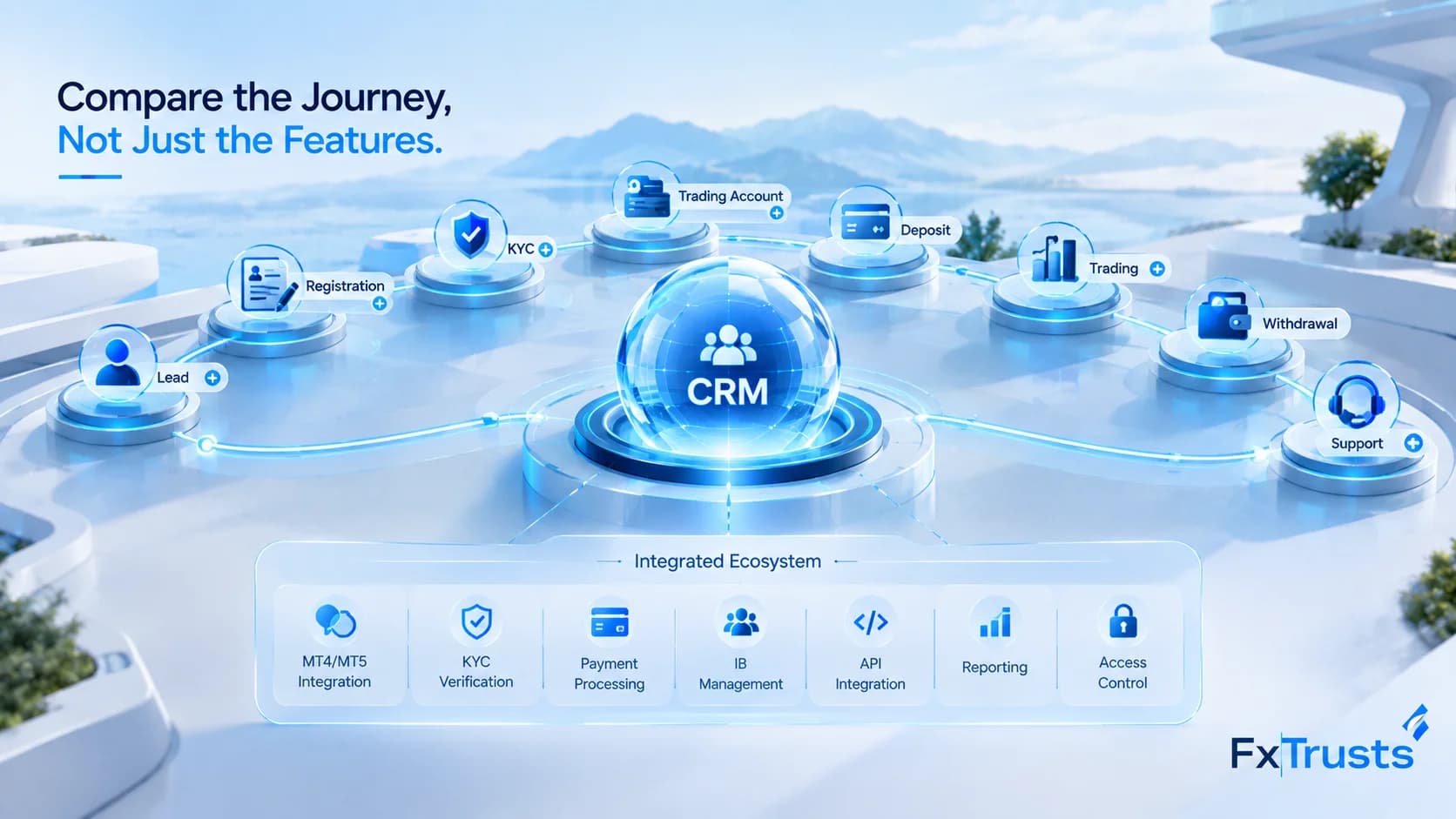
Forex CRM Software Comparison: Comparable Client Journeys
Choosing between forex CRM providers requires more than comparing feature lists. A brokerage may need lead management, KYC, trading-account integration, payments, IB management, reporting, support, and a client portal — but the real question is whether those systems work together across the complete client journey.
A practical broker CRM comparison should therefore follow the client from first contact to registration, verification, funding, trading, withdrawal, and ongoing support.
This approach also fits the broader brokerage technology model described by MetaTrader 5, which identifies CRM, KYC, trading infrastructure, liquidity, payment providers, and other technology components as part of setting up a brokerage.
What Is a Forex CRM?
A forex CRM is the operational system used to manage relationships between a brokerage and its clients.
Unlike a conventional sales CRM, a broker-focused CRM often needs to connect:
- Lead management
- Client onboarding
- KYC/AML
- Trading accounts
- Deposits and withdrawals
- IB and affiliate structures
- Client support
- Reporting
- Marketing and retention
The complete journey can look like:
Lead → Registration → KYC → Trading Account → Deposit → Trading → Withdrawal → Support
FxTrusts describes its Forex CRM & Trader's Room as a combined broker CRM, back office, IB portal, and client-facing portal supporting onboarding, KYC, payments, MT4/MT5 account management, deposits, withdrawals, rebates, and support workflows.
Forex CRM Comparison: Follow the Client Journey
1. Lead to Registration
The first test is how a CRM handles new prospects.
A broker should check whether the system can:
- Capture leads from websites and campaigns
- Assign leads to sales users
- Track conversion stages
- Maintain client history
- Identify referral or IB sources
- Connect registration information to the eventual client profile
The important point is continuity. A lead should not become a completely separate record once registration begins.
FxTrusts currently describes lead pipelines, assignment, lifecycle management and marketing workflows within its CRM environment.
2. Registration to KYC
KYC is one of the most important stages in the client journey.
A useful CRM feature checklist should ask:
| Area | What to Verify |
|---|---|
| Documents | What can clients upload? |
| Verification | Which provider is integrated? |
| AML | What screening workflow exists? |
| Review | Who approves applications? |
| Audit | Are decisions and timestamps recorded? |
| Exceptions | Can incomplete applications be returned? |
FxTrusts lists automated KYC/AML workflows and integrations including Sumsub and Onfido on its current Trader's Room page.
For regulatory due diligence, brokers should independently define their applicable KYC and customer-due-diligence obligations rather than treating a CRM's "KYC-ready" claim as proof of compliance.
3. KYC Approval to Trading Account
After verification, the client generally needs a trading account.
For a broker using MT4 or MT5, the CRM comparison should examine:
- Account creation
- Account-type assignment
- MT4/MT5 synchronization
- Balance and equity visibility
- Account status
- Internal transfers
- Error handling
- Client credential workflows
MetaTrader's own brokerage guidance specifically identifies CRM and KYC as connected parts of the wider brokerage technology stack.
FxTrusts states that its Trader's Room supports real-time MT4/MT5 synchronization and account-management workflows.
For brokers considering the complete platform stack, the Forex White Label page covers MT5 infrastructure, CRM, liquidity connectivity, KYC, payments and related implementation components.
4. Trading Account to First Deposit
Funding is another major test.
The CRM should show the relationship between:
Deposit Request → Payment Processing → Transaction Status → Account Funding → Reconciliation
Questions to ask include:
- Which PSPs are supported?
- Is payment status synchronized automatically?
- Can finance teams reconcile transactions?
- Are failed payments recorded?
- Can clients see their transaction history?
- Are multiple currencies supported?
FxTrusts currently describes deposit and withdrawal workflows, multi-currency wallets, payment integrations and transaction tracking within its Trader's Room solution.
For a broader payment-focused deployment, brokers can also review the site's Payment & Financial Infrastructure offering.
5. Active Client and IB Management
Once a client is funded, the CRM becomes an ongoing operational system.
The brokerage may need to manage:
- Active and inactive clients
- Trading accounts
- Client segmentation
- Support requests
- Deposits and withdrawals
- IB relationships
- Rebates and commissions
- Retention campaigns
IB functionality deserves particular attention because a simple affiliate field is not equivalent to a full multi-tier partner structure.
A vendor demonstration should test:
IB Created → Client Assigned → Trading Activity → Commission Calculated → Report Generated
FxTrusts currently lists multi-tier IB and affiliate commission functionality as part of its broker CRM offering.
For brokers requiring copy-trading or managed-account workflows, the relevant PAMM, MAM & Copy Trading solution should be evaluated separately rather than assuming those functions are automatically included in every CRM package.
Forex CRM Feature Checklist
A practical vendor scorecard can use the following structure:
| Capability | Evidence to Request |
|---|---|
| Lead management | Live workflow |
| KYC/AML | Provider + workflow documentation |
| MT4/MT5 | Integration demonstration |
| Trader's Room | Complete client journey |
| Payments | Deposit/withdrawal test |
| IB management | Commission calculation |
| API | Current API documentation |
| Reporting | Sample reports |
| Permissions | Role/access matrix |
| Security | Security documentation |
| Implementation | Responsibility matrix |
| Support | Escalation process |
| Pricing | Dated commercial proposal |
This prevents vendors from being compared solely on the number of features listed on a sales page.
CRM Proof of Concept
A CRM proof of concept should use realistic workflows.
For example:
Test 1: New Client
Lead → Registration → KYC → Approval → MT5 Account → Deposit
Test 2: Existing Client
Login → Account Management → Internal Transfer → Support Request → Transaction History
Test 3: Withdrawal
Withdrawal Request → Compliance Review → Approval → Payment Processing → Status Update
Test 4: IB
IB Registration → Client Referral → Trading Activity → Commission Calculation → Reporting
The objective is to discover whether the systems actually communicate correctly.
This is particularly important because MetaTrader's brokerage guidance recommends testing trading conditions, risk management, client onboarding, and client-fund processes before going live.
Integration and Implementation Responsibility
A CRM proposal should clearly identify who owns each part of the implementation.
| Workstream | Vendor | Broker | Third Party |
|---|---|---|---|
| CRM configuration | Configure | Approve | — |
| KYC integration | Technical setup | Compliance approval | KYC provider |
| MT5 connection | Integration | Platform approval | Platform provider |
| Payments | Technical setup | Commercial approval | PSP |
| IB configuration | Configure | Commission rules | — |
| UAT | Support | Sign-off | Relevant provider |
| Production launch | Deploy | Approve | As applicable |
For brokers evaluating a complete technology stack, the MT5 White Label offering can be assessed alongside the CRM rather than treating the CRM as a standalone product.
Likewise, infrastructure requirements should be separated from CRM functionality. MetaTrader's official documentation notes that brokerage technology involves hosting, liquidity, payment providers, CRM, KYC and other components.
How to Compare Forex CRM Providers
A structured comparison should ask every provider the same questions:
- Which trading platforms are supported?
- How deep is the MT4/MT5 integration?
- Which KYC providers are supported?
- Which payment providers are integrated?
- How are deposits reconciled?
- How are withdrawals approved?
- Does the system support multi-tier IB structures?
- What APIs are available?
- How are administrator permissions controlled?
- Who manages hosting and infrastructure?
- Who maintains integrations?
- What is included in implementation?
- What requires separate third-party contracts?
- What happens when an integration fails?
- How is data exported if the relationship ends?
For brokers considering more than CRM alone, FxTrusts also separates its broader technical and operational infrastructure from the CRM layer, which can help when defining implementation responsibilities.
Final Takeaway
A useful forex CRM software comparison should follow the client journey rather than simply count features.
Start with:
Lead → Registration → KYC → Trading Account → Deposit → Trading → Withdrawal → Support
Then test every stage with documented integrations, live demonstrations, API information, security documentation and a clearly defined implementation responsibility matrix.
The goal is not to find the vendor with the longest feature list. It is to establish whether the proposed CRM can support the brokerage's actual workflows and integrate reliably with its trading, payment, compliance and operational systems.
For brokers assessing a complete technology setup, the FxTrusts platform currently brings together broker CRM, Trader's Room, MT5/RTX5 infrastructure, liquidity, payments and related brokerage technology services.
Sources
-
MetaTrader 5 — How to Start a Brokerage Business
Official MetaTrader source covering brokerage technology, CRM, KYC, liquidity, hosting and related infrastructure.
MetaTrader 5 — How to Start a Brokerage Business -
FATF — Customer Due Diligence
Official Financial Action Task Force material for KYC/customer due-diligence context.
FATF — Customer Due Diligence -
FATF — Risk-Based Approach for the Securities Sector
Useful authoritative source for risk-based AML/CFT considerations relevant to financial-services businesses.
FATF — Risk-Based Approach for the Securities Sector -
FxTrusts — Forex CRM & Trader's Room
Primary product source for the CRM, Trader's Room, onboarding, KYC, MT4/MT5, payments and IB-related capabilities discussed in the article.
FxTrusts — Forex CRM & Trader's Room -
FxTrusts — Forex White Label
Primary source for the wider brokerage technology stack and integration context.
FxTrusts — Forex White Label
Frequently Asked Questions
What is a forex CRM?
A forex CRM is software designed to manage brokerage client relationships, including leads, onboarding, KYC, trading accounts, payments, IB relationships, support and reporting.
What should I compare when choosing a forex CRM?
Compare trading-platform integration, KYC/AML workflows, payment connectivity, IB management, client portals, reporting, APIs, permissions, security, implementation scope and support.
Does a forex CRM need MT4 or MT5 integration?
For brokers using MetaTrader, integration can be an important requirement because client-account and operational workflows may need to exchange information with the trading environment.
What is a Trader's Room?
A Trader's Room, also called a client cabinet or client portal, is the client-facing environment where traders can register, complete KYC, manage accounts, deposit funds, request withdrawals and access support.
Why is KYC important in a forex CRM?
KYC helps a brokerage manage identity-verification and customer-onboarding processes. The exact regulatory requirements depend on the broker's jurisdiction and business model.
What should a CRM proof of concept include?
A POC should test realistic workflows such as registration, KYC, trading-account creation, deposit, withdrawal, IB commission calculation and support.