MT5 CRM Software
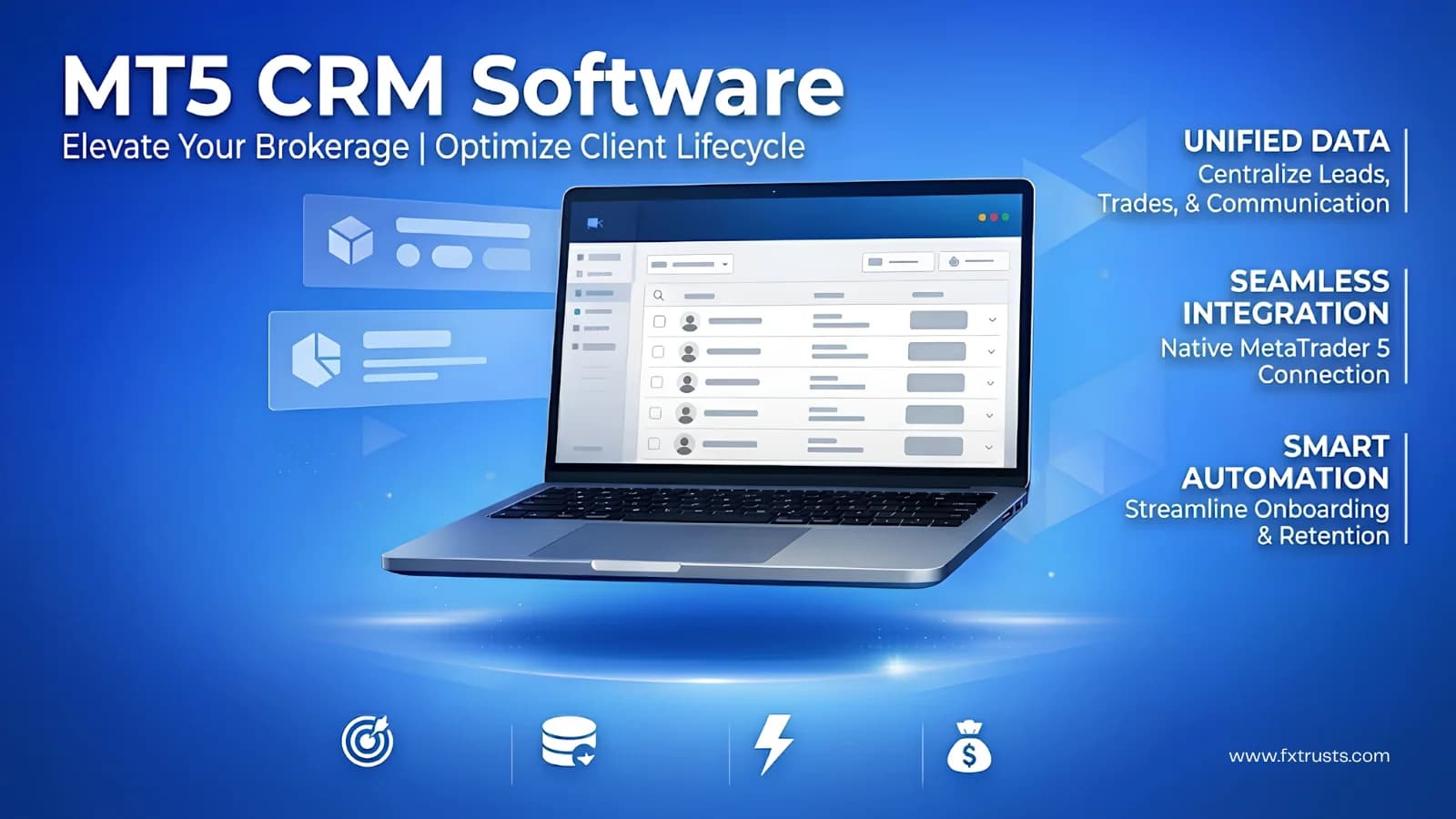
MT5 CRM Software That Removes Operational Friction for Forex Brokers
Most brokerage founders discover the same hard truth within the first 90 days of going live on MetaTrader 5. The trading platform executes orders flawlessly. Everything else—lead follow-up, document collection, account provisioning, deposit crediting, and IB payouts—lives in spreadsheets, email threads, and disconnected tools. The result is delayed clients, disputed commissions, and support tickets that never stop.
MT5 CRM software closes that gap. It sits between your MT5 server and every operational team, turning manual work into automated, auditable workflows. This page focuses on the practical capabilities, technical requirements, and deployment path that decision-makers need when they are ready to move from spreadsheets to a production-grade system.
Ready to see real-time MT5 account sync and automated KYC in action?
Request a live technical walkthrough tailored to your current server setup and client volume.
How MT5 CRM Software Solves Forex Brokerage Challenges
Brokers running MT5 without a dedicated CRM face recurring, expensive problems:
- Leads sit unassigned because no single system owns the pipeline.
- KYC documents arrive by email or WhatsApp and get lost or delayed.
- Deposits require manual bank-statement matching before the trading account is credited.
- IB partners demand commission reports that take hours to compile from MT5 Manager exports.
- Support agents cannot see live equity or open positions while talking to a client.
- Compliance teams lack a clean audit trail when regulators ask questions.
An MT5-native CRM removes these friction points by treating trading accounts, balances, orders, and client records as first-class, synchronized objects. When a client completes KYC, the system can create the MT5 account, assign the correct group and leverage, and notify the client—all without a staff member logging into the Manager terminal.
Key Features & Technical Capabilities

Native MT5 Manager API Synchronization
The foundation of any serious MT5 CRM is a direct, bidirectional connection via the official Manager API (and often Web API). This delivers real-time updates of balance, equity, margin level, open positions, and transaction history into every client profile. Latency is measured in seconds, not minutes. Account creation, password resets, leverage changes, and group moves can be triggered from the CRM and executed on the trading server automatically.
Automated KYC / AML Workflows
Clients upload identity and address documents through a secure portal. The CRM routes them into review queues, integrates with providers such as Sumsub or Onfido for automated checks, and records every decision with timestamps and user IDs. Once approved, the system can instantly provision the MT5 live account and send credentials. Expired documents trigger automated reminders.
Multi-Tier IB and Affiliate Engine
Complex commission structures—CPA, volume rebates, revenue share, hybrid models—are calculated from actual trading data pulled from MT5. Multi-level hierarchies are supported. Partners receive their own portal showing referred clients, volume, and pending payouts. Settlement cycles are configurable, reducing disputes and manual reconciliation.
Centralized Financial Operations
Deposits and withdrawals flow through a wallet layer that supports multiple currencies and payment service providers. Approved deposits credit the linked MT5 account in near real time. Withdrawal requests appear in a controlled queue with status tracking and notifications. Internal transfers between a client’s own accounts are handled without leaving the portal.
Role-Based Dashboards and Reporting
Sales, compliance, finance, and support each see the data and actions relevant to their role. Dashboards surface lead-to-funded conversion rates, deposit success rates, inactive client segments, IB performance, and volume by symbol or group. Full audit logs capture every change for regulatory readiness.
Self-Service Client Portal (Trader’s Room)
Clients manage their own profiles, upload documents, open additional accounts, fund wallets, request withdrawals, and view live trading data without contacting support. Mobile-responsive design and optional white-label branding keep the experience on-brand.
Platform Connectivity & API Integration
A production MT5 CRM must connect cleanly to the rest of the brokerage stack:
- Trading servers: Multiple MT5 (and often MT4) instances with independent groups and symbols.
- KYC providers: Sumsub, Onfido, Jumio, or custom local services via API.
- Payment gateways: 40–50+ PSPs covering cards, e-wallets, bank wires, and crypto.
- Communication: Email, SMS, and optional VoIP or live-chat widgets.
- External systems: Webhooks and REST/Web APIs for custom front-ends, marketing tools, or risk engines.
The best implementations use the Manager API for authoritative trading data and webhooks for event-driven actions (deposit approved → credit account → notify client).
Want to map your current payment providers and KYC flow against a live MT5 CRM instance?
Schedule a 30-minute integration review with a technical specialist.
Solutions Tailored to Your Needs
New Forex Broker Startups Speed to market is everything. A ready MT5 CRM with white-label portal lets a founding team launch client onboarding, funding, and basic IB tracking in days rather than months. Focus remains on acquiring clients instead of building internal tools.
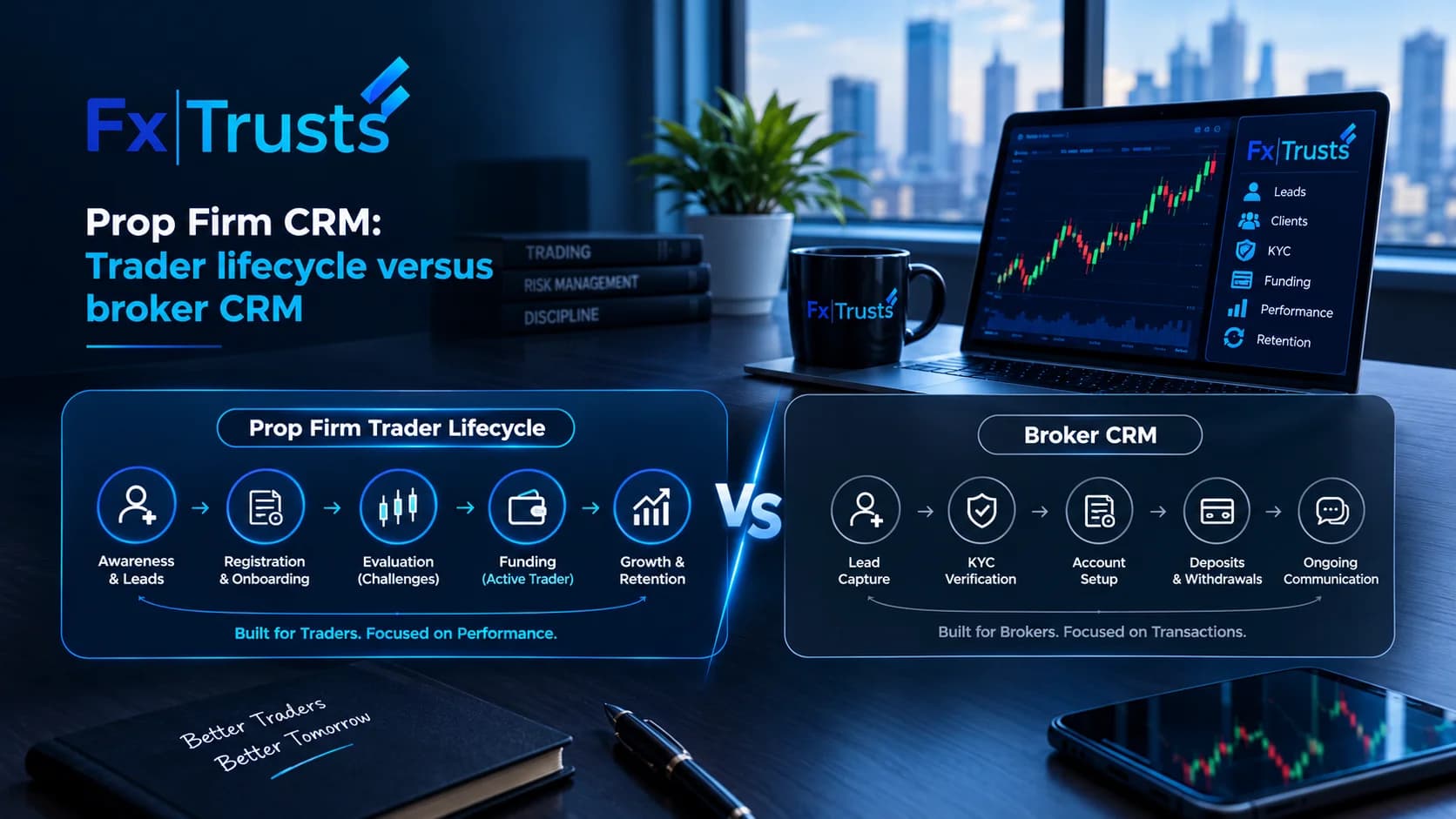
Prop Firm Operators Challenge and evaluation accounts require strict group controls, automated pass/fail logic, and clean separation of evaluation versus funded accounts. An MT5 CRM provides the back-office layer that tracks challenge status, payouts, and risk parameters alongside the trading server.
Established Multi-Asset Brokers When volume grows across forex, metals, indices, and crypto CFDs, manual processes break. Real-time visibility into equity exposure and automated IB calculations become mandatory for accurate P&L and partner payments.
Introducing Broker Networks and White-Label Partners Partners need transparent reporting and reliable commission settlement. A multi-tier IB module inside the CRM turns the partner channel into a scalable, self-service revenue engine.
Implementation & Onboarding Process
A typical professional deployment follows this sequence:
- Discovery & mapping (1–3 days) – Current MT5 server details, existing payment and KYC providers, required commission structures, branding assets.
- Environment provisioning (2–4 days) – Staging and production instances, API credentials, SSL, domain setup.
- Core integration (3–5 days) – Manager API connection, account sync testing, group mapping, basic KYC and wallet flows.
- Configuration & branding (2–4 days) – Role permissions, commission rules, email templates, portal theming.
- Testing & data migration (2–3 days) – Parallel run with a limited client group, historical data import if required.
- Go-live & monitoring – Soft launch, 24/7 observation, staff training.
Many providers complete a standard branded setup in 7–10 business days when the trading server is already live and assets are ready. Complex multi-server or custom PSP work extends the timeline.
Important comparison table – Operational impact of MT5 CRM adoption
| Operational Area | Without Dedicated MT5 CRM | With Native MT5 CRM Software |
|---|---|---|
| Account creation after KYC | Manual Manager terminal steps, hours/days | Automated provisioning in seconds |
| Deposit crediting | Email receipt + manual balance adjustment | Wallet approval → real-time MT5 credit |
| IB commission calculation | Spreadsheet exports from MT5 Manager | Automatic from live volume, multi-tier ready |
| Client support visibility | Separate tools, incomplete trade history | Live equity, positions, and full profile in one view |
| Compliance audit trail | Fragmented emails and files | Timestamped, role-attributed, exportable logs |
| Lead-to-funded conversion | Lost follow-ups, no ownership | Pipeline ownership + automated reminders |
| Staff scaling | Linear headcount growth with volume | Higher client-to-staff ratio via self-service |
Ready to Get Started?
The difference between a brokerage that scales cleanly and one that constantly fights operational fires usually comes down to whether the trading platform and the back office speak the same language in real time. MT5 CRM software is the practical bridge.
Is the client portal (Trader’s Room) fully white-label?
Professional solutions allow logo, color scheme, domain, and email template customization. Clients never see third-party branding. Mobile responsiveness is expected as standard.
Frequently Asked Questions
How does MT5 CRM software actually connect to the trading server?
It uses the official MetaTrader 5 Manager API (and often the Web API). The CRM authenticates with Manager credentials, then reads and writes account data, creates accounts, changes leverage or groups, and receives real-time updates on balances and trades. Proper implementations maintain a persistent or frequently polled connection so the CRM never drifts from the trading server state.
Can the CRM create live and demo MT5 accounts automatically?
Yes. After KYC approval (manual or automated), the CRM issues a create-account command with the correct group, leverage, and currency. Credentials are generated and delivered to the client via the portal or email. The same mechanism supports additional accounts for the same client.
What happens if my brokerage already has existing clients on MT5?
Most systems support bulk import of existing accounts and mapping them to CRM client records. Historical trade and transaction data can be synchronized so reporting remains continuous. Parallel running during migration is standard practice.
How are multi-level IB commissions calculated accurately?
The CRM pulls closed volume or other agreed metrics directly from the MT5 server, applies the configured rules (lot rebate, revenue share, CPA, hybrid), and credits partner wallets or generates payout files on the settlement schedule. Disputes drop because both sides see the same source data.
What security and compliance features are non-negotiable?
Role-based access control, full audit logging of every action, encrypted document storage, two-factor authentication options, and the ability to export complete client and transaction histories for regulators. SOC 2 or equivalent hosting practices and regular penetration testing are baseline expectations.
How long does a typical deployment take?
Standard single-server, branded setups with existing payment and KYC providers commonly go live in 7–10 business days. Multi-server environments, custom commission logic, or new PSP integrations add time. A clear project plan with defined milestones prevents scope creep.
Can the same CRM support both MT4 and MT5?
Many modern platforms do. They maintain separate server connections and present a unified client and IB view. This is valuable for brokers still running legacy MT4 books alongside MT5.
What ongoing support and SLA should I expect?
Look for 24/7 infrastructure monitoring, defined response times for critical issues (account sync failures, payment gateway outages), and access to technical staff who understand both the CRM and the MT5 Manager API. Uptime SLAs of 99.9 % are common for cloud-hosted solutions.