Prop firm crm: trader lifecycle versus broker crm | FxTrusts
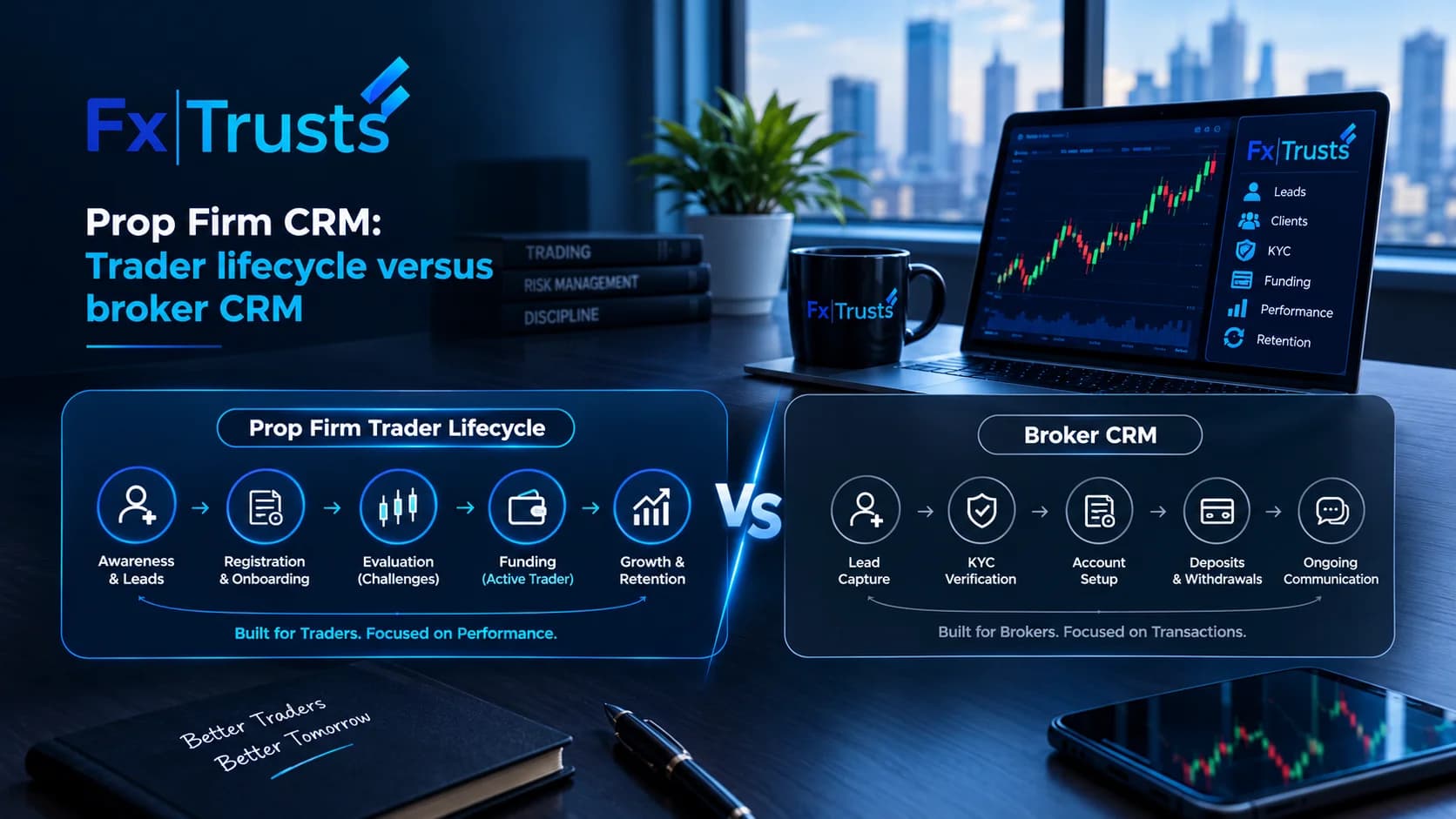
Prop firm crm: trader lifecycle versus broker crm is mainly a workflow-design decision, not a label-selection exercise. Start there. Map how prospects, applicants, funded traders, broker clients, partners, payments, reviews, and support cases should move through your operation before comparing interfaces or vendor positioning.
Trader lifecycle vs broker crm: definition and decision context?
The practical distinction begins with the operating journey the system must coordinate. A prop-firm setup can be framed around applicant progression, evaluation rules, account states, exceptions, and trader support, while a broker-oriented setup can be framed around prospects, onboarding, account servicing, deposits, withdrawals, partners, and retention. These are planning categories rather than universal product definitions, so teams should test them against their own operating model.
Begin with a lifecycle map rather than a feature list. Write down each status a person or account may enter, the event that changes that status, the team responsible for the change, and the information needed at the handoff. Then mark where a decision should be automatic, where a person should review it, and where an exception should pause the flow. This exercise turns broad CRM language into an operational specification.
The distinction also affects how teams review a Platform overview. Instead of asking whether a platform has a generic dashboard, ask whether its records and permissions can represent the lifecycle you have designed. Treat polished screens as secondary to workflow clarity, auditability, and manageable handoffs. Without approved external evidence in the supplied research pack, this article does not compare named vendors, capabilities, prices, or implementation outcomes.
Who should consider prop firm crm: trader lifecycle versus broker crm?
Founders and operating teams should consider the distinction when their planned customer journey contains materially different stages, responsibilities, or exception paths. The useful question is not whether the business calls itself a prop firm or a broker. It is whether one shared workflow can represent the operation clearly without forcing unrelated processes into the same statuses, queues, permissions, and reports.
A new prop-firm operator can use the comparison to define how applicants move from registration through assessment, review, account changes, support, and closure. A brokerage team can use it to define how leads, applicants, clients, partner referrals, funding requests, service cases, and account changes should be handled. A hybrid operator should map both journeys separately before deciding which records, teams, and integrations may safely be shared.
The exercise is also relevant when reviewing a Forex white label because the CRM decision should fit the surrounding operating stack rather than sit apart from it. Keep the evaluation qualitative until approved evidence is available. Do not assume a product supports a workflow merely because its marketing uses familiar terms; request a demonstration using your own statuses, exception cases, approval paths, and access roles.
Benefits and practical limitations
A lifecycle-led comparison can make requirements easier to discuss, but it does not remove implementation risk. Its main value is organizational: teams can align on records, responsibilities, handoffs, and exception handling before debating individual modules. Its limitation is equally important. A neat process diagram may hide difficult questions about data ownership, integration behavior, manual work, regulatory interpretation, and the operational consequences of incomplete or conflicting information.
Potential benefits
- Requirements can be organized around actual operating stages instead of broad product labels.
- Teams can identify where sales, compliance, payments, dealing, support, and partner workflows intersect.
- Demonstrations can be tested against defined scenarios, including pauses, rejections, corrections, and escalations.
- Permissions and notifications can be discussed in relation to responsibility rather than convenience alone.
Practical limitations
- A workflow model cannot confirm that a vendor can deliver the required integration or control.
- Shared records may create ambiguity when prop-firm and brokerage processes use similar terms differently.
- Automation can reproduce a poorly designed rule more consistently without making the rule appropriate.
- Implementation still depends on data quality, operating discipline, documented ownership, and review procedures.
Use the limitations as evaluation prompts when exploring Prop firm software. Ask the vendor to show how the system behaves when data is missing, an integration is unavailable, a status changes unexpectedly, or a manual reviewer disagrees with an automated result. Because the research pack contains no approved evidence, no claim is made here about any provider’s safeguards, service levels, or operating performance.
Prop firm crm and the reader decision
The reader decision should be based on lifecycle fit, control boundaries, and implementation responsibilities. Build a requirement matrix with rows for lifecycle stages and columns for records, triggers, owners, permissions, notifications, integrations, evidence, and exceptions. A vendor response should explain how each requirement is handled, what remains manual, what requires customization, and which part of the wider stack owns the final state.
Keep adjacent systems visible during the review. Payments, identity checks, support tools, trading infrastructure, reporting, partner management, and communication channels can all create handoffs that the CRM must represent or receive. The CRM does not need to perform every function itself, but the operating design should make clear where information originates, how it changes, and which team resolves a mismatch. For payment planning, the site’s Payment infrastructure page provides first-party context rather than independent evidence.
Where partner allocation or managed-account functionality enters the planned stack, review the PAMM/MAM copy trading page as a separate first-party product area. Do not assume that a partner, allocation, or account-management workflow belongs inside the same CRM record merely because the information is related. Decide whether the CRM should initiate an action, display a status, store a reference, or remain outside that process.
Suitable forex crm and the reader decision
A suitable CRM is the one that can be evaluated against the operating model without leaving important responsibilities vague. Avoid reducing the decision to a long feature checklist. Two products may use the same feature name while expecting different records, user roles, setup work, or external systems. The evaluation should therefore use scenarios that show who acts, what changes, what is recorded, and how the team recovers when the expected path breaks.
Include compliance and licensing questions without assuming that software determines legal suitability. Document where identity information is requested, where a case is paused, who reviews an exception, what evidence must be retained, and how access is restricted. Then take the jurisdiction-specific questions to qualified professionals. The Licensing & compliance page may help frame a first-party discussion, but it is not a substitute for independent legal or regulatory guidance.
Technical teams should also review how the proposed setup exchanges data with the rest of the stack. Use the API docs as first-party implementation material, then create test cases for record creation, updates, duplicate handling, delayed responses, failed requests, permission boundaries, and reconciliation. The goal is not to presume capability. It is to turn each required handoff into a question that can be demonstrated, documented, and assessed before commitment.
Conclusion
The decision is clearer when prop-firm and broker CRM requirements are treated as lifecycle designs rather than interchangeable product categories. Map each journey independently, identify the shared records and genuine points of separation, and then evaluate systems against those requirements. This approach does not select a vendor for you, but it creates a more disciplined basis for demonstrations, implementation scoping, and internal review.
Before proceeding, prepare a compact operating brief. Include lifecycle stages, owners, permissions, required evidence, integration boundaries, exception paths, manual reviews, and unresolved jurisdictional questions. Ask vendors to respond to the same scenarios so differences are easier to examine. Keep first-party product material separate from independent evidence, and avoid relying on rankings, outcome claims, or broad labels that the supplied research pack does not support.
Use the Blog for additional first-party operating context, but pause any comparative or compliance conclusion until appropriate evidence is available. The current research pack contains no approved sources or facts, so this draft intentionally avoids named-vendor comparisons, prices, performance statements, regulatory specifics, and product-capability claims. Human review and a complete evidence pack are required before publication.
- Lifecycle stage
- A planning label for a defined point in a prospect, applicant, trader, client, partner, or account journey.
- Handoff
- A planned transfer of information or responsibility between people, teams, or connected systems.
- Exception path
- A documented route for cases that cannot continue through the expected workflow without review or correction.