
White Label in Forex Brokerage: Definition and Models
White label forex brokerage is a model in which a firm runs a brokerage under its own brand on trading technology supplied by another provider. The provider keeps the software and sets the contract terms. Regulatory permission comes from a regulator, not from the technology contract, so a platform licence and a regulatory licence are separate questions.
FxTrusts publishes this page and supplies brokerage technology and implementation services, so it includes our commercial perspective. It is general information, not legal, tax or investment advice, and it does not describe any regulator's decision on a specific business. The MetaQuotes and FCA statements were checked against those pages on 10 November 2026.
On this page
- What white label forex brokerage means
- Platform licence and regulatory licence are not the same
- White label, brokerage as a service and full licence compared
- Where the white label model fits, and where it does not
- Questions to ask before you sign a white label contract
- Grey label and other terms you will meet
- Where FxTrusts fits in a white label decision
- Key takeaways
- Frequently asked questions
What white label forex brokerage means
In fintech, white label describes a product that one company builds and another company sells under its own brand. In forex brokerage, that product is usually the trading stack: a trading platform, a client portal, a back office and the connections that link them to liquidity and payments. The client sees the broker's name on the login screen, the client agreement and the statements.
The term has a wider meaning in other markets, which is outside this page. The same label can hide very different rights, so the contract matters more than the name.
For a broker, the practical questions are not whether a logo can be added. They are who holds the permission to serve clients, who controls the software, and what happens to client data and the brand if the arrangement ends. The white label brokerage answer covers the same ground in a broader question-and-answer format, including roles, licensing rights, brand, client data and exit.
Platform licence and regulatory licence are not the same
Two licences are often confused. A platform or software licence is a right to use trading software on the vendor's terms. A regulatory licence, or authorisation, is permission from a financial regulator to carry on regulated activities with clients. One comes from a software vendor and the other from a regulator. Holding one does not give you the other.
MetaQuotes describes itself as a software development company that does not provide investment or brokerage services. Its broker pages describe three licence types, Entry, Standard and Enterprise, that differ in real-account capacity and included system components. They also state that the broker deploys the software on its own hardware and that MetaQuotes does not offer SaaS or similar solutions that would permit even partial external management or third-party control of a broker’s operations (MetaQuotes, MetaTrader 5 for brokers). A platform licence therefore answers a software question. It does not answer the regulatory one.
In the UK, the FCA’s authorisation guidance says a firm must not start performing regulated activities while its application is under review, unless an exemption or temporary permission applies. It also says that carrying on regulated activities without authorisation is a criminal offence. A separate FCA page on appointed representatives says an appointed representative carries on regulated activity under the responsibility of an authorised firm, known as the principal. This page does not say whether that route is available for any activity. These are UK examples. For any other market, check the regulator where the clients are served.
White label, brokerage as a service and full licence compared
This page compares three models. They answer different questions, and vendor names do not always match the definitions below. The table compares them by who holds each right and duty.
| Question | White label | Brokerage as a service (BaaS) | Full licence |
|---|---|---|---|
| Who takes the client | The brand owner | The brand owner, with the provider running more of the operation under contract | The company itself |
| What the provider supplies | A branded platform and back-office systems | Platform access plus modules such as CRM, payments, liquidity connections and reporting | The platform licence from the software vendor; the company sources hosting, CRM, payments and liquidity itself |
| Who holds the software right | The provider or its licence holder, extended to the brand owner by contract | The provider or a hosting partner, under a service contract | The company, under its own platform licence from the software vendor |
| Who holds the regulatory permission | The brand owner, or an authorised firm it acts under where the regulator allows that route; the platform contract does not grant it | Same as a white label: the service contract does not grant it | The company, under its own authorisation; the platform licence does not grant it |
| Main contract check | Brand rights, data ownership, migration and exit terms | Responsibility matrix, service scope and exit terms | Vendor contracts, internal capacity to run the stack, and the licence process |
- Who takes the clientWhite label: The brand ownerBrokerage as a service (BaaS): The brand owner, with the provider running more of the operation under contractFull licence: The company itself
- What the provider suppliesWhite label: A branded platform and back-office systemsBrokerage as a service (BaaS): Platform access plus modules such as CRM, payments, liquidity connections and reportingFull licence: The platform licence from the software vendor; the company sources hosting, CRM, payments and liquidity itself
- Who holds the software rightWhite label: The provider or its licence holder, extended to the brand owner by contractBrokerage as a service (BaaS): The provider or a hosting partner, under a service contractFull licence: The company, under its own platform licence from the software vendor
- Who holds the regulatory permissionWhite label: The brand owner, or an authorised firm it acts under where the regulator allows that route; the platform contract does not grant itBrokerage as a service (BaaS): Same as a white label: the service contract does not grant itFull licence: The company, under its own authorisation; the platform licence does not grant it
- Main contract checkWhite label: Brand rights, data ownership, migration and exit termsBrokerage as a service (BaaS): Responsibility matrix, service scope and exit termsFull licence: Vendor contracts, internal capacity to run the stack, and the licence process
The table is a simplified view, and the lines overlap in practice. A white label deal can include BaaS modules, and a full licence buyer can still rent hosting. For the BaaS model in more detail, read the brokerage as a service guide.
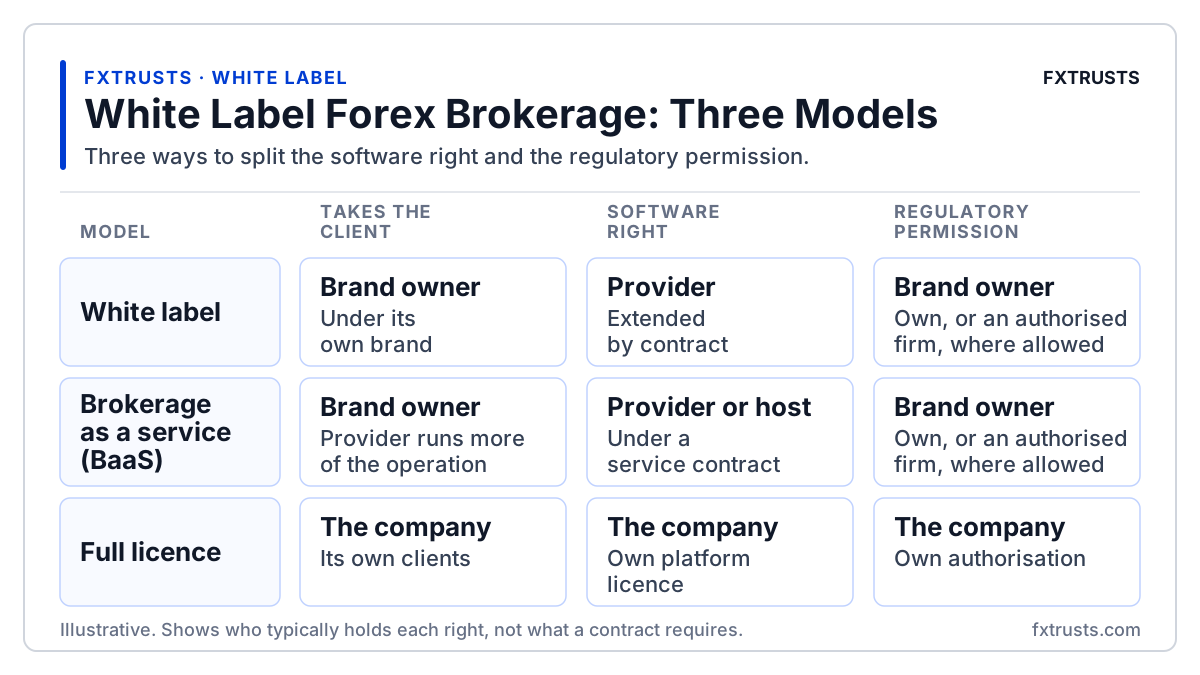
The diagram below shows the same three models as a grid: who takes the client, who holds the software right and who holds the regulatory permission.

Where the white label model fits, and where it does not
A white label arrangement suits a broker that already has, or is applying for, the permission it needs in its target market, and that wants a brand, a client relationship and go-to-market control without writing trading software. It is a weaker fit where the buyer needs control of source code, data flows or hosting locations from the first day.
- Good fit: a company with a route to the regulatory permission for its target clients, which wants a branded stack run under a written scope.
- Good fit: a team that is content to let the provider operate the platform and back office, provided the responsibility split is written down.
- Weaker fit: a buyer that needs full control of the code, the data pipeline or the server location from the start.
- Weaker fit: a company with no clear route to the regulatory permission for the market it wants to serve.
Check before you sign
Ask the provider to name the entity that will be the client-facing broker, the entity that holds the software licence, and the regulator that covers each market. If any of the three is unclear, the deal is not ready to sign.
Questions to ask before you sign a white label contract
Use these questions to test a white label proposal. Each answer should appear in the contract or in a schedule to it, not only in a sales deck.
- Who holds the software licence, and does the licence name the broker, the provider or a hosting partner?
- Which legal entity is the client-facing broker in each market, and which permission does that entity hold there?
- Who owns the client data, the brand and the domain names on exit, and in what format is the data returned?
- Which systems are in scope, and which are separate contracts, such as liquidity, payments and market data?
- What notice, migration support and cut-over steps apply if the arrangement ends?
FxTrusts uses the same split in its own material. Our pricing page states that the Prop Firm CRM package price excludes the trading-platform licence and third-party API charges. Our pricing FAQ says that not every deployment needs a direct MetaQuotes licence, and that the licence holder and permitted use must be verified in writing.
Grey label and other terms you will meet
MetaQuotes lists three licence types for brokers, Entry, Standard and Enterprise, on its broker licence page. That page does not use the term grey label, so grey label is not one of those licence types. FxTrusts’ own pricing FAQ treats grey label as a market term, not a verified MetaQuotes licence category. A seller may still use grey label, white label, private label or reseller to describe a hosted or branded arrangement.
None of these labels tells you who holds the licence, who is the regulated entity, or who owns the brand. Read the contract for those facts. For the MetaTrader 5 side of the decision, an FxTrusts article covers licence holder and contractual rights. A platform-focused read is in our platform guide for brokers.
Where FxTrusts fits in a white label decision
FxTrusts supplies brokerage technology and implementation services. Our solution page for white label scope describes the items we define with a broker: the MT5 access model, CRM and back office, liquidity connections and a responsibility matrix. FxTrusts is a technology provider. It is not a licensed broker, bank or regulated financial institution, and it offers no retail trading accounts.
An FxTrusts technology contract does not give a broker regulatory permission, and FxTrusts does not hold the client relationship. The client relationship stays with the brand owner. Regulatory permission stays with the brand owner, or with an authorised firm it acts under where the regulator allows that. Where a platform licence or hosted access depends on a third party, the scope must say so. We do not treat a vendor statement as a substitute for the written licence holder and permitted use.
Key takeaways
- White label forex brokerage means a firm runs a brokerage under its own brand on trading technology supplied by another provider.
- A platform or software licence and a regulatory licence are separate. One does not replace the other.
- Compare white label, brokerage as a service and full licence by who holds each right and duty, not by the label.
- Grey label is a market term. It is not among the licence types MetaQuotes lists on its broker pages. Confirm the licence holder in writing.
- Before you sign, check the entity that takes clients, the software licence holder, data export and exit terms.
Frequently asked questions
Does white label forex brokerage mean the provider takes the clients?
Usually not. In the model described here, the brand owner takes the client and signs the client agreement. Regulatory permission for that activity is a separate question for the brand owner and its regulator. The provider supplies technology and services under contract. Whether a given provider has any client-facing role depends on its own licences and contract, so ask for that in writing. FxTrusts is a technology provider and offers no retail trading accounts.
What is the difference between a platform licence and a regulatory licence?
A platform licence is a right to use trading software on the terms of the software vendor. A regulatory licence, or authorisation, is permission from a financial regulator to carry on regulated activities. MetaQuotes describes itself as a software development company that does not provide investment or brokerage services. In the UK, the FCA says a firm must not start performing regulated activities while its application is under review, unless an exemption or temporary permission applies, and that carrying on regulated activities without authorisation is a criminal offence.
Is grey label the same as white label?
Grey label is a market term used for some hosted or branded access arrangements. MetaQuotes lists Entry, Standard and Enterprise licence types on its broker pages, and grey label is not one of them. Whatever label a seller uses, the licence holder, the permitted use and the brand rights should be written into the contract.
How is brokerage as a service different from white label?
Brokerage as a service covers a wider set of operations that a provider runs or supplies under contract, such as CRM modules, payments, liquidity connections and reporting. A white label arrangement is often narrower and centres on a branded platform and back office. Neither contract is a regulatory permission, so who is authorised stays a separate question. The boundary blurs in practice, so compare the scope lines rather than the names.
Can a white label brokerage be launched in any country?
Not on the technology alone. A technology contract is not a regulatory permission. Start with the regulator where the clients are served, confirm which entity holds the permission, and do not rely on a vendor's general statement about coverage. This page does not give licensing advice for any jurisdiction.
Related FxTrusts resources
- Brokerage as a service: definition and models
- MT5 white label: licence holder and contractual rights
- FxTrusts white label scope for brokers
- Glossary of brokerage terms
Sources
- MetaQuotes, MetaTrader 5 for brokers (captured 10 November 2026)
- MetaQuotes, MetaTrader 5 licence types for brokers (captured 10 November 2026)
- FCA, how to apply for authorisation or registration (captured 10 November 2026)
- FCA, principals and appointed representatives: responsibilities (captured 10 November 2026)
Scope a white label with FxTrusts
Send us your target markets, the entity that will hold each permission and your platform choice. We can review the scope with you and set out the responsibility split in writing.
Contact FxTrusts