
Brokerage as a Service: Definition and Models
Brokerage as a service (BaaS) is a model in which a technology provider supplies systems a brokerage runs on, such as trading platform access, CRM, liquidity connections and payment integrations, under a commercial contract. The licensed entity that takes clients keeps its own regulatory duties. Scope, hosting and exit terms decide how much of the stack the buyer actually controls.
FxTrusts supplies brokerage technology and implementation services, so this guide includes our commercial perspective. It is general information, not legal, tax or investment advice, and it does not describe any regulator’s decision on a specific business.
On this page
- What brokerage as a service means
- How responsibilities divide in a BaaS deal
- Brokerage as a service delivery models to compare
- How BaaS relates to white-label setups
- Licensing and permissions for a BaaS model
- Contract checks before you buy a BaaS package
- An illustrative cost example for a BaaS budget
- Key takeaways
- Frequently asked questions
What brokerage as a service means
Brokerage as a service packages the parts a broker needs to run daily operations: trading platform access, a CRM and back office, liquidity and execution connections, payment and KYC tooling, and reporting. The provider runs or supplies these parts under contract. The broker brands the service, signs the client agreements and sells to its own market.
The most important point is that technology does not carry the licence. A platform agreement or hosted access arrangement does not, by itself, authorise a company to carry on regulated activities. In the UK, the FCA’s authorisation guidance says a firm must not start performing regulated activities while its application is under review, unless an exemption or temporary permission applies, and that carrying on regulated activities without authorisation is a criminal offence. Other jurisdictions set their own rules.
How responsibilities divide in a BaaS deal
A useful test is to list every function a client touches, then assign each one to a named party. The provider normally carries the software and its operation within the agreed scope. The broker carries the decisions that the software cannot make for it: who may become a client, which products are offered in which country, how client money is handled, and how complaints and suspicious activity are escalated. The diagram below shows this split as a starting point for your own mapping.

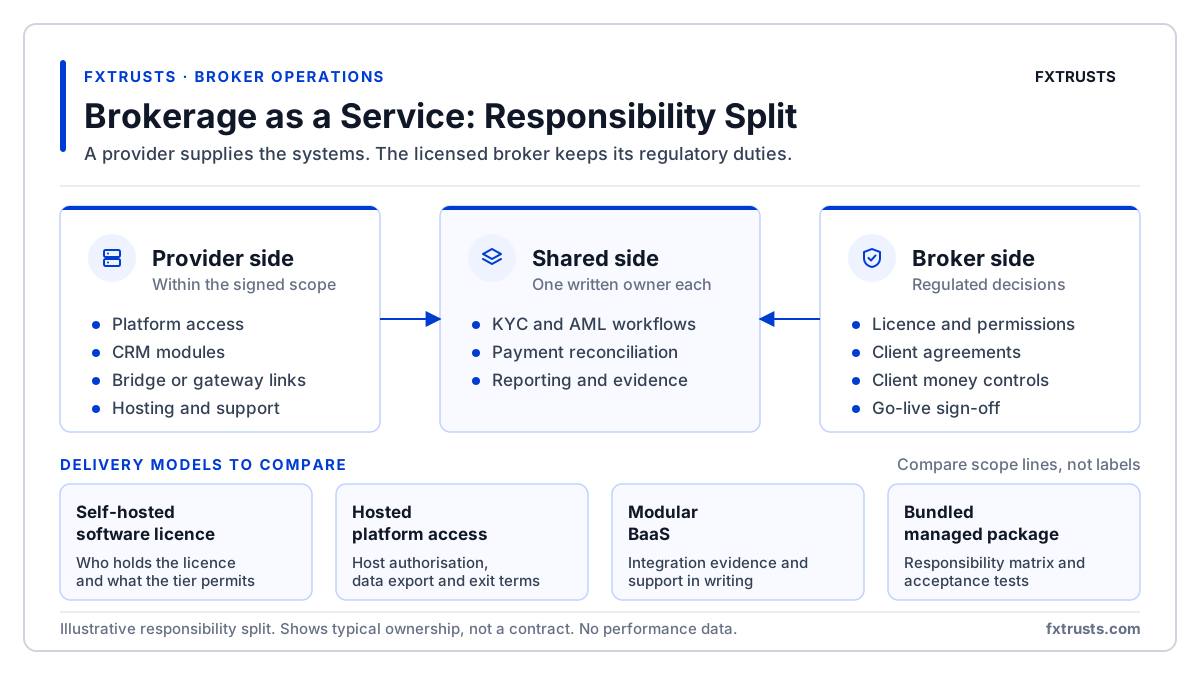
- Provider side: platform access, CRM modules, bridge or gateway connectivity, hosting and support, all as far as the signed scope says.
- Broker side: licence and entity permissions, client agreements, marketing claims, client money controls, compliance approvals and final sign-off on go-live.
- Shared side: KYC and AML workflows, payment reconciliation and reporting, where each party needs defined inputs, owners and evidence.
Any shared item needs a written owner. Where ownership is unclear, the gap usually appears later as an unreconciled balance or an approval nobody can find.
Brokerage as a service delivery models to compare
Providers package BaaS in several ways. The table compares four common shapes. Names differ between vendors, so compare the scope lines, not the labels.
| Model | What the provider typically supplies | What the broker still owns | Main contract check |
|---|---|---|---|
| Self-hosted software licence | Platform software under a licence tier | Servers, hosting, staffing and every integration | Who holds the licence and what the tier permits |
| Hosted platform access | A hosted environment run by a contracted host, with manager or API access | Entity permissions, client onboarding and liquidity agreements | Host authorisation, data export and exit terms |
| Modular BaaS | Selected modules such as CRM, payments, liquidity bridge or market data | The modules not supplied and the vendor contracts behind them | Integration evidence and support commitments in writing |
| Bundled managed package | A wider set of systems plus implementation support | Regulated decisions, client money controls and final acceptance | Responsibility matrix, acceptance tests and dependency owners |
- Self-hosted software licenceWhat the provider typically supplies: Platform software under a licence tierWhat the broker still owns: Servers, hosting, staffing and every integrationMain contract check: Who holds the licence and what the tier permits
- Hosted platform accessWhat the provider typically supplies: A hosted environment run by a contracted host, with manager or API accessWhat the broker still owns: Entity permissions, client onboarding and liquidity agreementsMain contract check: Host authorisation, data export and exit terms
- Modular BaaSWhat the provider typically supplies: Selected modules such as CRM, payments, liquidity bridge or market dataWhat the broker still owns: The modules not supplied and the vendor contracts behind themMain contract check: Integration evidence and support commitments in writing
- Bundled managed packageWhat the provider typically supplies: A wider set of systems plus implementation supportWhat the broker still owns: Regulated decisions, client money controls and final acceptanceMain contract check: Responsibility matrix, acceptance tests and dependency owners
MetaQuotes describes MetaTrader 5 as software that brokers run on their own infrastructure, and it states that it does not offer SaaS or similar solutions. A hosted MT5 arrangement is therefore a third-party arrangement, and its authorisation and exit terms must be confirmed with the party that holds the platform agreement.
How BaaS relates to white-label setups
In practice, white label is one common route to a BaaS arrangement. A white-label deal focuses on branding and a provider-run platform, while BaaS describes the wider set of services behind the brand, from CRM to payments to liquidity. Read the two terms as overlapping rather than opposed. Our white-label brokerage answers cover the contract questions in depth, and the forex white-label scope page lists the modules we offer on that route.
Licensing and permissions for a BaaS model
The rules that apply depend on the client, the product and the country, and they are set by the regulator where you are authorised. For retail CFD business in certain jurisdictions, the rules are strict. ESMA’s 2018 product intervention measures for retail CFDs set maximum leverage on opening a position between 2:1 and 30:1, depending on the underlying asset’s volatility, and require a standardised risk warning with the share of retail accounts that lose money. Retail CFD accounts can lose money quickly because of leverage, and ESMA’s data shows most retail accounts lose money. The FCA’s rules for retail CFDs in PS19/18 similarly limit leverage between 30:1 and 2:1 and require negative balance protection. Some BaaS providers can configure leverage and warnings, but the broker must decide and evidence that they apply.
Check the entity first
Before you compare providers, write down the entity, the activities, the products and the client countries you intend to serve. Take that list to qualified advisers. The answer determines which delivery models are even relevant.
Our licensing and compliance support page describes the scoping work we do with advisers, but the permission decision rests with the regulator, and the question of what your entity needs rests with your qualified advisers.
Contract checks before you buy a BaaS package
A short contract review catches most of the problems that appear after launch. Ask the provider to answer each point in writing, and check the answers against the signed order form rather than the sales deck.
- Name the licence or access holder for every component, and state which party signs each third-party agreement.
- List the modules, instruments, account types and client countries included, and list the items excluded.
- Describe hosting, monitoring, support hours and incident escalation, with the commitments stated as written terms.
- Set out data ownership, export formats and the process and timing for leaving the service.
- Agree acceptance tests, with pass criteria, before the first client account is opened.
Compare the contract with the broker integration guide so that connector, testing and sign-off questions are covered before signature.
An illustrative cost example for a BaaS budget
Recurring fees are easy to compare on paper and hard to compare in practice, because each provider bundles different services. A simple model helps you test a quote before you accept it. Start with the recurring lines, add the one-time setup costs, and then add the costs the provider does not quote at all, such as legal work, banking, regulatory capital and working capital.
Illustrative example
Imagine a hypothetical broker quoted $2,000 per month for platform access and $500 per month for a CRM module. Over twelve months the recurring lines total $30,000. If it also pays $8,000 of one-time setup costs, the first-year software cost is $38,000 before any legal, banking or capital costs. These numbers are invented for the example and are not market data or a quote.
FxTrusts publishes its own scope and fee lines on the pricing page, including the hosted MT5 access and prop-firm CRM scopes. Those lines do not define the cost of every BaaS deal, so request an itemised proposal for your own entity and countries.
Key takeaways
- Brokerage as a service is a contract model: the provider supplies systems, and the licensed broker keeps its regulatory duties.
- Compare delivery models by what you control, hosting, data ownership and exit, not by vendor labels.
- Map every client-facing function to a named owner before you compare prices.
- Rules for retail CFD clients can be strict, so confirm leverage, warnings and negative balance handling with your advisers.
- Ask for itemised costs and written acceptance tests, and treat any sales-deck promise as unconfirmed until it appears in the order form.
Frequently asked questions
Is brokerage as a service the same as white label?
They overlap but are not identical. White label usually describes a provider-run platform sold under your brand, while brokerage as a service describes a wider set of systems and services behind the brand, such as CRM, payments and liquidity. Some white-label deals are narrow and some BaaS deals are broad.
Does a brokerage as a service provider supply my licence?
No provider can grant your company a regulatory authorisation through a software or hosting agreement. Your entity must obtain any permissions its activities require from the relevant regulator, or use an arrangement that the regulator recognises. Take legal advice on the permissions for each country and product before you accept clients.
What should a brokerage as a service contract include?
The contract should name every licence or access holder, list included modules and excluded items, state hosting and support commitments, set data ownership and export rights, and describe the exit process. Acceptance tests with pass criteria belong in the contract or a signed schedule, so go-live depends on evidence rather than on a date.
Can a brokerage as a service model serve retail CFD clients?
It can, but the broker carries the obligations. Some regulators set leverage limits, standardised risk warnings and negative balance protection for retail CFDs. Some BaaS providers can help configure these controls, but the broker must decide how they apply and keep evidence that they work.
Which costs should I budget for?
Budget recurring platform and module fees, one-time setup costs, legal and incorporation work, banking and payment charges, regulatory capital where required, and working capital. Ask each provider for itemised quotes and do not assume a monthly package covers the full launch cost.
Related FxTrusts resources
- White label definition
- White-label brokerage technology
- White-label brokerage answers
- How forex brokers make money
- Broker integration guide
- Market maker glossary entry
Sources
- FCA: Apply for authorisation
- MetaQuotes: MetaTrader 5 for brokers
- FCA PS19/18: Restricting contract for difference products sold to retail clients
- ESMA: Agreed prohibition of binary options and restrictions on CFDs for retail investors
Scope a brokerage technology package
Share your entity, target countries, products and platform requirements. We will return an itemised scope with responsibilities, dependencies and acceptance tests.
Contact FxTrusts