Forex CRM Cost: Seats, Accounts, Usage & Pricing Guide
Forex CRM Cost: Seats, Accounts and Usage Pricing
Forex CRM cost is rarely determined by a single monthly license. Depending on the vendor and brokerage model, the commercial structure may include CRM user seats, managed client accounts, transaction or usage volumes, integrations, implementation, migration, hosting, and optional modules.
That makes comparing a $500 monthly CRM with a $1,500 monthly CRM misleading unless both are measured against the same scope.
For a broker or prop firm evaluating technology, the practical question is not simply “How much does the CRM cost?” It is “What will the CRM cost to operate over three years at our expected volume?”
Quick Answer
Forex CRM pricing can be structured around internal users, client accounts, modules, usage, integrations, or a combination of these models. Some vendors publish prices, while others require a scoped quotation.
FxTrusts currently publishes a $1,000/month Prop Firm CRM, Risk and Admin subscription with a defined scope for one brand connected to one approved trading platform. The published pricing also states that the CRM price does not include the trading platform license itself or third-party vendor API charges.
For brokers evaluating a broader operational setup, the Forex CRM and Trader's Room solution combines CRM, back-office, client portal, KYC, payments, MT4/MT5 account management and IB workflows in one environment.
MetaTrader's brokerage guidance also treats CRM as one component of a wider technology stack that can include trading infrastructure, KYC, liquidity and payment connectivity.
So a realistic cost model should include more than the headline CRM subscription.
What Determines Forex CRM Cost?
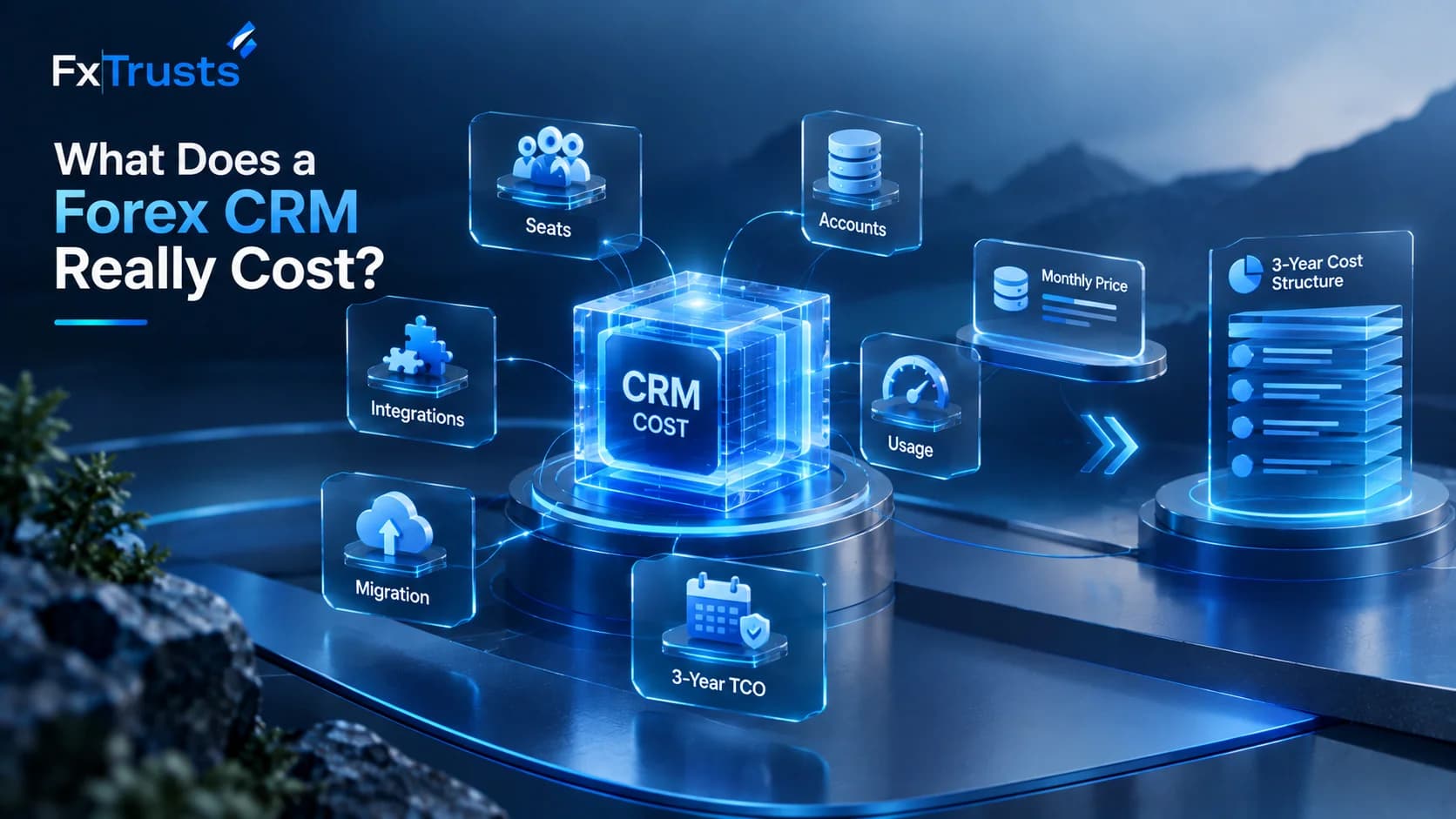
The main pricing variables usually fall into five categories.
| Cost component | What you may be charged for | Why it matters |
|---|---|---|
| User seats | Sales, compliance, finance and admin users | More internal users can increase license cost |
| Client accounts | Registered, active or funded clients | Some models scale with customer volume |
| Usage | Transactions, API calls, messages or other activity | High-volume brokers may incur additional charges |
| Modules | KYC, IB, payments, reporting, automation | Optional functionality can change total cost |
| Implementation | Setup, integration, migration and training | One-time costs can materially affect year-one spend |
Not every vendor uses all five models. The commercial structure needs to be confirmed in writing before comparing proposals.
1. CRM User Licenses and Seats
The first question should be: Who needs access to the CRM?
A brokerage may have separate teams for:
Sales
Compliance
Finance
Client support
IB management
Operations
Management
If pricing is seat-based, adding employees can increase recurring costs even when the number of traders remains unchanged.
However, seat count alone does not describe the actual cost of a brokerage CRM.
A system that charges for ten internal users but includes unlimited client records may have a very different cost structure from a system that charges based on client accounts.
Ask vendors:
How many internal users are included?
Are read-only users charged?
Are finance and compliance roles separate licenses?
Can permissions be customized by department?
Are additional seats priced monthly or annually?
2. Account-Based Pricing
Some brokerage technology costs may be influenced by the number of client or trading accounts rather than internal CRM users.
This distinction is particularly important because one client can potentially have multiple trading accounts.
For example:
500 clients ≠ necessarily 500 trading accounts.
A broker could have:
500 registered clients
350 verified clients
250 funded clients
600 trading accounts
Those numbers represent different operational workloads.
A CRM proposal should therefore specify exactly what the vendor means by “account.”
Does it mean:
CRM contact?
Registered client?
KYC-approved client?
Trading account?
Active trading account?
Funded account?
Without that definition, two apparently similar proposals cannot be compared reliably.
For brokers looking at the operational side of this setup, the FxTrusts Trader's Room and client portal describes client registration, KYC, trading-account management, deposits, withdrawals and support workflows.
3. Usage-Based Pricing
Usage pricing can become relevant as brokerage activity increases.
Potential usage metrics include:
API requests
Payment transactions
KYC checks
SMS or email notifications
Data synchronization
Reporting volume
Automated workflows
The important point is to identify the meter.
For example, “API included” is less useful than knowing whether there is a documented request limit, overage rate, rate limit or fair-use policy.
A vendor should provide the commercial definition of billable usage before implementation.
4. Integration and Migration Charges
The CRM license is only one part of implementation cost.
A brokerage may need integration with:
MT4 or MT5
KYC/AML providers
Payment providers
Liquidity infrastructure
Website registration
Email or communication systems
Internal reporting
Existing CRM databases
FxTrusts' Forex White Label solution currently describes a broader brokerage stack involving MT5, CRM, KYC/AML workflows, payments, liquidity planning and technical onboarding.
The Trader's Room solution also documents API connectivity, payment integrations, MT4/MT5 synchronization and CRM-related workflows.
But a feature appearing on a vendor's documentation does not automatically mean that your specific workflow is included in the quoted implementation.
5. Three-Year Operating Cost Model
Comparing monthly subscription prices alone can hide the actual economics.
A simple three-year model is:
Three-year TCO = subscription fees + implementation + integrations + migration + support + usage charges + optional modules
For example, imagine two hypothetical proposals:
| Cost | Vendor A | Vendor B |
|---|---|---|
| Monthly license | $1,000 | $700 |
| Initial setup | $5,000 | $12,000 |
| Migration | $3,000 | $8,000 |
| Additional integrations | $2,000 | $4,000 |
| Monthly usage | $100 | $350 |
| 3-year subscription | $36,000 | $25,200 |
| 3-year usage | $3,600 | $12,600 |
| Illustrative 3-year total | $49,600 | $49,800 |
These figures are illustrative only, not vendor quotations.
The example demonstrates why a lower monthly license does not necessarily mean a lower total cost.
For broader planning, FxTrusts also publishes a broker and prop firm setup cost worksheet that separates one-time, recurring and usage-based technology costs. Its figures are explicitly presented as planning figures rather than final quotations.
What Should Be Included in a CRM Quote?
A professional procurement request should ask the vendor to separate:
Recurring costs
CRM license
User seats
Client/account volume
Usage
Hosting
Support
Optional modules
One-time costs
Initial configuration
Branding
Data migration
API integration
Custom development
Training
Testing
Third-party costs
KYC provider
Payment provider
SMS/email provider
Trading platform
Liquidity connectivity
Regulatory or legal technology requirements
This structure makes proposals much easier to compare.
For payment-related requirements, the Forex payment infrastructure and payout solution covers payment rails, wallet/ledger workflows, trading-account synchronization and reconciliation considerations.
Forex CRM Cost vs. Total Brokerage Technology Cost
A CRM should not be evaluated in isolation.
A broader brokerage setup can include:
Trading platform → CRM → KYC → Payments → Liquidity → Reporting → Client portal
The more tightly these systems are connected, the more important implementation ownership becomes.
For example, FxTrusts describes its brokerage white-label technology stack as combining platform, CRM, liquidity and related operational infrastructure.
This distinction matters when comparing proposals. A $1,000 CRM subscription and a $1,000 integrated brokerage technology package are not necessarily comparable products.
Questions to Ask Before Signing
Before approving a forex CRM contract, request written answers to these questions:
Is pricing based on seats, clients, trading accounts, usage, or modules?
What exactly counts as a billable account?
How many internal users are included?
Are additional users priced per month or annually?
Are API calls limited?
Are integrations included in the implementation fee?
Is historical data migration included?
Who owns data mapping and migration testing?
Are KYC and payment-provider fees separate?
What happens when client or account volume increases?
What support level is included?
Which customizations create additional charges?
Is there a minimum contract period?
What are renewal and price-increase terms?
What happens to the data when the contract ends?
Final Takeaway
Forex CRM cost is a total operating-cost question, not simply a monthly subscription question.
Seats, client accounts, trading accounts, usage, integrations and migration can all affect the final budget. A useful comparison should therefore normalize every proposal against the same user count, account volume, integration scope and contract period.
A practical procurement process is to request a scoped demonstration, written pricing schedule and implementation responsibility matrix before comparing vendors.
For brokers evaluating the operational layer specifically, the FxTrusts Trader's Room provides a relevant reference point because its current scope covers CRM, back-office, client portal, KYC, payments, MT4/MT5 account management and IB workflows.
The goal is not simply to find the lowest CRM license. It is to understand what you are paying for, what is excluded, and how the cost changes as your brokerage grows.
Sources
-
MetaTrader 5 — How to Start a Brokerage Business
MetaTrader 5 — How to Start a Brokerage Business -
FxTrusts — Trader's Room & Client Portal
FxTrusts Trader's Room & Client Portal -
FxTrusts — Pricing
FxTrusts Pricing -
FxTrusts — Broker & Prop Setup Cost Worksheet
FxTrusts Broker & Prop Setup Cost Worksheet
Frequently Asked Questions
How much does a forex CRM cost?
Forex CRM cost depends on the pricing model and implementation scope. Vendors may charge for user seats, client or trading accounts, modules, integrations, usage, hosting and support. A published CRM subscription should therefore be treated separately from setup and third-party costs. FxTrusts currently publishes a $1,000/month Prop Firm CRM, Risk and Admin package under a defined scope; its general broker CRM pricing is scoped according to requirements.
Is forex CRM pricing based on users or trading accounts?
It can be based on either, depending on the vendor. A quote should clearly define whether a billable “account” means a CRM contact, registered client, trading account, active account or another unit. This distinction is important because one client can have multiple trading accounts.
What are CRM implementation costs?
Implementation costs can include configuration, branding, data migration, API integrations, testing, training and deployment. They should be listed separately from recurring CRM subscription fees so the first-year and long-term costs can be calculated accurately.
Do MT4 or MT5 integrations increase forex CRM cost?
They can. The final cost depends on the integration method, platform access, API requirements, account volume and whether the connection is included in the vendor's scope. MetaTrader's own brokerage guidance identifies CRM as part of the broader brokerage technology environment.
What should a broker include in a three-year CRM cost calculation?
A three-year model should include recurring CRM fees, user or account charges, implementation, migration, integrations, usage-based fees, support, optional modules and relevant third-party services. This gives a more realistic total cost of ownership than comparing monthly subscription prices alone. FxTrusts also provides a planning worksheet that separates one-time, recurring and usage-based technology costs.