
NDF Meaning: What a Non-Deliverable Forward Is
NDF meaning: a non-deliverable forward (NDF) is a forward FX contract on a restricted currency. The two parties agree a rate now, settle the difference against a fixing rate on a set date, and pay that difference, usually in US dollars. No restricted currency is ever delivered.
FxTrusts supplies brokerage technology to forex and CFD brokers and prop trading firms, so this entry reflects a technology provider's view of the instrument. It is general information, not legal, tax or investment advice.
On this page
NDF meaning in plain terms
The key word in NDF is "non-deliverable". A standard forward contract obliges two parties to exchange two currencies at a set rate on a future date. An NDF keeps the price mechanics of a forward but drops the physical exchange. At maturity, the contract is settled by a cash payment of the difference between the agreed forward rate and a reference rate.
The BIS describes NDFs as contracts for the difference between an agreed exchange rate and the spot rate at maturity. The contract is settled with a single US dollar payment, so the holder gets exposure to a currency's performance without funding that currency.
A typical NDF names a currency pair, usually a restricted local currency against US dollars. The confirmation records the notional amount, the forward rate, the fixing source, the valuation date and the settlement date. The master agreement then supplies the default definitions that apply to every trade under it.
How an NDF settles, step by step
The settlement sequence is the part most worth understanding before you read any NDF documentation. The diagram below follows the trade from the agreement to the single net payment, using the same terms as the text above.

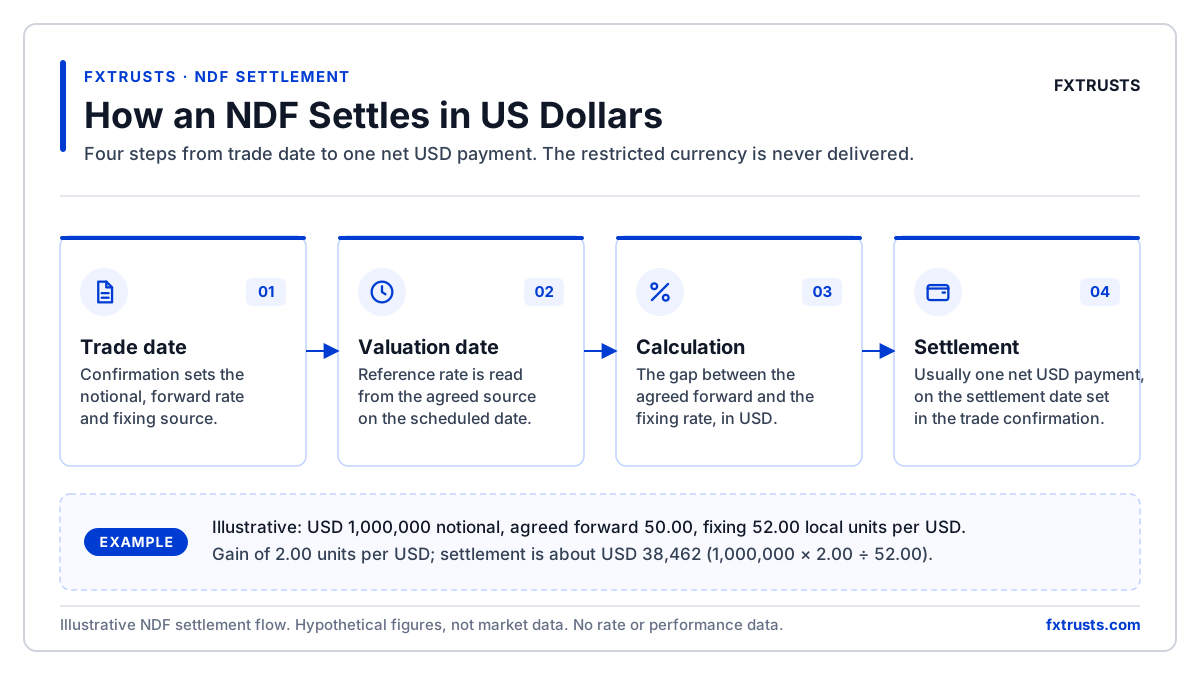
- Trade date: the parties agree the notional amount, the forward rate and the fixing source in the confirmation.
- Valuation date: the reference rate is observed from the agreed source on the scheduled date set in the confirmation, shortly before settlement.
- Calculation: the gap between the agreed forward rate and the fixing rate is converted into the US dollar settlement amount.
- Settlement: one net US dollar payment moves from the party that owes it to the other. The settlement date is set in the confirmation. Where the valuation date is moved because it falls on a non-business day, the FX Committee NDF supplement requires payment no later than two business days after the adjusted valuation date.
NDF vs deliverable forward: how the two compare
The table sets the NDF against a deliverable forward, the standard forward in which the two currencies are physically exchanged at maturity.
| Feature | NDF | Deliverable forward |
|---|---|---|
| Settlement at maturity | Net cash difference, usually paid in USD | Physical exchange of both currencies |
| Currency access needed | No delivery of the restricted currency | Funding and delivery in both currencies |
| Rate reference | Fixing source named in the confirmation | Agreed delivery rate for the currency pair |
| Where it is used | Currencies with restricted onshore or offshore delivery | Freely deliverable currency pairs |
| Typical users | Hedgers and position takers in restricted currencies | Businesses that need to pay or receive the currency |
- Settlement at maturityNDF: Net cash difference, usually paid in USDDeliverable forward: Physical exchange of both currencies
- Currency access neededNDF: No delivery of the restricted currencyDeliverable forward: Funding and delivery in both currencies
- Rate referenceNDF: Fixing source named in the confirmationDeliverable forward: Agreed delivery rate for the currency pair
- Where it is usedNDF: Currencies with restricted onshore or offshore deliveryDeliverable forward: Freely deliverable currency pairs
- Typical usersNDF: Hedgers and position takers in restricted currenciesDeliverable forward: Businesses that need to pay or receive the currency
Neither product is better in general. The choice depends on whether a business needs the currency itself or only the price exposure. For a broker, the more practical question is which structure a liquidity counterparty will quote and document, and that is a contract question as much as a product definition.
Why restricted currencies need NDFs
Authorities restrict some currencies in several ways. They may limit onshore trading by non-residents, or they may prevent delivery of the currency outside the home market. Participants who still want exposure need a route that avoids both limits, and an NDF provides one.
BIS research links NDF demand to hedging and position-taking in currencies that face restrictions on non-resident use. The NDF allows hedging and speculation without providing or requiring funding in the currency itself.
- Onshore limits: the home market may not allow certain counterparties to trade the currency freely.
- Offshore delivery: the currency may not be deliverable outside the home market, so a physical forward cannot settle.
- Policy change: restrictions can ease over time. BIS research on NDFs and currency internationalisation notes that for the renminbi, deliverable forwards have been displacing NDFs offshore.
Worked example of an NDF payment
The arithmetic is simple once the terms are known, but the calculation convention is set by the confirmation. Always read the exact formula in the document you sign, because rounding and fixing conventions can differ between contracts.
Illustrative example
Hypothetical figures only, not market data. A party long USD buys a USD 1,000,000 notional NDF at an agreed forward of 50.00 local units per USD. On the fixing date the reference rate is 52.00, so the local currency has weakened and the USD position gains 2.00 units per USD. The settlement is about USD 38,462, calculated as USD 1,000,000 multiplied by 2.00 and divided by 52.00. The exact formula and rounding come from the confirmation.
The example shows the mechanism, not an expected outcome. Real contracts can differ in the fixing source, the rounding rule and the business-day convention.
What an NDF means for a broker
For a broker, the NDF question is usually about hedging and liquidity sourcing, not about the client-facing product. Whether a broker takes positions, hedges them or passes orders to a counterparty depends on its licence, its provider agreements and its risk policy. The definition alone does not decide any of those points.
Counterparty and routing questions are covered on the liquidity page and in the liquidity provider selection guide. This glossary entry does not describe an NDF product offered by FxTrusts.
Market structure also shapes the answer. A broker that deals against its clients acts as a market maker, while a broker that passes orders on is closer to the model described in the DMA glossary entry. Both models sit inside the wider brokerage revenue model.
Risks and what to check in NDF documentation
Trading currencies, CFDs or leveraged FX positions carry risk of loss. An NDF adds a specific documentation risk, because its value and settlement depend on a reference rate published or calculated by a third party.
- Fixing source: identify which official or market rate applies, who publishes it, and what the contract says if it is not published.
- Fixing disruption: a suspended publication, a sudden devaluation or a change in calculation method can make settlement difficult. Settlement rate options are often set per currency, so check the one named for your currency.
- Valuation date adjustments: check the business-day convention and the payment deadline that follows any adjustment.
- Counterparty credit: confirm the credit terms, collateral and default provisions in the master agreement.
- Governing definitions: confirm which master agreement and definitions apply to each trade.
This page is general information. It does not state which regulator or licence applies to any NDF activity. Those questions are decided by the regulator and by the broker's own legal advisers.
Key takeaways
- An NDF is a cash-settled forward on a restricted currency, with no physical delivery at maturity.
- Settlement is one net payment, usually in US dollars, based on the difference between the agreed rate and the fixing rate.
- NDFs exist because of currency restrictions. They let participants hedge or take a position without funding the restricted currency.
- The fixing source, valuation date and fallback terms in the confirmation decide how a trade settles.
- For brokers, NDFs are a documentation and liquidity question first, so check the contract before the product.
Frequently asked questions
What does NDF stand for in forex?
NDF stands for non-deliverable forward. In forex it is a forward FX contract that settles in cash, normally in US dollars, rather than through the physical exchange of the two currencies. The term is used for currencies that face restrictions on delivery or onshore trading. An NDF is a contract type, and its exact terms are set in the individual confirmation and master agreement.
Is an NDF the same as a currency futures contract?
No. An NDF is an over-the-counter forward agreed privately between two counterparties under a master agreement and a confirmation. A currency futures contract is exchange-traded and has standardised terms set by the exchange. Both can be cash-settled, but the margin arrangements, counterparty exposure and documentation differ, so each product needs its own review.
Why do NDFs settle in US dollars?
Settlement is usually in US dollars because the dollar is freely convertible and is the most common reference currency in the FX market. The restricted currency is used only to measure the change in rate. The BIS describes NDF settlement as a single US dollar payment, and the FX Committee NDF supplement names USD as the settlement currency for its standard terms.
Can a retail trader open an NDF?
That depends on the provider and the jurisdiction. In many markets NDFs are institutional instruments, and access depends on the counterparty's eligibility rules and local regulation. This page does not state whether any retail client may trade NDFs. Check the provider's terms and the rules of the regulator in the client's jurisdiction before assuming access.
What happens if the fixing rate is not published?
The confirmation and master agreement set the fallback. Each reference currency can have its own settlement rate option, and the parties may need to agree a replacement rate or follow a stated fallback procedure. Disruption is a documentation risk, so read the fallback wording before trading and do not assume an outcome without checking the exact terms.
Related FxTrusts resources
- Liquidity provider selection guide
- Forex liquidity provider connectivity
- Market maker glossary entry
- How forex brokers make money
- CFD glossary entry
Sources
- BIS Quarterly Review, "Non-deliverable forwards: 2013 and beyond" (March 2014)
- BIS Quarterly Review, "Non-deliverable forwards: impact of currency internationalisation and derivatives reform" (December 2016)
- FX Committee, Master Agreement Supplement for Non-Deliverable Forward Transactions (New York Fed)
Scope your broker liquidity and back office
If you are planning a brokerage or prop firm build, FxTrusts can review the liquidity, CRM and back-office requirements with you.
Contact FxTrusts